

Internal Rate of Return (IRR)
May 20, 2026
What is the Internal Rate of Return?
Internal Rate of Return (IRR) is the discount rate at which the net present value (NPV) of an investment’s cash flows is zero. It is a single percentage figure that summarizes complex cash outflows and inflows, representing the rate at which the present value of all cash inflows equals the present value of all cash outflows.
For example, consider an investment project that requires an outlay of $500 at the beginning of year 1 and $300 at the end of years 1, 2, 3, and 4, with a promised return of $3,000 at the end of year 5.
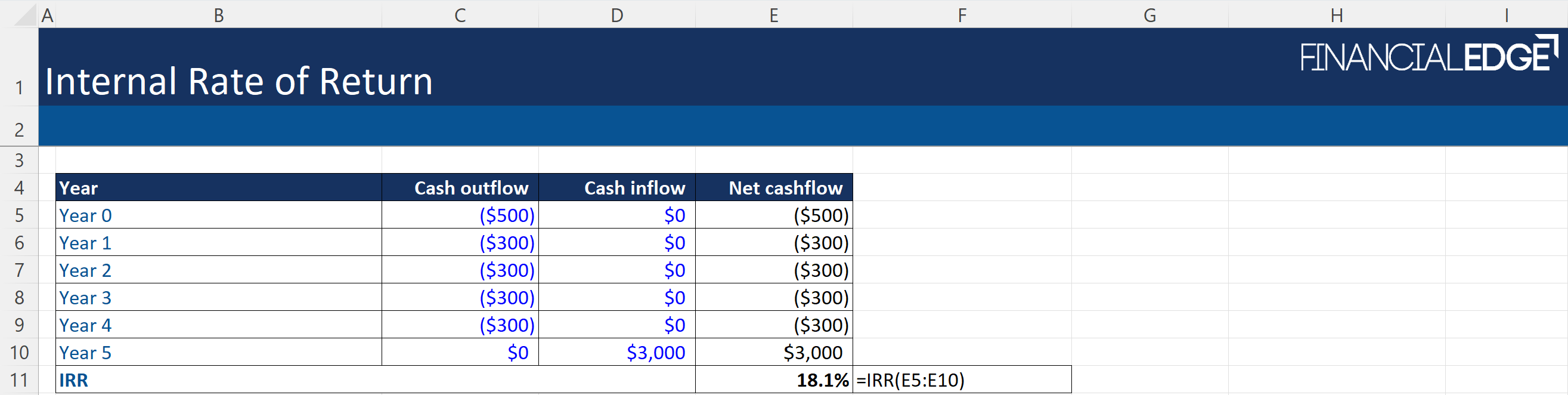
The single number that summarizes these cash flows is the IRR of 18.1%. At a discount rate of 18.1%, the net present value of these cash flows equals zero. Put differently, 18.1% represents the compounded return on these cash flows, after accounting for the time value of money. IRR is useful for comparing projects, testing against a hurdle rate, and communicating an investment case quickly. However, it does not measure the absolute dollars created, it can overstate the attractiveness of short-duration deals, and it can produce misleading results when cash flows change direction more than once.
Key Learning Points
- IRR is the discount rate at which an investment’s NPV equals zero, expressing complex cash flows as a single annualized return for quick comparison against hurdle rates
- IRR vs NPV: IRR measures the rate of return, whereas NPV measures the dollar value created. When the two conflict on mutually exclusive projects, follow NPV, as it directly reflects shareholder wealth
- IRR vs CAGR vs Discount Rate: Compounded Annual Growth Rate (CAGR) ignores interim cash flows while IRR captures them with timing. The discount rate is the required return (input), whereas IRR is the actual return (output). Accept the project when IRR exceeds the discount rate
- IRR vs XIRR vs MIRR: The standard Excel IRR function assumes evenly spaced annual cash flows, which rarely holds in practice. The Excel XIRR function accounts for exact dates and should be the default in any live deal model. The Excel MIRR function, which calculates the Modified IRR (MIRR), fixes the multiple value problem and the unrealistic reinvestment rate assumption by applying a realistic cost of capital for reinvestment and guaranteeing a single, reliable metric
- Limitations: IRR can yield multiple values when cash flows change sign more than once, assumes unrealistic reinvestment at the IRR itself, and ignores scale
- IRR in Private Equity: IRR is the default metric for Private Equity (PE) deals but short hold periods can inflate it, which is why it is always reported alongside Multiple on Invested Capital (MOIC) to show both speed and magnitude of returns
What does IRR Tell You?
IRR does three things at once, which is both why it is so powerful and why it is so frequently misread.
- It measures how hard your capital is working. A 25% IRR means every dollar deployed is generating more return per unit of time than a 12% IRR would. When capital is scarce, which it usually is, this matters enormously for ranking opportunities
- It bakes in the time value of money. A statement like “I invested $100 and got back $150” tells you almost nothing on its own. Over one year, that is a great outcome. Over ten years, it is a poor one. IRR forces the timeline into the calculation
- It provides a single number to benchmark against. Investment committees value this. An IRR can be compared directly against Weighted Average Cost of Capital (WACC), fund’s target return, or an alternative deal, and the comparison is immediate
However, there is one important thing IRR does not do: it does not tell you how much money you actually made. A $5,000 investment at a 100% IRR returns $10,000 at the end of 1 year, creating $5,000 in value. A $50mm investment at a 20% IRR returns $60mm at the end of 1 year, creating $10mm in value. Despite the much lower IRR, the second deal is the one that moves your portfolio. IRR alone cannot capture that, which is exactly why it should never sit on a slide by itself. It should always be presented alongside the absolute dollar value created, so that both the rate of return and the magnitude of return are visible immediately.
How to Calculate the Internal Rate of Return (IRR)?
IRR is the discount rate that makes the net present value (NPV) of an investment’s cash flows equal to zero. Mathematically, it is calculated as follows:
NPV = 0 = CF₀ + CF₁/(1+r)¹ + CF₂/(1+r)² + CF₃/(1+r)³ + … + CFₙ/(1+r)ⁿ

Here, CFₜ represents the cash flow at time t, r denotes the IRR, and n is the project duration.
Note: t=0 signifies the start of the project, effectively day 1. No discounting is required at this stage, as any amount at t=0 already reflects its present value.
Note on IRR calculation: In practice, you cannot solve for ‘r’ directly using standard algebra. Because the rate is embedded in a polynomial equation, it must be found through iterative processes, essentially a ‘trial and error’ method. Today, this is mostly handled by financial calculators or the ‘=IRR()’ function in Excel, which runs these iterations in milliseconds.
IRR Formula in Excel
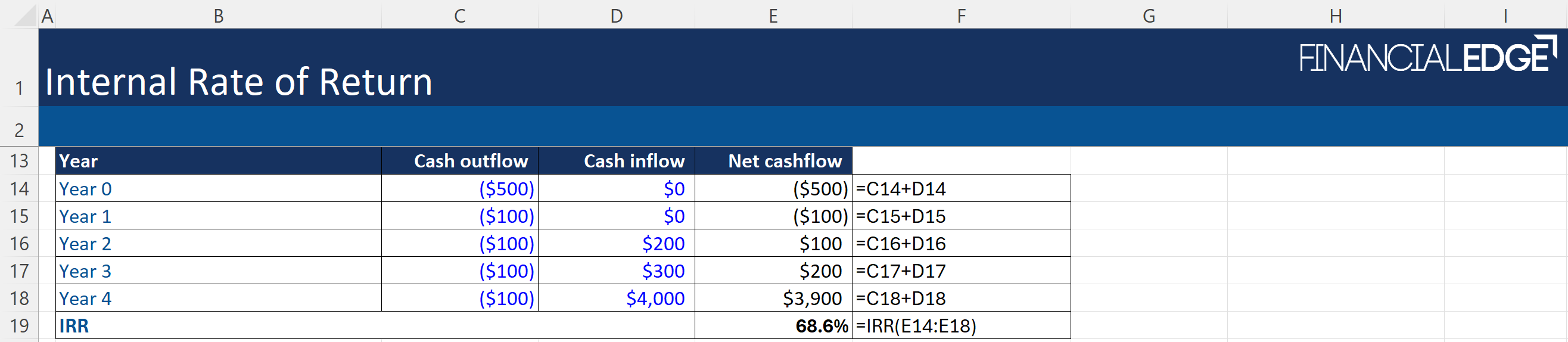
A quicker way to calculate IRR is by using the “IRR” formula in Excel. Simply type “=IRR” and select the range of cash flows. Since a given period may contain both cash inflows and outflows, it is advisable to apply the IRR formula on the net cash flow for each period. Please note: this formula assumes cash flows occur at the end of each period.
For example, consider an investment in a piece of machinery. The initial investment is $500 at year 0, followed by additional investments of $100 at the end of each year from year 1 through year 4 to keep the machine operational. In return, the investment generates $200 at the end of year 2, $300 at the end of year 3, and $4,000 at the end of year 4. The resulting net cash flows are -$500, -$100, $100, $200, and $3,900 from year 0 through year 4. The IRR of these cash flows is 68.6%, meaning the investment delivers an effective annualized return of 68.6% on the capital deployed.
How to apply the ‘IRR’ formula:
Step 1: Type “=IRR(”
Step 2: Select the column containing the net cashflows
Step 3: Press Enter
Example for ‘IRR’ formula in Excel
XIRR Formula in Excel
A key limitation of Excel’s “IRR” formula is that it assumes every cash flow occurs at the end of the year, which rarely reflects real-world scenarios. While cash flows, both inflows and outflows, tend to follow a rhythm, they can occur at any time during the year. In practice, investment cash flows seldom fall neatly on year-end dates.
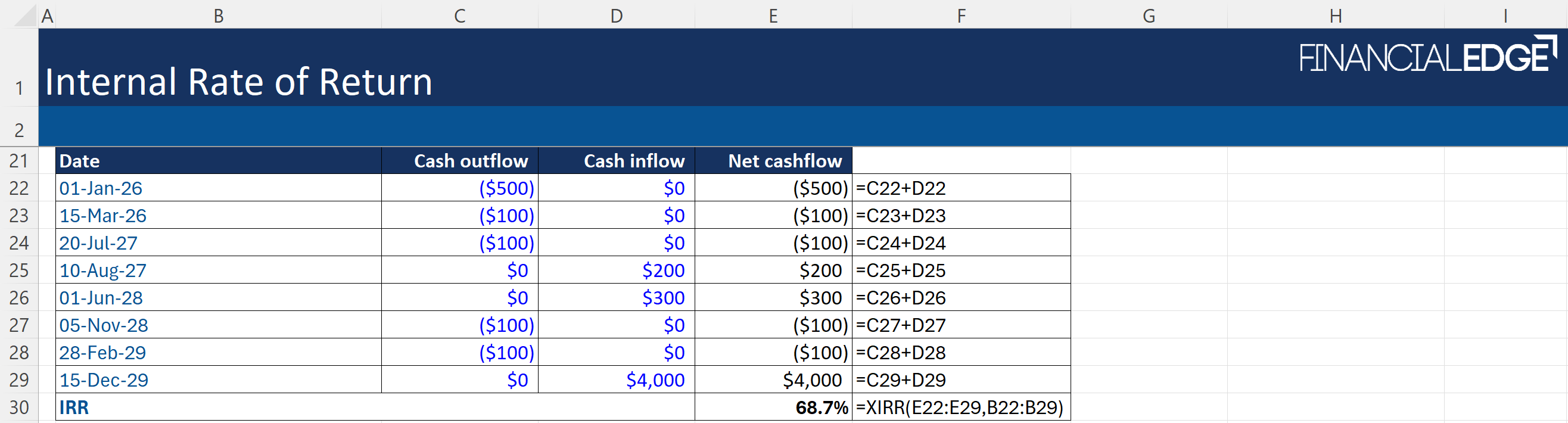
For example, consider an investment in a piece of machinery purchased on January 1, 2026 for $500. To keep the machine operational, additional investments of $100 are made on March 15, 2026, July 20, 2027, November 5, 2028, and February 28, 2029. The investment generates returns of $200 on August 10, 2027, $300 on June 1, 2028, and $4,000 on December 15, 2029. Because these cash flows occur on irregular dates rather than at uniform annual intervals, the standard IRR formula, which assumes equally spaced periods, would give an inaccurate result. Instead, the XIRR formula is used, as it accounts for the exact timing of each cash flow. The XIRR of this investment comes out to 68.7%, representing the effective annualized return on the capital deployed, adjusted for the precise dates on which money was invested and returned.
How to apply ‘XIRR’ formula:
Step 1: Type “=XIRR(”
Step 2: Select the column containing the net cash flows
Step 3: Select the column containing the dates
Step 4: Press Enter
Example for ‘XIRR’ formula in Excel
Instructor Tip: IRR vs. XIRR is often taught as a “nice to know” distinction, but I would frame it differently. It is actually a risk management issue. I have seen an analyst present quarterly cash flows using =IRR(), not realizing the output was a quarterly rate, not an annual one. The true annualized IRR in that case would have been roughly four times higher, a difference large enough to make a bad deal look acceptable, or a good deal look extraordinary. The fix is simple and permanent: default to XIRR for any live model, and reserve IRR for classroom exercises and back-of-the-envelope math. If you are reaching for =IRR() in a deal model, pause and ask yourself whether you can explain exactly what period that rate represents. If you hesitate, switch to XIRR.
IRR vs NPV
Net Present Value (NPV) is a method to calculate the value of a project in today’s terms, given a specific discount rate. Both IRR and NPV are used to assess whether a project is worth investing in, but the two metrics answer slightly different questions: IRR tells you the rate of return, while NPV tells you the dollar value created.
For an independent project (one evaluated on a standalone, accept-or-reject basis), NPV and IRR will always give the same conclusion:
- Scenario 1 – If NPV is positive, it implies that the IRR is higher than the cost of capital, and both metrics signal a go
- Scenario 2 – If NPV is negative, it implies that IRR is lower than the cost of capital, and both metrics signal a no-go
However, when comparing two mutually exclusive projects (where you can pick only one), IRR and NPV can rank them differently. Consider the following illustration:
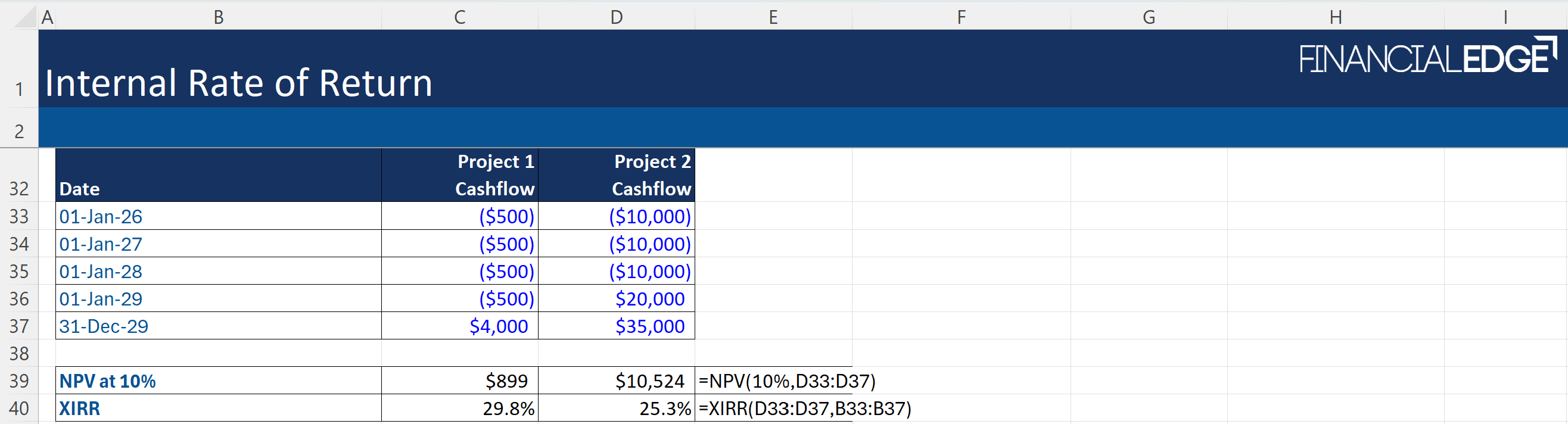
- By IRR, Project 1 looks more attractive, since 30% beats 25%
- By NPV at a 10% cost of capital, Project 2 is clearly better, creating $10,524 of value compared to just $899 for Project 1. The reason is straight forward: Project 2 deploys far more capital ($30,000 in total outflows vs. $2,000 for Project 1), so even at a lower percentage return, the absolute dollar value created is much larger
For mutually exclusive projects, the NPV method is preferred for two key reasons:
- It quantifies the actual dollar value added to the firm, which is what ultimately matters for shareholder wealth
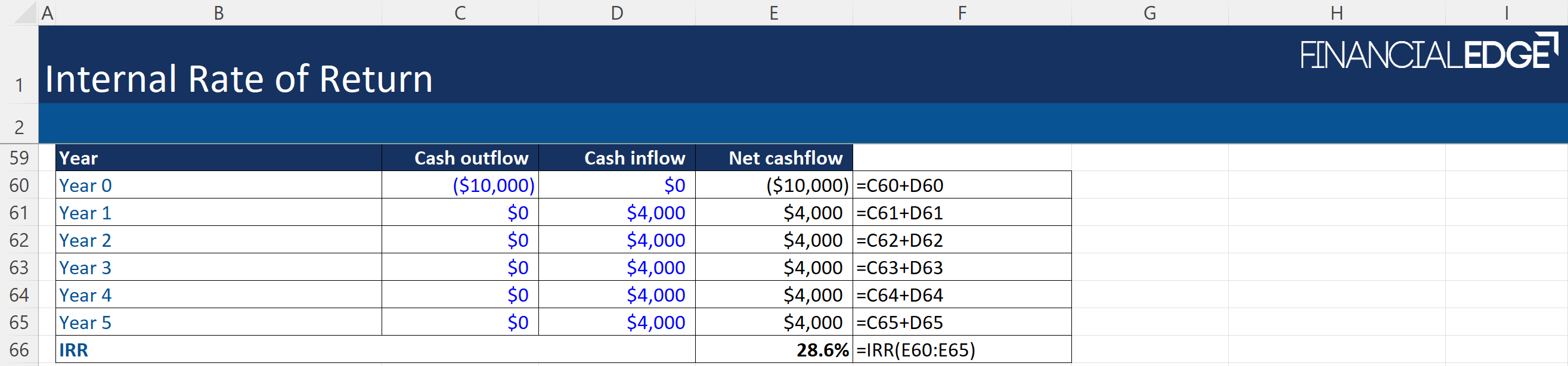
- It assumes interim cash flows are reinvested at the cost of capital, which is a far more realistic assumption than IRR’s implicit assumption that they are reinvested at the IRR itself. For example, a $10,000 investment returning $4,000 annually for 5 years yields a 28.6% IRR. This calculation assumes those $4,000 payments are reinvested at 28.6%, which is rarely possible. In an LBO, for instance, interim dividends cannot typically be funnelled back into the same deal at that same high rate. They are more realistically reinvested at a conservative cost of capital, which is what NPV assumes
Instructor Tip – IRR Decision Rule: In practice, the cleanest approach is to look at both metrics together. IRR tells you how efficient the capital is; NPV tells you how much wealth is created. When the two disagree on mutually exclusive projects, follow NPV. However, real-world capital allocation is rarely a simple choice between two isolated options. Firms typically evaluate a large pipeline of opportunities against a fixed budget. This requires rigorous financial analysis to “jigsaw” together the optimal combination of projects that maximizes the total NPV for the entire firm.
IRR vs CAGR
These two metrics are often mixed up, since both produce an annualized percentage. But they answer different questions.
CAGR only needs a starting value and an ending value. It draws a straight line between two points and tells you the smoothed annual growth rate:
CAGR =((Ending Value)/(Beginning Value))^(1/n) – 1

where ‘n’ is the time period between ending value and beginning value.
IRR, on the other hand, handles everything in between: multiple cash flows, in different directions, occurring at different times. However, the standard Excel IRR function assumes these flows happen at perfectly regular intervals, whereas the real-world investments rarely follow a strict schedule. The Excel XIRR function solves this by tying every transaction to an exact date. This handles non-regular cash flows and calculates a precise annualized return, no matter how erratic the timing.
In fact, when there are only two cash flows, an investment at the start and a single exit at the end with nothing in between, CAGR and IRR will give exactly the same answer. They are mathematically identical in this special case. The moment you introduce interim distributions, follow-on investments, or any irregular cash flow, which describes basically every real deal, the two metrics diverge.
For example, a PE fund that distributes capital in years 2, 3, and 4 before a final exit in year 6 will have an IRR shaped by exactly when each distribution arrives. A CAGR calculation is meaningless in this case, as using only the entry and total exit value would miss the timing completely, and timing, in this business, is where a huge amount of the return story lives.
IRR vs Discount Rate
The discount rate (also called the hurdle rate or required return) is the input. It is what you demand from a project given its risk profile, typically derived from the firm’s WACC and adjusted for project-specific factors. IRR is the output. It is what the project’s cash flows actually deliver.
Putting the two side by side gives you a clear decision rule:
- IRR > Discount Rate: The project earns more than it costs. Accept it
- IRR < Discount Rate: The project earns less than it costs. Reject it
- IRR = Discount Rate: The project just breaks even. It can be rejected, since breaking even does not add to shareholder wealth, and execution risks are often not fully captured in the discount rate
IRR in Private Equity
Private Equity (PE) deals follow a clear pattern of invest, operate, and exit. This pattern fits the IRR framework perfectly, which is why IRR is the industry’s default performance metric. The most common type of PE transaction is the Leveraged Buyout (LBO). In traditional financial modeling, analysts use WACC to discount free cash flows and determine a company’s baseline enterprise value. However, in an LBO, the capital structure constantly shifts as debt is rapidly paid down. This constant movement makes a static WACC highly inaccurate for discounting those cash flows, further cementing IRR as the more practical valuation tool. A typical PE deal involves an equity check at close, possible follow-on capital, periodic dividends or recaps, and a final exit. Since these cash flows are irregular, XIRR is the standard.
A common pitfall is that short hold periods inflate IRR. Exiting a company in eight months at 1.3x produces an annualized IRR of 48.5%, even though the absolute dollars created are modest. A seven-year hold at 5x may show 25.8% IRR but generates far more value in dollar terms.
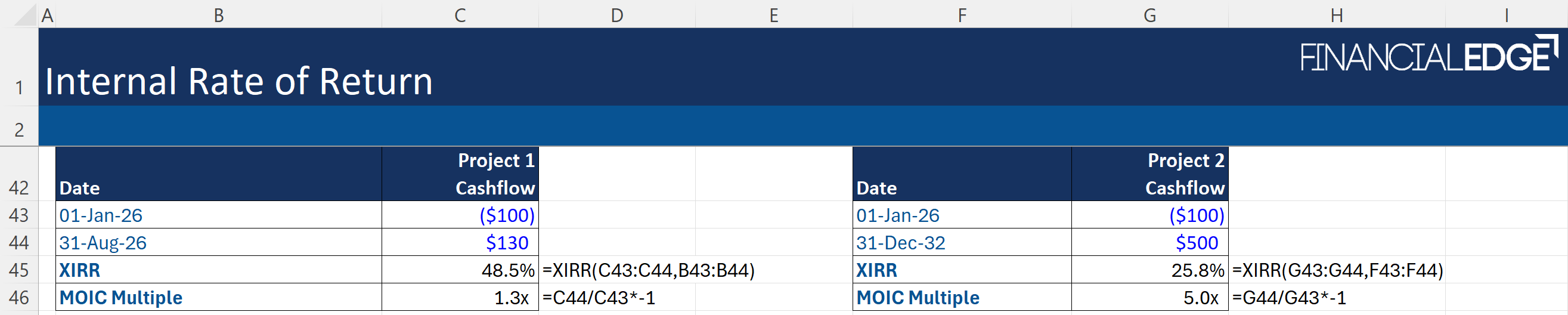
Choosing between these two profiles is a difficult decision. If an LP could string together a back-to-back sequence of those short eight-month deals, each having 48.5% IRR, they would easily prefer the first project. However, finding and closing good PE targets that rapidly is highly impractical. The second project is often the winner because the LP can put their capital to work for a long horizon without the constant pressure to redeploy it.
This is exactly why PE reports IRR alongside Multiple on Invested Capital (MOIC). The two metrics answer different questions: IRR shows how fast capital worked, MOIC shows how much it earned. Either number on its own tells an incomplete story.
Advantages of IRR
- It communicates instantly. Telling a board that a project returns 18% per year lands immediately, whereas “$2.3mm NPV” often does not. IRR expresses returns as a clear rate that can be directly compared against other investment opportunities or against a hurdle rate to assess attractiveness
- Time value of money is built in. This makes IRR a more accurate measure of profitability than simpler metrics such as payback period or accounting rate of return, which ignore when cash flows occur
- It is self-contained. No discount rate is needed to calculate it, which is useful when the right discount rate is itself uncertain
Disadvantages of IRR
- Multiple IRRs: When a project’s cash flows change direction more than once (negative, positive, negative), the IRR equation can have multiple valid solutions, making the decision ambiguous. The cleaner approach is to fall back on NPV, which always returns a single answer, or to use the Excel MIRR function, which calculates the Modified IRR (MIRR). For MIRR, you need to enter discount and reinvestment rate. For example, on cash flows of -$100, $200, -$100, $400, and $500 over five years, applying a 12% finance rate and a 6% reinvestment rate gives an MIRR of 59%, a more realistic measure of return than IRR alone.
- Reinvestment assumption: IRR implicitly assumes that interim cash flows are reinvested at the IRR itself, which is rarely realistic, especially for high-IRR projects. Finding a comparable reinvestment opportunity at, say, 40% is unlikely, so the realized return on capital is often lower than the headline IRR suggests
- Missing scale. A $1,000 investment at 100% IRR and a $10mm investment at 15% IRR are not comparable on IRR alone. The smaller deal looks better on a percentage basis but creates far less wealth in dollar terms. Always pair IRR with NPV
IRR Interview Questions
The following questions come up in banking, PE, and corporate development interviews.
Q1: What is IRR, and how does it differ from NPV?
IRR is the rate that zeros out NPV. It outputs a percentage (capital efficiency); NPV outputs dollars (value creation). They can conflict on project ranking when scale or timing differs, and when they do, NPV is theoretically correct.
Q2: A project has a 30% IRR. Is it a good investment?
This is a trap. The right response is to push back: what’s the hurdle rate? What’s the scale? What’s the risk profile? A 30% IRR on $10 is noise. On $100mm against a 12% cost of capital, it’s exceptional. They want to see you resist the reflex to say “yes.”
Q3: Can a project have more than one IRR?
Yes, it can be. When cash flows change sign more than once. Explain the polynomial math briefly, then pivot to the practical solution: use NPV or MIRR instead.
Q4: IRR or NPV: if you could only pick one?
NPV. It measures actual value creation, avoids the reinvestment rate problem, always gives a unique answer, and ranks mutually exclusive projects correctly. But the sophisticated add-on is acknowledging that IRR’s percentage output makes it more useful for boardroom communication.
Q5: How does leverage affect IRR?
More debt means less equity invested. However, leverage does not automatically make the IRR go up. Instead, it amplifies volatility. If a deal performs well, achieving a positive return on a smaller equity base drives the equity IRR much higher. This upside magnification is the core of every LBO model. But the math works in both directions. If the deal underperforms, the fixed debt burden causes a negative IRR to plummet even faster. Leverage simply acts as an amplifier for both the upside and the downside.
Q6: What Is a Good IRR?
There’s no universal answer, and anyone who gives you one without asking “for what kind of investment?” is cutting corners. But here are the ranges that informed professionals work with:
| Asset Class | Target IRR Range | Notes |
| Corporate Projects | 8–15% | Varies by industry and risk profile |
| PE Buyouts (Net) | 18–25% | Top-quartile; median is 12–16% |
| Venture Capital | 25–35%+ | Compensates for high failure rate |
| Real Estate (Core) | 8–12% | Shifts with interest rate cycle |
| Real Estate (Value-Add) | 12–18% | Active management premium |
| Real Estate (Opportunistic) | 18%+ | Development/distressed risk |
| Infrastructure | 8–14% | Highly stable and predictable cash flows. Targets vary by greenfield vs. brownfield projects |
Instructor Tip: Interviewers are not testing whether you can compute IRR. They are testing whether you can think with it. The candidates who stand out push back on incomplete questions (“a 30% IRR on what, against what hurdle, over how long?”), speak in trade-offs rather than absolutes when comparing IRR to NPV, and treat every IRR as an output of underlying assumptions rather than a fixed fact. Memorizing definitions gets you through the first round. Thinking with the metric gets you through the rest.
Conclusion
IRR is one of the most widely used metrics in finance because it captures the time value of money, distils irregular cash flows into a single comparable percentage, and communicates returns in a way that lands instantly with investment committees and boards. However, its strength as a summary metric is also its weakness: a headline IRR can hide differences in scale, hold period, reinvestment realism, and cash flow patterns. The most reliable approach is to treat IRR as one lens rather than the full picture, pairing it with NPV to capture absolute value creation, with MOIC in private equity contexts to capture the magnitude of returns, and with XIRR to ensure timing is accurately reflected. Used this way, IRR becomes a tool for thinking clearly about investments rather than a number that drives decisions on its own.
Additional Resources
Net Present Value vs Internal Rate of Return