Transaction Comparables Excel Workout
Sign up to access your free download and get new article notifications, exclusive offers and more.
Featured Product

Transaction Comparables
July 16, 2026
What is “Transaction Comparables”?
A Transaction Comparables Model (also known as ‘deal comps’ or ‘precedent transactions’) is a relative valuation methodology similar to a trading comparables model. It is used when a deal has been announced (or a potential deal is being explored) to help determine if the sector or industry has any price patterns that can be spotted by examining previous deals.
It analyzes the price paid in M&A transactions, typically focusing on acquisitions where control is achieved. The key objective is to understand the premium buyers are willing to pay for a controlling stake in a business.
Key Learning Points
- Transaction comparables is a relative valuation methodology similar to trading comparables
- It involves comparing the unaffected share price to the price paid in an M&A transaction to understand the size of the premium buyers are willing to pay to acquire a controlling stake in a business
- Only acquisitions where control is achieved are considered
- Screening for comparable transactions is difficult and time-consuming, and it is best to review several sources of data
- There are many reasons why a buyer is prepared to pay a premium in a deal, and common reasons include competitive tension, scarcity of assets, and synergies
Steps for Using the Transaction Comparables Model
Gathering information for transaction comparables models can require a lot of detailed research. If companies are listed, the information on deals and announcements of deals will be publicly available and easy to find. Data on private transactions can be trickier to get, as there are no requirements to release the information to the general public.
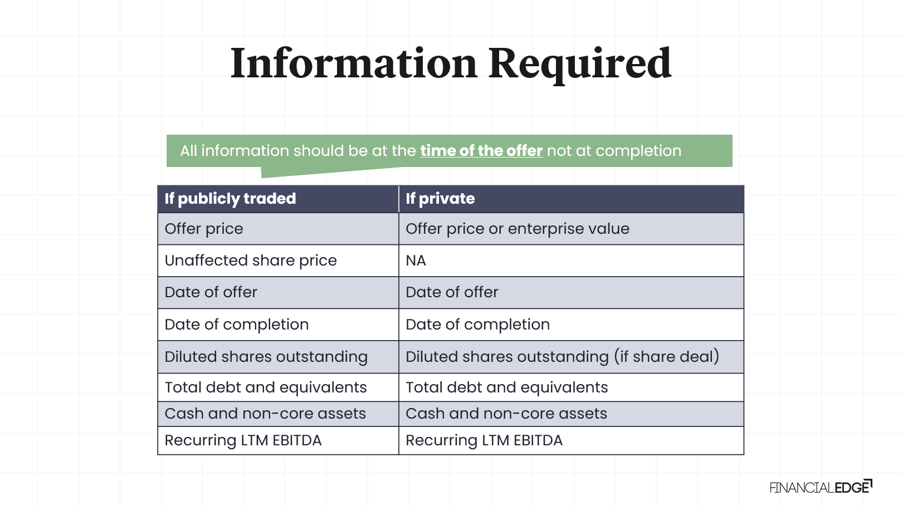
The table below shows the typical information required to build a transaction comparables model. This information should be fairly straightforward to gather from listed companies. For private companies, even the deal date can be challengingbe challenging to get hold of. If actual data, such as LTM (last twelve months) EBITDA, cannot be found, it can sometimes be possible to use an estimate or assumption from other market or company data. This will require noting in any of the models to ensure all users are aware that estimates rather than actual data are being used.
All share price data should be taken from the date of the offer, rather than the date that the deal was completed.
All share price data should be taken from the date of the offer, rather than the date that the deal was completed.
Follow these steps to create your own transaction comparables model
- Gather Data: Collect all necessary information about the target company and the transaction, including details of the company or business unit in question
- Calculate Equity Value per company: multiply the offer price by diluted shares outstanding to gain the equity value
- Determine Enterprise Value: add net debt, NCI, and equity affiliates to the equity value
- Compute EBITDA for: add D&A to EBIT – this is helpful to have for historic information, usually the last reported period, and also the last twelve months (LTM) and next twelve months (NTM) to aid comparisons
- Calculate Multiples: divide Enterprise Value by EBIT and EBITDA to get EV/EBITDA for each time-period
- Determine Offer Premium: compare offer price to unaffected traded price
- Analyze Results: compare the calculated multiples and premiums to industry benchmarks
What You’ll Get with the Transaction Comparables Model
This type of valuation methodology can help understand how the deal price compares to the company’s financial metrics. It can help determine if a company has been undervalued relative to peers and the rest of the market before the transaction. It can also reveal if the deal is at a higher valuation than previous deals, which may require further investigation.
The comparables model allows for premium insights into the control premium paid in the transaction. Some premiums may be justified due to the scarcity of an asset or business. Or it may be influenced by the availability of debt financing at the time of the deal announcement.
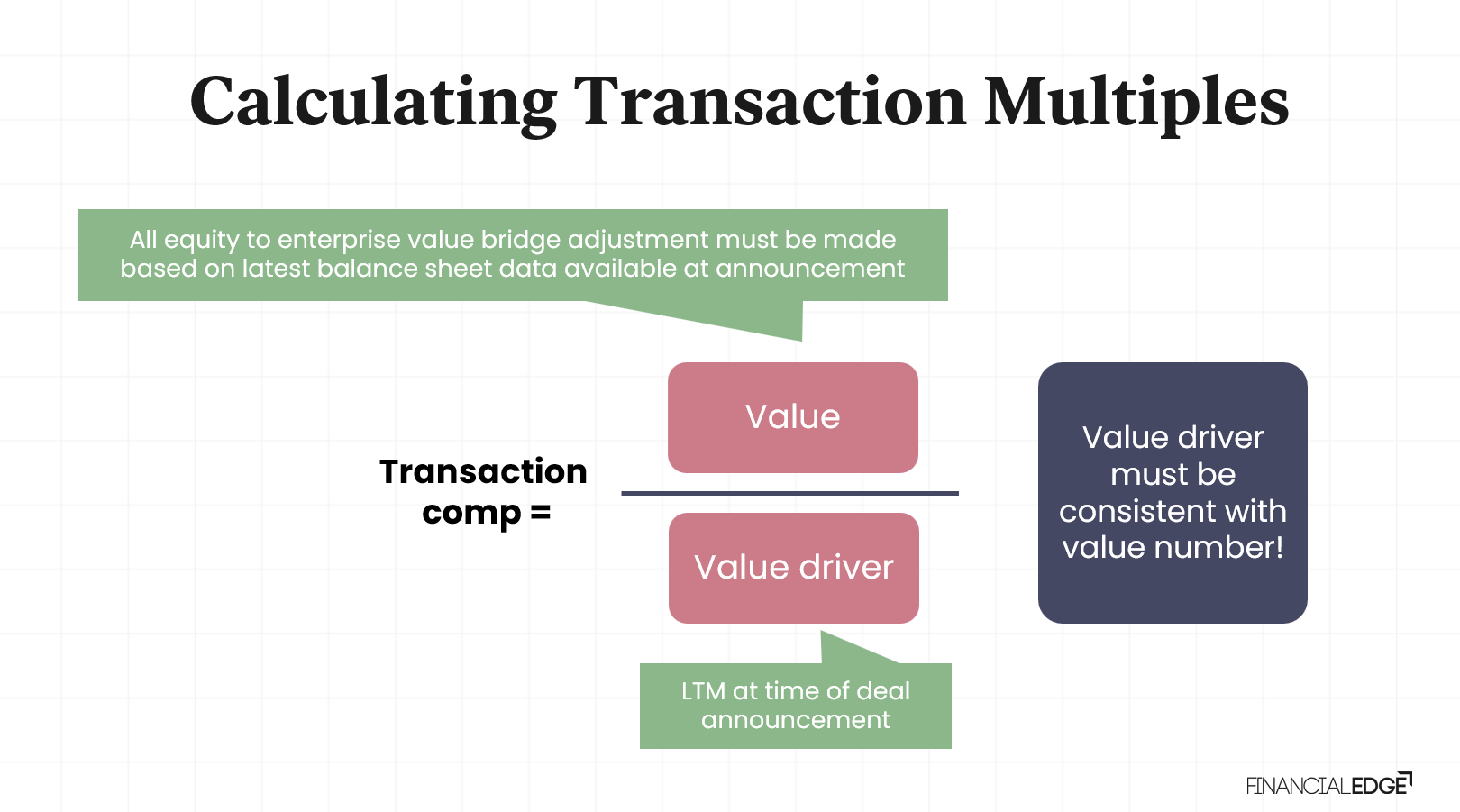
Calculating Transaction Multiples
Analysts should always use the transaction multiples that are suitable for the particular industry or sector when analyzing deals. The most frequently used metric is EV/EBITDA, but it could also be EV/Sales, EV/EBIT, or even a P/E multiple. All values used should be consistent across the data pool and also be checked to ensure any adjustments are correct and consistent.
Market Benchmarks
Transaction Comparable Models will typically contain a peer group – either by sector, sub-sector but it can also be by company size or geography. Often, the sector average will give an indication of whether a deal is at a premium or discount to the rest of the sector.
The average should only contain deals that are comparable to the deal being examined. For instance, deals between large, listed companies and those involving smaller, unlisted companies may not be directly comparable when simply looking at a deal premium or discount. Analysts will need to check the details of deals to best understand whether companies are prepared to pay higher premiums, for e.g. market leading brands, or geographical expansion opportunities.
Deal Rationale Understanding:
Using a Transaction Comparables Model allows investors to gain insights into why buyers might be prepared to pay premiums for specific assets or types of companies. Conducting in-depth analysis of the peer group and comparable deals can reveal a lot about investor sentiment and market expectations. It can also indicate whether a deal offer is likely to be successful or not.
Comparables will be evaluated by factors such as scarcity of assets (in which case premiums are likely to be higher) or if investment is being targeted into certain types of deals. The structure of debt and equity within the company is also a key consideration.
The table below shows a peer group being compared on an EV/LTM EBITDA basis.
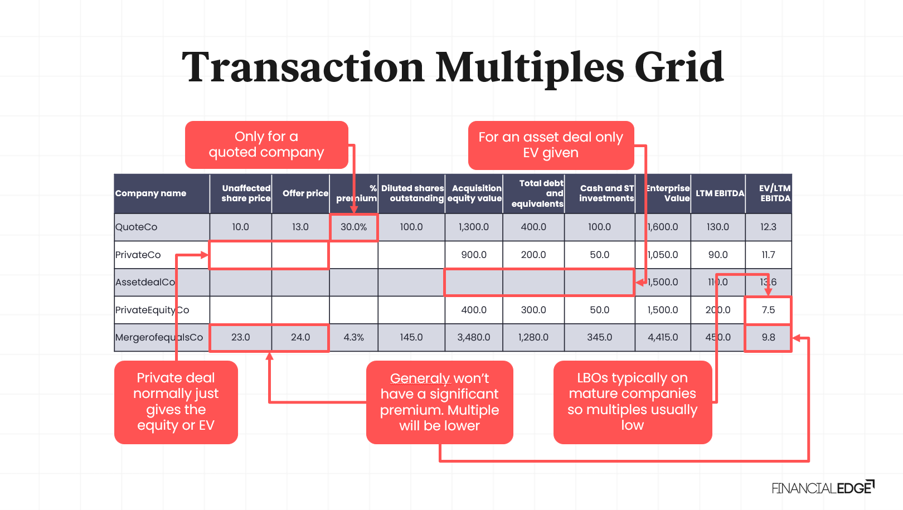
This table can be created for any company deal when looking at EV/EBITDA. As noted, some information, such as an up-to-date share price, will only be available for listed companies. So, price premiums for private companies can be trickier to extract. For deals driven by the underlying assets, there may be less detail about debt and equity within the firm, as it is an asset-led transaction.
When looking at mergers rather than outright acquisitions, analysts should expect there to be less of a significant premium, given that the companies are not trying to outbid other parties or spend excess cash on the deal.
Leveraged buyouts (LBOs) tend to typically be for mature companies, as management has had a significant impact on growing sales, profits, and cash flow within the company. Therefore, the transaction multiples on these deals tend to be lower, due to the lower growth prospects of the company.
Conclusion
Transaction comparables models are a great way to analyze M&A deals, pay careful attention to ensure that all the information used is up-to-date and relevant to the peer group. Analysts building these types of models should ensure that each transaction that is contributing to the comparables has been carefully analyzed. Factors such as timings (some years are more buoyant for M&A activity than others) and scarcity of assets or new subsectors of growth can be key contributors to explaining why a particular deal has garnered its premium.
Of course, not all deals are conducted at a premium. Companies with low growth prospects, declining sales, or mounting debt obligations may be acquired at significant discounts to the peer group. This is an area where transactions will specialize in restructuring companies, stripping assets, or renegotiating debt burdens to salvage some value from companies in distress.
To learn more about when transaction comparable models are required, access the range of courses available.