Send download link to:
AI Survey Results Report

2026 AI in Finance L&D Survey Findings
March 30, 2026
The problem in investment banking is no longer access to AI; it’s the widening gap between the firms using it and the firms using it well.
Financial Edge surveyed L&D leaders across 15 global investment banks to understand where AI adoption stands heading into 2026, and where it is falling short. What emerged is a clear picture: tools are everywhere, capability is not.
Adoption Vs Investments in AI
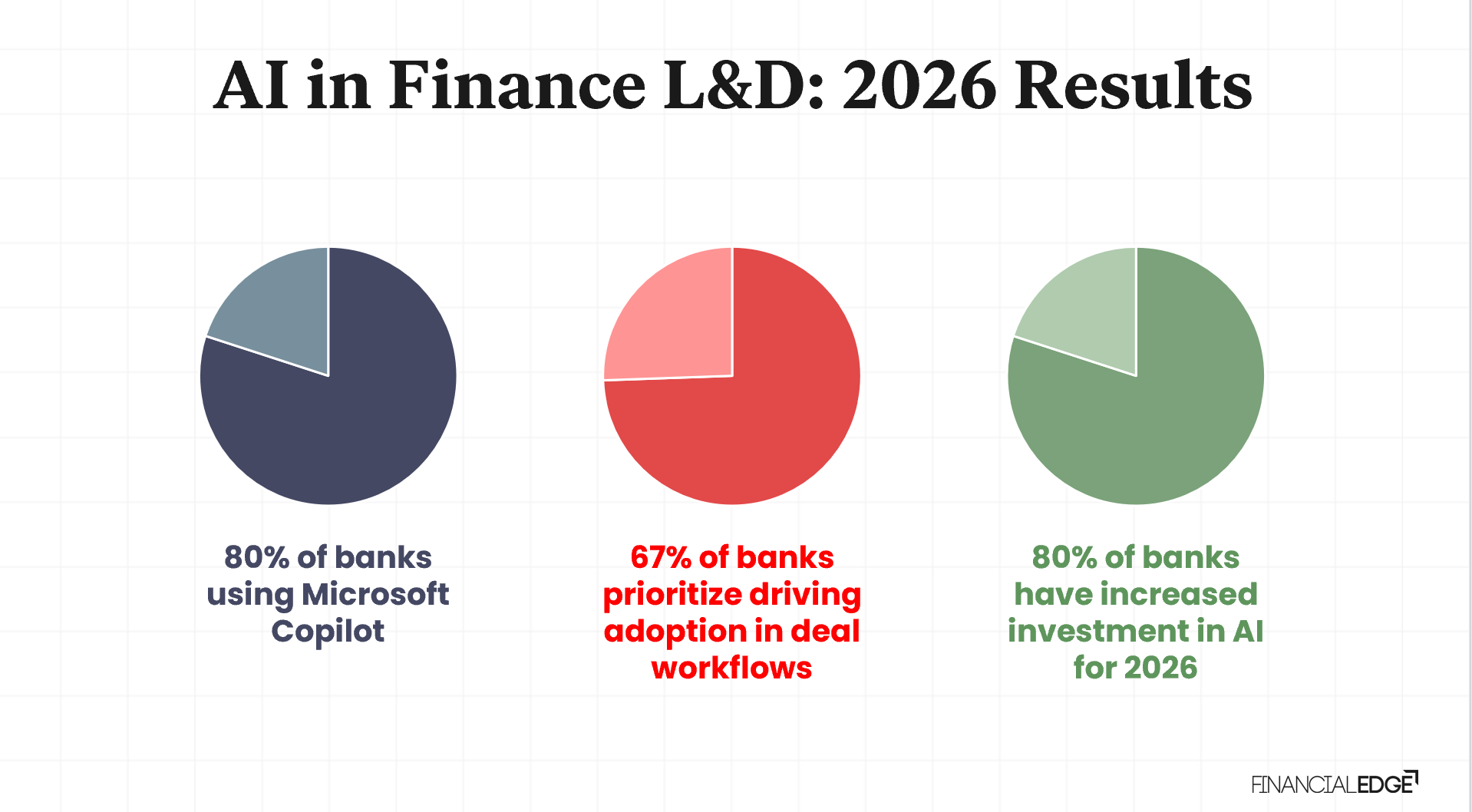
AI tools are now well established across the sector. 80% of respondents reported using Microsoft Copilot, and an equal proportion have increased investment in AI for 2026. This indicates that most firms have moved beyond early experimentation and are now focused on scaling AI usage across teams and functions.
Deal workflow adoption is the dominant priority for two-thirds of respondents, yet firms are at very different stages of the journey. Nearly a third are still at the exploration or early discussion stage, a further third are running limited pilots within select teams, and only three report scaling AI across multiple deal workflows.
Four in ten L&D leaders describe the pressure to demonstrate measurable productivity gains as unrealistic. Ownership of AI initiatives remains split across technology teams, HR, L&D, and formal governance groups, with three respondents reporting no clear owner at all.
Respondents consistently flagged the gap between theory and practice. One noted there is almost too much discussion of potential, weaknesses and governance, and not enough opportunity to learn applied skills.
Where Firms Are Facing Challenges
Four barriers to AI adoption came up consistently across respondents:
- Regulatory risk and data privacy concerns are creating hesitation at the point of use. Employees must also develop strong, responsible judgment to avoid incorrect, biased, or hallucinated outputs.
- AI governance is split across Technology, Compliance, HR, and L&D, with no single function driving adoption coherently. The result is slow decision-making and inconsistent rollout.
- Embedding AI into existing systems and live deal workflows is harder than deploying a license. Many firms are still at the pilot stage while pressure to scale is mounting.
- 40% of L&D leaders reported unrealistic pressure to demonstrate measurable productivity gains, even as adoption remains inconsistent across roles and teams. Resistance to change, both top-down and bottom-up, was widely reported. This tension is real, and it is stalling progress.
The most consistent finding across all respondents: training is too theoretical. Generic AI literacy programs are not translating into workflow-level behaviour change. The gap between understanding what AI can do and knowing how to apply it to a live deal is where most firms are falling short.
What L&D Teams Should Be Doing
The survey sets out four clear recommendations for L&D teams looking to close the gap:
Build role-specific AI enablement, not generic training: L&D should move beyond broad AI 101 content towards applied, role-aligned enablement, co-creating use cases with Banking, PE, Credit, Research and Ops teams, and building a standardised library of prompts and playbooks mapped to real deal tasks.
Strengthen confidence in compliance and responsible use: L&D teams should partner with legal and compliance to define clear guardrails covering data classification, PII handling and audit logging, and roll out practical modules on data privacy, hallucination risks, and judgment skills.
Clarify ownership and fix operational blockers: L&D should position itself as the partner responsible for skills, safety and adoption readiness, advocate for a joint AI Enablement Council across Tech, L&D and Compliance, and develop a network of AI champions inside deal teams to provide workflow-level support.
Demonstrate measurable impact quickly and report it: L&D must track beyond usage, measuring time saved, quality review scores and revision counts, while spotlighting early wins through internal communications to reinforce momentum.
Conclusion
AI adoption in financial services is progressing, but the challenge is no longer access; it is effective application.
For L&D teams, the priority is ensuring AI is applied consistently within real workflows, supported by clear governance and measurable outcomes. Firms that succeed will be those that move beyond experimentation and embed AI into everyday processes.
Download the full survey findings for the complete data and recommendations.