Send download link to:Calculate Bond Value in Excel Workout
Recommended Course for Professionals

How to Calculate Bond Valuation in Excel
May 21, 2026
What is Bond Valuation?
Bond valuation estimates the current fair value of a bond based on the cash flows it is expected to generate over its life. In practice, investors seek to determine the price that appropriately reflects the bond’s periodic coupon payments and the repayment of principal at maturity.
What Affects Bond Valuation?
The bond’s market price is not fixed and adjusts as interest rates, credit risk, and time to maturity change. Therefore, investors use bond valuation methods to assess whether a bond is appropriately priced relative to its required rate of return.
How Does Bond Valuation Work?
The underlying principle of bond valuation techniques is the time value of money. Future cash flows must be discounted because money received in the future is worth less than money received today. For the simplest type of bond, known as a plain-vanilla bond, these cash flows consist of periodic coupon payments and the repayment of face value at maturity.
Key Learning Points
- Bond valuation methods discount expected future cash flows to the present value, reflecting the time value of money and expressing all payments in today’s terms for consistent comparison
- The value of a bond is equal to the present value of the regular coupon payments and principal repayment
- Bond prices move inversely to interest rates, as higher discount rates reduce the present value of future cash flows, while lower rates increase the value, establishing the price–yield relationship
- Yield to maturity (YTM) is the market-required rate used to discount cash flows and is the primary valuation driver, reflecting interest rates, credit risk, and time to maturity
Bond Valuation Formula
Below is the standard bond pricing formula:

Where:
P = bond price
C = coupon payment per period
F = face value (par value)
r = required yield per period
n = number of periods to maturity
This formula has two components:
- the present value of the coupon stream
- the present value of the redemption value
Together, they determine the fair value of the bond. If coupons are paid semi-annually, both the coupon and the discount rate must be adjusted to a semi-annual basis and the number of periods doubled.
The key inputs are:
- Face value – this is typically $1,000
- Coupon – the fixed, regular interest rate paid by the bond
- Yield to maturity (YTM) – the market-required return used for discounting
- Time to maturity – remaining life of the bond
Bond valuation is fundamentally a discounted cash flow (DCF) exercise. The process typically follows the steps below:
- Identify the bond’s contractual cash flows
- Adjust the yield to match the payment frequency
- Discount each coupon payment to present value
- Discount the face value or redemption repayment
- Sum all discounted cash flows to obtain the price
Key Drivers of Bond Valuation
The primary drivers of bond valuation are:
Interest Rates
The required yield acts as the discount rate. When market interest rates rise, bond prices fall, and vice versa. This inverse relationship is key to fixed income analysis.
Instructor tip: Sensitivity to yield changes varies across bonds. Longer maturities and lower coupon rates typically increase price sensitivity, as more value is derived from distant cash flows. For example, a 10-year 2% coupon bond exhibits greater price sensitivity to a given yield change than a 2-year 6% coupon bond.
Credit Quality
Investors demand higher yields for lower-quality issuers. As credit risk increases, required returns increase, reducing the present value of cash flows.
Time to Maturity
Longer-maturity bonds are more sensitive to changes in interest rates. This is often referred to as “duration risk”.
Discounted cash flow (DCF) analysis is the primary valuation method for bonds. The key analytical challenge is in selecting an appropriate discount rate that reflects market conditions, credit risk, and liquidity.
How to Calculate Bond Valuation in Excel (step by step)
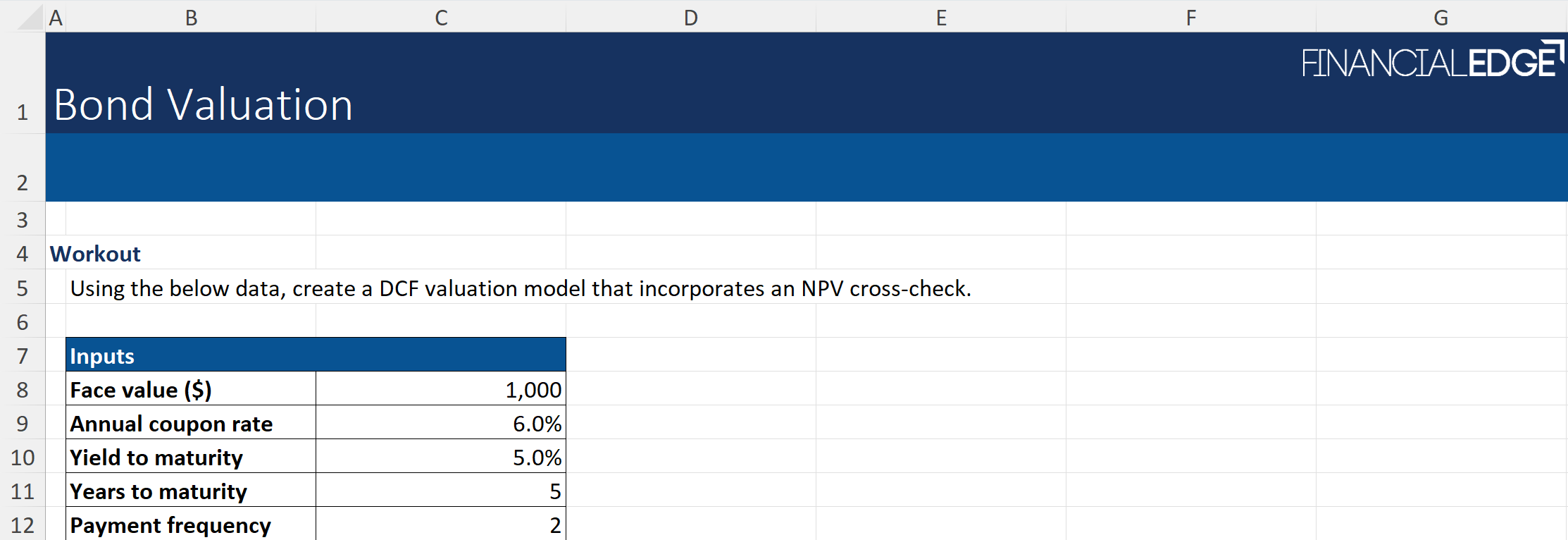
A simple Excel model should begin with a clean input section:
- Face value
- Annual coupon rate
- Yield to maturity
- Years to maturity
- Payment frequency
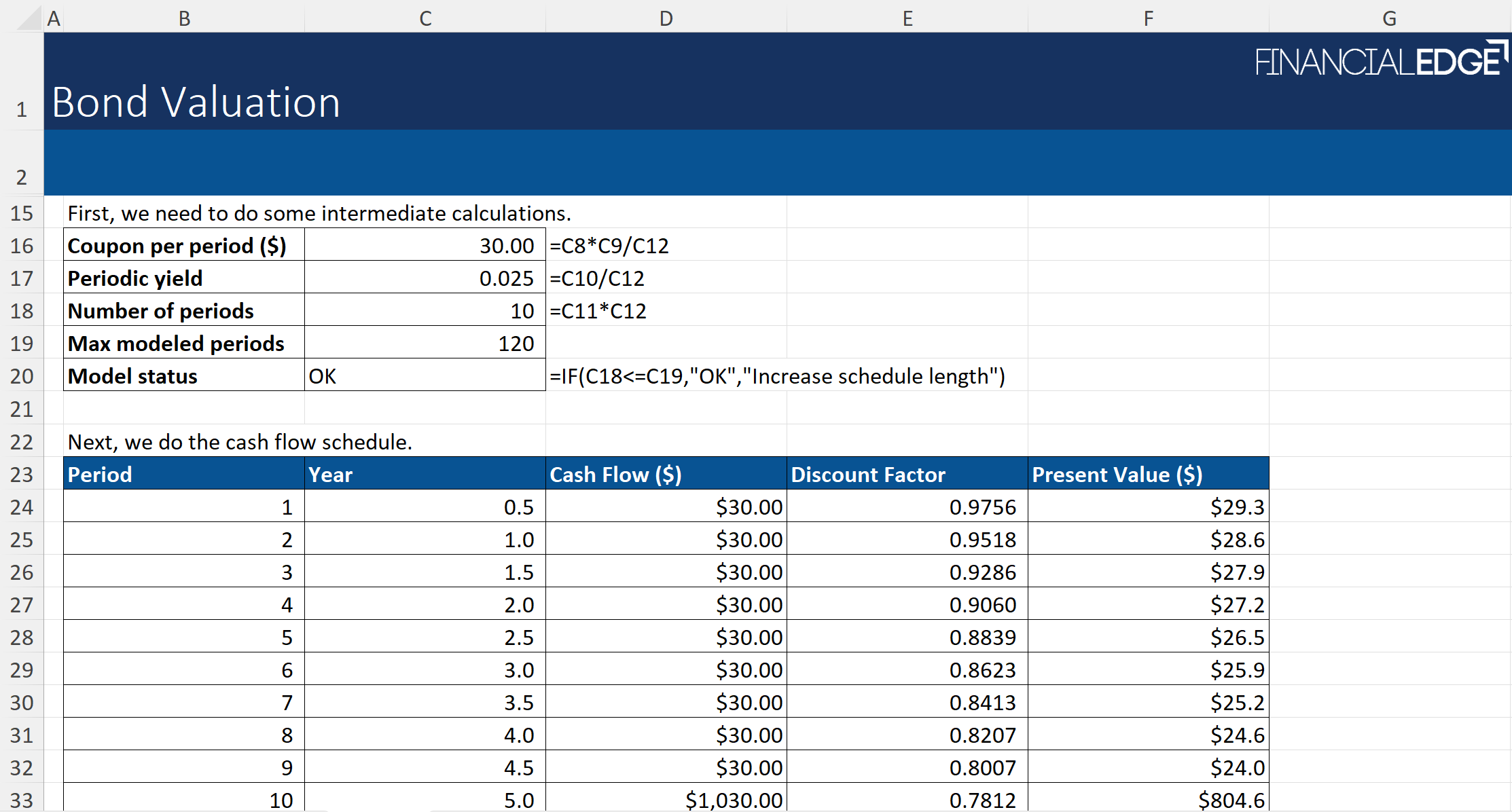
Then, it should calculate the:
- Coupon per period = Face value × Coupon rate ÷ Frequency
- Periodic yield = YTM / Frequency
- Number of periods = Years to maturity × Frequency
From there, the model discounts cash flows directly. That involves creating a timeline of coupon payments and discounting each coupon using the periodic yield. Then, it should discount the face value in the final period and sum all present values.
This is the most transparent method because it clearly shows where the price originates.
There is also an alternative method, which uses Excel’s financial functions.
Excel’s “PRICE” function returns the price per 100 of face value for a security paying periodic interest, which makes it useful for quoted bond prices.
Investors can also use “NPV” as an alternative if they explicitly model the future coupon and redemption cash flows. However, Excel’s “NPV” function discounts a series of future cash flows starting one period from today, so the cash flow timing must be set up carefully.
Bond Valuation Examples (worked problems)
Below we look into three standard cases as a useful way to understand bond valuation. They provide a practical framework for interpreting bond prices and understanding how changes in market yields affect valuation.
Par Bond
If the coupon rate equals the required yield, the bond trades at par. In this case, the present value of the coupon payments and the principal exactly equals the bond’s face value.
Let’s consider a $1,000 bond with a 5% annual coupon and a required yield of 5%. The investor receives $50 per year. Because the discount rate matches the coupon rate, the bond’s price is exactly $1,000.
This case represents equilibrium: the bond’s promised return (coupon) is aligned with the market-required return.
Discount Bond
If the coupon rate is below the required yield, the bond trades below par. Investors require a higher return than the bond’s coupon provides, so the price must fall to compensate.
For example, consider a $1,000 bond with a 5% coupon, but a required yield of 7%. The fixed $50 coupon is an insufficient return relative to current market rates, so the bond will trade at a discount (i.e., below $1,000). The lower price increases the effective yield to match the required 7%.
This highlights a key principle – when yields rise above the coupon rate, prices must decline to maintain equilibrium.
Premium Bond
If the coupon rate is above the required yield, the bond trades above par. Investors are willing to pay a premium because the bond offers coupon payments that exceed current market yields.
Consider a $1,000 bond with a 6% coupon and a required yield of 4%. The bond pays $60 annually, which is attractive relative to the market. As a result, investors bid up the price above $1,000 to reduce the effective yield to 4%.
This reflects the inverse relationship between price and yield – when yields fall below the coupon rate, prices rise above par.
Instructor tip: If price, coupon, and maturity are known, the yield to maturity can be solved iteratively. This involves finding the discount rate that equates the present value of future cash flows to the observed market price. This distinction is important – bond valuation can involve solving for either price (given yield) or yield (given price).
Bond Valuation Vs. Stock Valuation
Generally speaking, bonds are more straightforward to value than equities, as in most cases, cash flows are contractually defined (this may not be the case for bonds with embedded options or floating rates). A fixed-rate bond specifies the timing and amount of coupon payments as well as the repayment of principal at maturity (assuming no default). As a result, valuation primarily involves discounting known cash flows at an appropriate required yield.
For example, for a 5-year bond with a fixed 5% coupon and $1,000 face value, investors can explicitly map out all future cash flows ($50 annually plus $1,000 at maturity) and discount them using the market yield. The only uncertainty lies in the appropriate discount rate, not the cash flows themselves.
In contrast, stock valuation involves uncertain and variable cash flows. Dividends are not contractually guaranteed, and free cash flow projections depend on assumptions about revenue growth, margins, reinvestment, and macroeconomic conditions. For instance, valuing an equity using a DCF model may require forecasting cash flows over multiple stages (high growth, transition, and terminal phase), each with different assumptions. This introduces significant estimation risk.
The table below outlines the key differences between bond and stock valuation.
| Feature | Bond Valuation | Stock Valuation |
| Cash flows | Typically fixed and contractual (coupons + principal, for plain-vanilla bonds) | Variable and uncertain (dividends or free cash flow) |
| Maturity | Defined maturity date | No maturity (perpetual life) |
| Valuation method | Typically a single-stage DCF | Multi-stage DCF or relative valuation |
| Key input uncertainty | Discount rate (yield) | Cash flows and discount rate |
| Sensitivity | Primarily to interest rates and credit spreads | Sensitive to growth assumptions and market sentiment |
| Complexity | Relatively lower | Relatively higher |
Credit Ratings and Default Risk Premium
Credit ratings influence bond valuation through their impact on the required yield. Corporate bonds typically trade at a spread above the risk-free rate, reflecting the compensation for taking on credit risk. This can be simplified as:
Required yield = Risk-free rate + Default risk premium + Other spreads
Higher-rated bonds have lower spreads due to lower expected default risk. Lower-rated bonds require higher yields, which reduces their present value and market price. In practice, analysts observe credit spreads directly from the market and use them to adjust discount rates accordingly.
Conclusion
Overall, the bond valuation process provides a structured framework for pricing fixed income securities based on the time value of money. By discounting predictable cash flows at an appropriate required yield, investors can determine whether a bond is fairly priced relative to the market.
Additional Resouces
Bond Pricing
Bond Duration
Bond Yield
Sales & Trading Course