

Equity Risk Premium
June 19, 2026
What is the Equity Risk Premium?
The Equity Risk Premium (ERP) is the level of additional return that investors expect to earn from investing in equities rather than risk-free assets. An example of this would be government bonds. In practice, the ERP compensates investors for taking on the additional risk and potential losses associated with stock market investing.
The ERP is an important concept in portfolio management because it helps investors form expectations about the long-term return that equities may generate relative to safer assets. Portfolio managers typically use ERP assumptions when determining strategic asset allocation, estimating expected portfolio returns, and evaluating risk-adjusted performance.
For example, if investors can earn 4.0% from a 10-year government bond but require 9.0% from equities, the implied equity risk premium is 5.0%.
Key Learning Points
- The equity risk premium measures the additional return investors require above the risk-free rate for investing in equities
- Historical ERP uses past market returns, while implied ERP reflects current market expectations
- ERP is a critical input into the CAPM, WACC and DCF valuations
- Even small changes in ERP assumptions can materially affect company valuations
Equity Risk Premium Formula
The standard ERP formula is:

Where:
Re = expected return on equities
Rf = risk-free rate
For example, if the expected stock market return is 10% and the risk-free rate is 4%, the ERP equals 6%. Analysts often distinguish between:
Historical ERP is based on historical market performance and calculated using long-term historical equity returns relative to government bond yields. This approach assumes that historical market behaviour provides a reasonable indication of future expected returns
Implied ERP is derived from current market valuations and expected future cash flows. Rather than relying on historical averages, implied ERP reflects the return currently required by investors based on prevailing equity prices, earnings expectations, dividend forecasts, and interest rates. Due to its relative simplicity in calculation and reliance on observable long-term market data, historical ERP has been the most commonly used approach. However, before estimating it, investors must also decide whether to use arithmetic or geometric average returns, as the choice can materially affect long-term return assumptions and portfolio allocation decisions.
Arithmetic averages calculate the simple average annual return across multiple periods and are generally more suitable for short-term forecasting and mean return estimates
Geometric averages measure the compounded annual growth rate over time and are generally more appropriate for estimating long-term investment performance
For example, if an investment rises by 20% in Year 1 and falls by 10% in Year 2, the arithmetic average return would be 5%, calculated as the simple average of the two yearly returns. However, an initial £100 investment would grow to £120 after Year 1 before falling to £108 after Year 2, resulting in a geometric annualised return of approximately 3.9%. This demonstrates how volatility and compounding reduce realised long-term returns, which is why arithmetic averages are usually higher than geometric averages. In practice, portfolio managers often prefer geometric averages for long-term strategic asset allocation assumptions because they better reflect the investor’s realised compounded return over time.
How to Calculate the Equity Risk Premium?
The table below summarizes the two main approaches used to estimate the equity risk premium.
| Approach | Description | Formula | Advantages | Limitations |
| Historical ERP | Compares long-term historical equity market returns against historical government bond yields | Historical ERP = Average Equity Return – Average Risk-Free Rate | Simple, widely understood, and based on observable market data | Historical returns may not reflect future expectations and results can vary depending on the time period and methodology used |
| Implied ERP | Estimates the premium embedded in current market prices by forecasting future market cash flows or dividends, estimating the market’s required return, and subtracting the current risk-free rate | Implied ERP = Expected Market Return – Risk-Free Rate | Forward-looking and reflects current market conditions and investor expectations | More sensitive to market assumptions and valuation inputs |
Some institutions also use survey-based ERP estimates derived from investor and economist expectations, although these are generally viewed as more subjective.
Equity Risk Premium Calculation Example
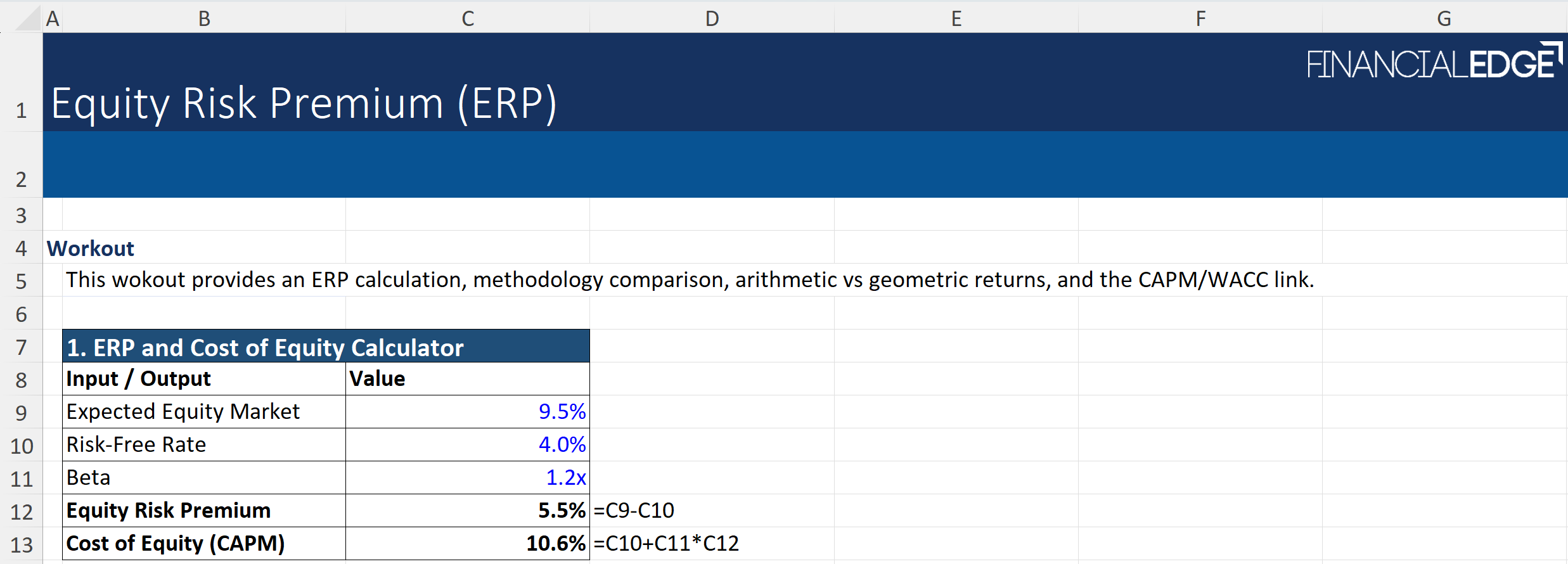
The example below provides calculations illustrating how the equity risk premium is estimated and applied into CAPM, WACC, and long-term return analysis. Access the Equity Risk Premium Workout in the free downloads section.
Current Equity Risk Premium 2026 – US & UK Estimates
ERP estimates change over time as interest rates, inflation expectations, equity valuations, and market sentiment evolve.
Current implied ERP estimates for the US market in 2026 are generally in the range of approximately 4% to 6%. Factors that influence the current estimates include elevated interest rates (relative to the post-2008 period), AI-driven equity market concentration and economic growth uncertainty.
In the UK, ERP estimates are often slightly higher than US estimates because the local market is generally viewed as smaller and less growth-oriented. Therefore, investors may demand additional compensation for political and currency-related uncertainty. The UK ERP estimates in 2026 are broadly in the range of 5.0% to 6.0%
Investors should note that ERP assumptions vary materially between firms and valuation providers.
Damodaran Implied ERP
Aswath Damodaran, a finance professor at New York University, publishes one of the most widely followed implied ERP estimates globally. His methodology starts with current equity index levels, forecasts future market cash flows, solves for the market-implied required return, and then subtracts the current government bond yield to estimate the implied equity risk premium.
Damodaran’s ERP estimates are particularly popular among investment professionals because they are forward-looking, updated regularly, and publicly available with transparent assumptions and methodology. His implied ERP framework is widely referenced when building discounted cash flow (DCF) models, estimating the cost of equity, and assessing whether equity markets appear relatively attractive compared with government bonds.
However, the methodology is still sensitive to assumptions regarding future cash flows, earnings growth, terminal growth rates, and market conditions. As a result, implied ERP estimates can change materially during periods of market volatility or shifts in investor sentiment.
Kroll Recommended ERP
Kroll, formerly known as Duff & Phelps, is one of the most widely recognized valuation and financial advisory firms globally. Its recommended ERP assumptions are extensively used by valuation firms, investment banks, accounting professionals, and litigation specialists when estimating the cost of equity and the weighted average cost of capital (WACC). Kroll publishes regular cost of capital guidance and maintains one of the most widely referenced valuation datasets used in professional practice.
Kroll’s ERP guidance is particularly popular because it combines historical market evidence, current market conditions, professional judgement, and long-term valuation considerations rather than relying solely on a purely market-implied approach. Many practitioners prefer Kroll’s methodology because it provides stability and consistency across valuation engagements and is widely accepted by auditors, regulators, and financial advisors.
However, one limitation is that Kroll’s recommended ERP is partly judgement-based and may therefore react more slowly to rapid market changes than fully implied ERP models such as Damodaran’s framework. In practice, many investors benchmark their assumptions against both Kroll and Damodaran estimates when developing portfolio return expectations or discount rates.
Equity Risk Premium in CAPM and WACC
The ERP is a core component of the Capital Asset Pricing Model (CAPM). Within the CAPM framework, the ERP represents the additional return investors require for accepting the systematic risk of equities relative to risk-free assets. As a result, changes in ERP assumptions directly affect the estimated cost of equity, expected portfolio returns, and asset valuations, making it one of the most important inputs in portfolio management and valuation analysis.
The CAPM formula is:

Where:
Re = cost of equity
Rf = risk-free rate
B = beta, a measure of systematic risk
ERP = equity risk premium
The ERP therefore, directly affects:
- Discount rates
- Equity valuations
- Investment hurdle rates
- Corporate financing decisions
The cost of equity is then incorporated into the weighted average cost of capital (WACC) calculation:

Where:
E / V = the proportion of equity financing within the company’s capital structure
D/V = the proportion of debt financing
Re = the cost of equity estimated using CAPM
Rd = the pre-tax cost of debt
(1-T) = adjusts for the tax deductibility of interest expenses, reflecting the after-tax cost of debt financing
A higher ERP increases the cost of equity and usually reduces company valuations because future cash flows are discounted at a higher rate.
Cost of Equity Calculation Using ERP
Let’s assume the following:
- Risk-free rate = 4.0%
- Beta = 1.2
- ERP = 5.5%
The cost of equity is:

This means investors require a 10.6% return to compensate for the company’s systematic risk exposure.
Expert Instructor Tip: Even small changes in ERP assumptions can materially affect DCF valuations. Increasing ERP by just half a percent may significantly reduce terminal values and enterprise valuations.
Equity Risk Premium in Investment Banking Interviews
ERP is a common topic in investment banking and valuation interviews because it tests understanding of valuation fundamentals, knowledge of CAPM and WACC, and the ability to interpret market assumptions. Below are some examples of common IB interview questions on ERP.
What is the Equity Risk Premium?
The equity risk premium is the additional return investors require for investing in equities instead of risk-free securities.
Why Does ERP Matter in Valuation?
ERP affects the cost of equity and WACC, which directly influence DCF valuations and investment decisions.
What Happens to Valuations if ERP Increases?
Higher ERP increases discount rates, reducing the present value of future cash flows and lowering valuations.
Why Might Implied ERP Rise During Market Stress?
Falling equity prices increase the expected return investors require, causing implied ERP estimates to rise.
Which ERP is Better: Historical or Implied?
Many practitioners prefer implied ERP because it reflects current market conditions, although historical ERP remains useful as a long-term reference point.
Conclusion
Overall, the equity risk premium is a core concept in portfolio management that measures the additional return investors require for holding equities over risk-free assets. ERP assumptions influence expected returns, strategic asset allocation, and company valuations. As market conditions change, investors must regularly reassess ERP estimates to ensure that portfolio assumptions remain realistic.