
Financial Forecasting Vs Financial Modeling
August 13, 2026
Financial forecasting is the process of estimating future financial outcomes such as revenues, expenses, and other financial metrics based on historical data, market trends, and assumptions. It often uses statistical models like regression and trend analysis over a short- to medium-term horizon.
Financial modeling, on the other hand, is a broader and more dynamic tool. It involves building detailed representations of a company’s financial performance using spreadsheets, typically integrating the income statement, balance sheet, and cash flow statement with formulas and linked statements. Modeling includes forecasting, but also allows scenario analysis, valuation, and decision-making support to simulate various outcomes.
Forecasting is a component of financial modeling. Modeling is the structure; forecasting is one of the outputs.
Side-by-Side Comparison: Financial Forecasting vs. Financial Modeling
Here’s a comparison model between financial forecasting and financial modeling:
| Aspect | Financial Forecasting | Financial Modeling |
| Definition | Predicting future financial outcomes based on historical data and trends | Creating abstract representations of financial scenarios using mathematical models |
| Key Components | Historical data analysis, trend identification, statistical methods | Assumptions, scenarios, formulas, financial statements |
| Use Cases | Budgeting, revenue projections, cash flow forecasting | Valuation, investment analysis, scenario planning, mergers and acquisitions |
| Time Horizon | Typically, short to medium term (e.g. quarterly or yearly) | Can be short, medium, or long-term depending on the model |
| Data Dependency | Heavily reliant on historical data and trends | Based on assumptions and hypothetical scenarios |
| Flexibility | Less flexible, focused on extrapolating existing trends | Highly flexible, allows testing of various scenarios |
| Output Format | Numerical forecasts, charts, and graphs | Detailed spreadsheets with formulas and linked statements |
| Purpose | To estimate future financial performance and guide planning | To evaluate financial decisions and simulate outcomes |
What is Financial Forecasting?
Financial forecasting is a series of estimates created to gauge the potential of a company’s future financial performance. Forecasts are typically done over 3 to 5 years, and are based on historical company data and assumptions created by the analyst. Forecasting is invaluable for assisting with budgeting and resource allocation, planning capital expenditures, assessing financing needs, and supporting valuation and investment decisions. Forecasting tools are universally used by companies, external investors and industry specialists alike.
Forecasting methods fall into two categories; qualitative, based on expert judgment, market research, and management commentary, and quantitative, which uses statistical models like regression, moving averages, and trend analysis. All can be used or blended together to create as realistic outlook as possible.
What is Financial Modeling?
Financial modeling is the construction of a spreadsheet-based representation of a company’s financial performance. It includes inputting historical data, building ratios and statistics, making assumptions, and forecasting financial statements.
Models are typically used for tasks such as valuation, M&A analysis, credit rating assessment, and operational planning. Types of models include three-statement models, LBO, DCF, M&A, and IPO models. The type of model will depend on the intended purpose, so internal teams may hold intricate models exploring the company’s sales performance and future opportunities. Meanwhile, external investors would be likely to build models such as discounted cash flow as their focus would be exploring the overall valuation of the company.
Tools for Financial Forecasting and Financial Modeling
Forecasting and modeling draw on different toolkits. Forecasting leans on statistical methods, like regression, moving averages, and trend analysis, usually run in Excel, Power BI, or Python. Modeling is built in spreadsheets, where formulas link the income statement, balance sheet, and cash flow statement into a single working structure.
How to Learn Financial Forecasting and Modeling Skills
Excel is used in both financial modeling and forecasting. The Modeler provides the perfect introduction to building Excel models with iterations, estimates and the cash sweep capability. This online course can help develop multiple techniques for a comprehensive and practical understanding of the topic. The Research Analyst, explains how to build error-free models and robust financial forecasts, critical for investment decisions. This includes a critical analysis of an analyst’s case company model to explore error checking in models, value drivers in forecasts, and the use of ratio analysis to sense check forecasts.
Power BI and Tableau are used for visualizing forecasts. Data Visualization and Power BI shows you how data can influence banking decisions. Learn how to analyze patterns and trends in client portfolios, financial transactions, and more.
Python and R are used for advanced statistical forecasting. Python Fundamentals provides you with the foundational skills you will need to be able to apply Python in the world of finance. Build on your excel skills to develop core competency efficiently and prepare for the real deal, applied machine learning in the world of finance.
Can Financial Forecasting and Modeling Be Used Together?
Analysts will typically require both financial forecasting and financial modeling skills which can be used together to explore a company or industry’s expected performance. Forecasting is about predicting future performance using historical data and assumptions and remains essential for budgeting, planning, and setting financial targets. Financial modeling is about simulating scenarios to evaluate strategic decisions like investments, acquisitions, or expansions. Modeling will usually incorporate forecasting as this is one of the components to create a valuation estimate.
Which skill to prioritize financial forecasting or financial modeling?
When beginning a career in finance it can be most useful to look at financial modeling first. This provides a strong foundation in understanding financial statements (income statement, balance sheet and cash flow etc.) and the relationships between different financial metrics. Understanding financial modeling is a critical skill for various finance roles and will make learning financial forecasting easier.
Progress to financial forecasting, once you have a solid understanding of financial modeling. Forecasting builds on the principles of modelling and adds predictive analytics to your skill set. This can require a strong understanding of the particular company or sector being explored to be able to fully grasp both external factors (such as industry changes, regulation and any macro-economic factors) as well as internal factors (such as capacity, production costs and logistics).
Here is an example of financial forecasting:
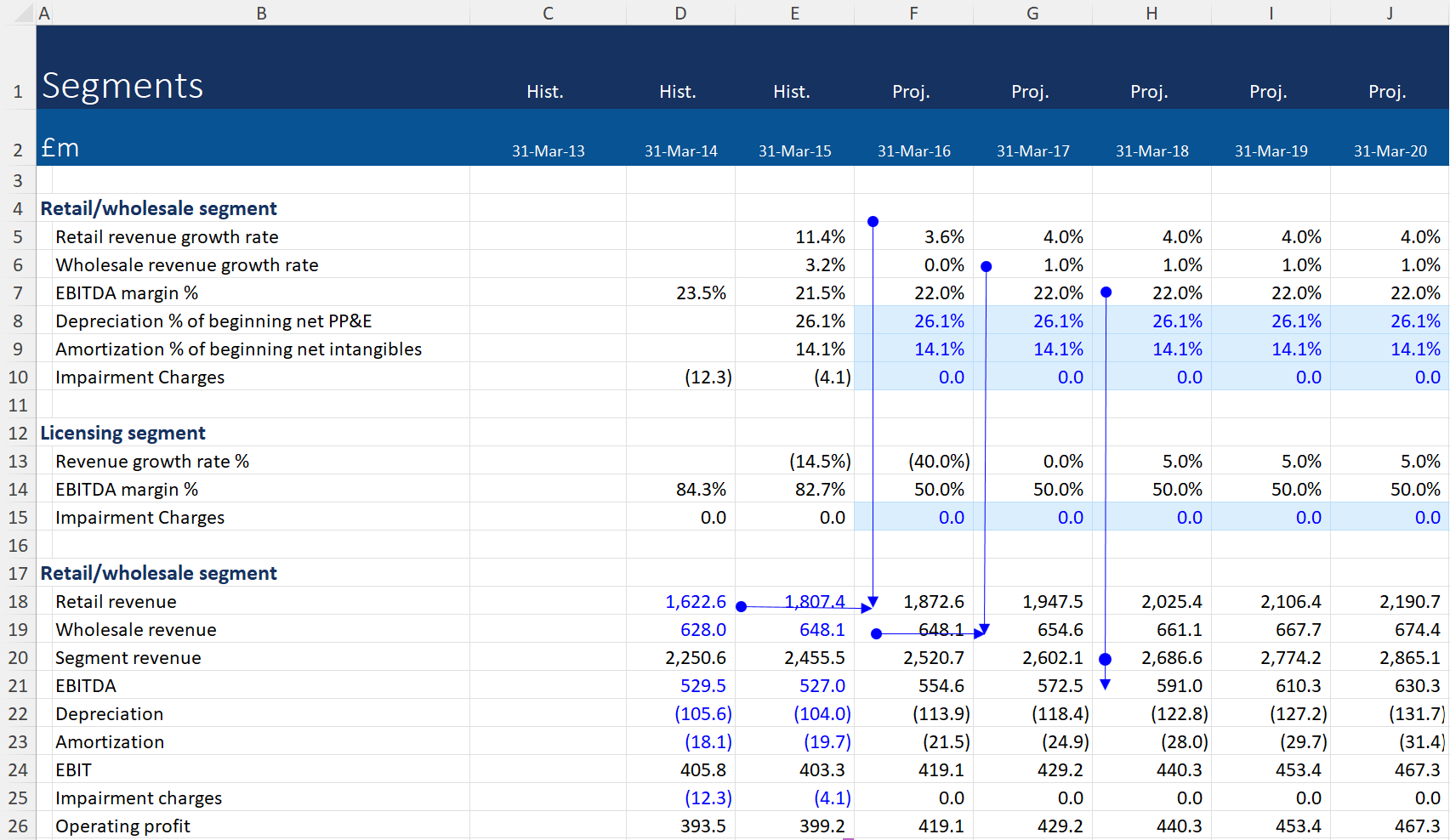
This shows a retail company model where financial forecasts have been created for the company segments. We can see that historical revenue figures are being combined with growth rate estimates to produce revenue estimates for the future. This particular model is also estimating depreciation, amortization and impairment charges by division as well.
This type of segmental financial forecasting will then be linked into the Excel income statement forecasts (which in turn will be linked to other items such as the balance sheet and cash flow) to create a full financial model.
Essentially the financial model can create the ‘big picture’ take on a company as it will look at historical performance and include estimates and assumptions for creating financial forecasts. It will also usually go a step further and attempt to draw a conclusion from the outlook that the forecasting has created. This can be a valuation range when doing an LBO or DCF model or it may a model that explores sales growth and cash flow potential and concludes that further CAPEX spending is a suitable company strategy.
How long does it take to learn in Financial Forecasting and Modeling?
Proficiency in financial modeling and financial forecasting will typically depend on your background, dedication, and the complexity of the models and forecasts you are working with. Learning the core skills will take a few weeks to develop, and to become truly proficient and apply those skills will take 1-2 years experience working on complex models and real-world projects and applying forecasting methods to various financial scenarios.
To accelerate your understanding of forecasting and modeling, these courses can be useful. The Modeler provides the perfect introduction to building models with iterations, estimates and cash sweep. The course takes 12 hours and includes Excel exercises and exams.
The Research Analyst, explains how to build error-free models and robust financial forecasts which can be critical for investment decisions. The course takes 40 hours to complete and explores not only financial forecasting and modeling covered in 4 hours, as well as accounting, valuation, and markets and investing.
Data Visualization and Power BI shows how data can influence banking decisions, and how to analyze patterns and trends in client portfolios, and financial transactions. The course takes 5 hours to complete and includes Excel exercises and an exam to test understanding.
Python Fundamentals provides the foundational skills needed to be able to apply Python in the world of Finance. The course takes 5 hours to complete and includes Excel exercises and an exam to test your understanding.
Conclusion
Financial forecasting and financial modeling are both crucial tools for businesses to predict future performance and make informed strategic decisions. While financial forecasting focuses on estimating future financial outcomes based on historical data and assumptions, financial modeling involves creating detailed representations of a company’s financial performance to simulate various scenarios. Both skills are complementary and essential for effective financial planning and analysis.