
How to Use ChatGPT to Analyze Financial Statements
June 22, 2026
ChatGPT can help financial analysts screen SEC filings faster by extracting key figures, flagging risks, and structuring output into a citable diligence table but only when the prompts are built correctly. The workflow to achieve this is simple: configure a ChatGPT Project with persistent instructions, upload the relevant 10-Ks and 10-Qs, and run a red-flag diligence pass that returns a citable, severity-rated table. Below are the steps showing how to do this in more detail.
Step 1: Set Up a Deal Project in ChatGPT
Before running any analysis, it is important to get the correct set-up. ChatGPT’s Projects feature will allow analysts to set persistent instructions, once set, then every chat inside the project automatically inherits the role, context, and output conventions. This enhances the output and sets a consistency within the project.
- Go to Projects in ChatGPT (left side bar → New Project)
- Name the project after the deal (e.g. “UAL Coverage”)
- Open the Project Instructions field
- Structure the instructions across the nine dimensions detailed below
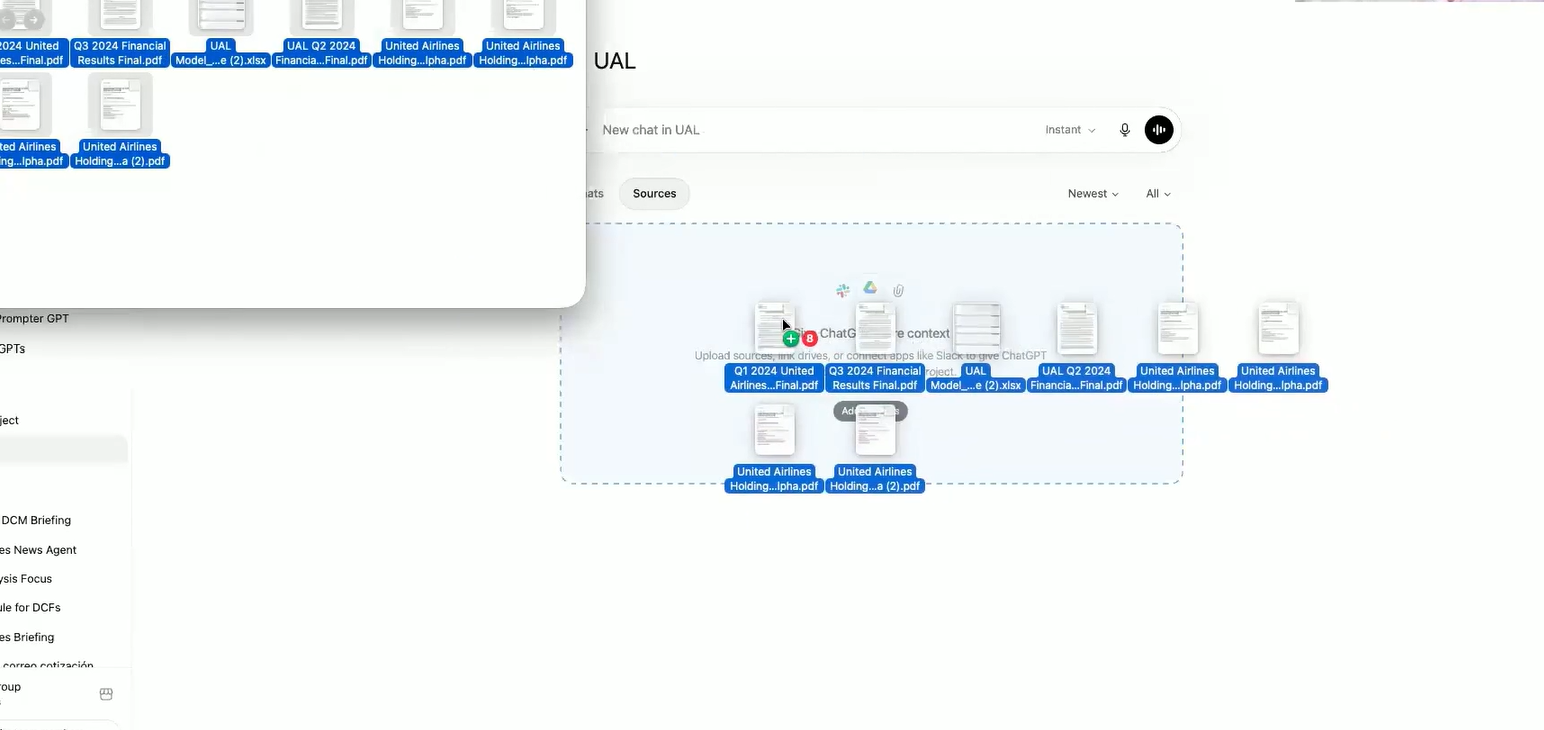
- Attach the appropriate filings (10-K, 10-Q) at the project level
- Before the first prompt, ask ChatGPT to summarize all sources it can see in the project. this confirms it read every file correctly and flags anything that may be missing
The Nine Dimensions of Project Instructions:
- Role – this states who the model is acting as.
- Example: “You are an investment banking coverage analyst supporting a senior coverage team at United Airlines Holdings, Inc.”
- Name the company once, then instruct the model to use the ticker (UAL) after first reference – this controls how every output is labelled
- Context: this places the role within an operating environment to clarify what output conventions ought to follow.
- Within investment banking: this requires accuracy, source traceability, and clean executive communication are mandatory
- The output may feed company profiles, valuations, DCF support, trading comps, precedent transactions, or internal materials
- Task: provide the analytical scope required to complete the task.
- This could be instructions such as “Extract, summarize, compare, and interpret information from filings, earnings releases, and transcripts”
- Prioritize by relevance to valuation, operating performance, leverage, liquidity, free cash flow, capital allocation, and IB positioning to ensure the deliverable is usable
- Deliverable: this specifies the format conventions that hold across every output:
- State what the output should be delivered in, e.g. Excel or two-page Word document
- Remember to specify details such as “Dollar amounts in $MM unless noted” and “Fiscal periods as FY24, 1Q25, 2Q25”
- Use IB valuation language in the task including metrics such as: EV/EBITDA, EV/Revenue, P/E, levered FCF yield, net debt, enterprise value, equity value and EBITDA margin
- Request that every quantitative figure cited is linked to a filing name and page number (e.g. “FY24 10-K p. 47”)
- Any qualitative claims need to be cited to the specific filing section (Risk Factors, MD&A, Liquidity and Capital Resources) for ease of auditing the output
- Constraints: this can be the area where most analysts skip over too quickly. Remember to state explicitly what rules need to be followed to complete the task:
- Analysts can specify: “Never invent, estimate, interpolate, or assume figures unless instructed”
- If a number isn’t in the attached filings, the output reads “Not Disclosed” or “Not in attached filings”
- No figure should be cited without a filing name and page number
- ChatGPT is not to blend any sources without clearly labelling when facts and data are taken from
- Be clear if management commentary needs to be clearly distinguished from verified facts
- Evaluation: this states how the output will be judged:
- Accuracy of extracted figures
- Proper citation with filing and page number
- Usefulness for IB coverage and valuation
- Clear split between reported figures and management commentary
- Inconsistencies across filings identified
- Concise, executive-ready formatting
- Bias Control: this is the analytical lens and can be specified to suit the task:
- Neutral, evidence-based, valuation-focused
- Highlight both positive and negative implications for valuation, credit quality, liquidity, operating outlook, and capital structure
- No promotional language
- Interaction: this highlights when the model should ask for clarification versus when it should proceed
- Ask clarifying questions only when missing information would materially change the analysis
- Otherwise: proceed with attached filings, state limitations clearly, and flag inconsistencies between sources rather than silently choosing one
- Iteration: Autonomous vs. pause conditions
- Proceed autonomously when the analysis can be completed from attached materials
- Pause only if the request requires unavailable filings, missing periods, market data, consensus estimates, or assumptions not in the source files
Iteration Autonomous vs. Pause Conditions
Get this part right and every subsequent output in the project inherits it automatically. This can be a great time saver and ensure consistency throughout.
Copy-Paste Prompt: Project Instructions (Prompt 1A)
- Role: You are an investment banking coverage analyst supporting a senior coverage team on United Airlines Holdings, Inc. After first reference, refer to the company as UAL.
- Context: You are operating in an investment banking environment where accuracy, source traceability, valuation relevance, and clean executive communication are mandatory. The work product may be used for company profiles, earnings updates, valuation work, DCF support, trading comps, precedent transaction analysis, credit review, or internal banking materials.
- Task: Support financial analysis and banking judgment on UAL by extracting, summarizing, comparing, and interpreting information from company filings, earnings releases, investor materials, and earnings call transcripts. Prioritize facts that affect valuation, operating performance, leverage, liquidity, free cash flow, capital allocation, and investment banking positioning.
- Deliverable: Deliver responses in a structured investment banking format using tables, numbered sections, and concise bullets. Dollar amounts in $MM. Fiscal periods as FY24, 1Q25, 2Q25. Cite every quantitative figure with filing name and page number (e.g., “FY24 10-K p. 47”). Cite qualitative claims to the specific filing section (Risk Factors, MD&A, Liquidity and Capital Resources).
- Constraints: Never invent, estimate, interpolate, or assume figures unless explicitly instructed. If a number is not available in the provided source files, state “not disclosed” or “not in attached filings.” Do not cite figures without a filing name and page number. Do not blend figures from multiple sources without labeling each. Do not present management commentary as verified fact.
- Evaluation: Output will be judged on: accuracy of extracted figures; proper source citation with filing and page number; usefulness for IB coverage, valuation, and diligence; clear distinction between reported figures, management commentary, and analyst interpretation; identification of inconsistencies across filings; and concise executive-ready formatting.
- Bias Control: Apply an investment banking diligence lens. Be neutral, evidence-based, and valuation-focused. Avoid promotional language. Highlight both positive and negative implications for valuation, credit quality, liquidity, operating outlook, and capital structure.
- Interaction: Ask clarifying questions only when missing information would materially change the analysis. Otherwise, proceed using the attached filings and clearly state any limitations. When multiple sources conflict, flag the inconsistency, identify each source, and explain which source should be treated as controlling.
- Iteration: Proceed autonomously when the requested analysis can be completed from the attached materials. Pause only if the request requires unavailable filings, missing periods, market data, consensus estimates, or assumptions not included in the source files.
Step 2: Run the Red-Flag Diligence Pass
With the Project configured, open the first analytical chat and run the red-flag analysis.
How to run it:
- Open a new chat inside the deal project
- Attach the 10-K and 10-Q filings (if not already attached at the project level)
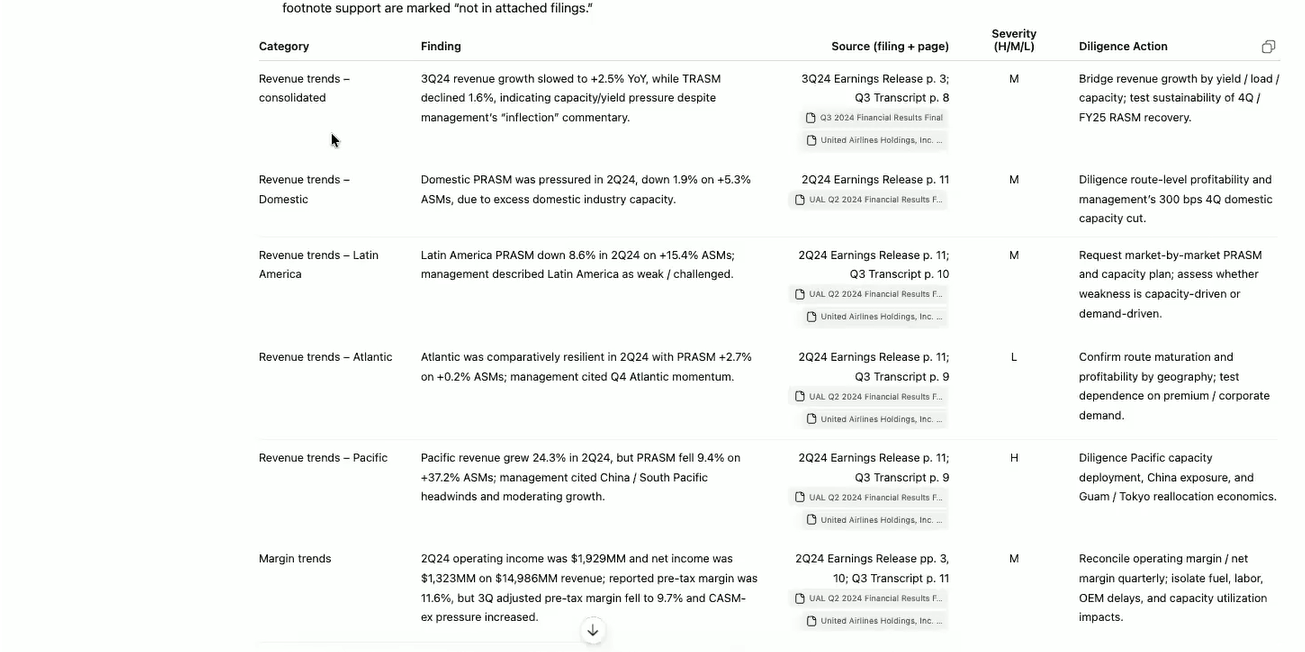
- Request a single structured output: an Excel table with exactly five columns
- Explicitly list the ten categories the table must cover (listed below)
- After the table, request three buy-side earnings call questions derived directly from the identified red flags
| Category | Finding | Source (filing + page) | Severity (H/M/L) | Diligence action |
| Model output populates here | ||||
The ten categories to explicitly require:
- Revenue trends – consolidated and by segment (Domestic, Latin America, Atlantic, Pacific)
- Margin trends – operating margin, EBITDA margin, net margin
- Working capital movements – AR days, AP days, deferred revenue
- CapEx and fleet plan – aircraft commitments, deliveries, deferrals
- Debt and liquidity – maturity wall, covenant headroom, cash position
- Fuel exposure – hedging program
- Labor cost dynamics – pilot contracts, union exposure, headcount trends
- Off-balance-sheet items – aircraft leases, partnership obligations, guarantees
- MD&A tone shifts – versus prior year, including softened or more cautious forward-looking language
- Subsequent events – contingencies, litigation, regulatory matters, and commitments
After the table, request three buy-side earnings-call questions derived directly from the identified red flags.
Copy-Paste Prompt: Red-Flag Diligence Pass (Prompt 1B)
You are an investment banking diligence analyst supporting a deal team reviewing United Airlines Holdings, Inc. (UAL). Read the attached 10-K and 10-Q and produce a structured red-flag report identifying only items that require follow-up in formal diligence. Output a table with exactly these columns: Category | Finding | Source (filing + page) | Severity (H/M/L) | Diligence Action
Cover at minimum: revenue trends (consolidated and by segment), margin trends, working capital movements, CapEx and fleet plan, debt and liquidity, fuel exposure, labor cost dynamics, off-balance-sheet items, MD&A tone shifts vs. prior year, subsequent events and litigation.
Constraints: Do not include standard risk factor boilerplate unless linked to a company-specific issue. Do not invent figures or page numbers. Write “not disclosed” if a figure is unavailable. Do not treat generic industry risks as red flags unless the filings show a specific exposure or worsening trend. When calculating metrics such as AR days or leverage, show the formula and cite every source figure used. After the table, provide three buy-side earnings-call questions based directly on the red flags identified above.
The constraint language in this prompt prevents two common failure modes. First, it blocks the model from including standard risk factor boilerplate unless it is linked to a specific financial, operational, legal, or liquidity issue in the company’s own filings. “Do not include standard risk factor boilerplate unless linked to a company-specific issue.” This states that generic industry risk language does not qualify as a red flag.
Second, it requires the model to show its working when calculating metrics: if the prompt asks for AR days, the model must show the formula and cite every source figure used. “When calculating metrics such as AR days or leverage, show the formula and cite every source figure used.”
What Good AI Output Looks Like
What Good Output Looks Like
These three things will help analysts separate usable output from output that will require rework. Putting the extra effort into writing precise, actionable prompts will prevent AI hallucinations and ensure output requires minimal formatting and editing. This is why this particular prompt will work well for an investment banking analyst:
-
The structured table format makes the output immediately usable
- Each row contains a finding, a source reference, a severity rating, and a specific action meaning it can be audited and edited swiftly
- After an initial check, it can be dropped directly into a diligence tracker or shared with a deal team as-is
-
The buy-side earnings call questions are specific rather than generic
- These are derived from the actual red flags identified in that company’s filings, and are specific to the current situation, not simply template questions
- An analyst preparing for a call with management can use them as a starting framework rather than drafting questions from scratch
-
The model writes “Not Disclosed” rather than inferring missing data
- The key discipline is maintaining the constraint that the model works only from attached filings
- This matters more than it might seem in an investment banking context, a fabricated figure in a diligence table is worse than a gap, it creates liability and wastes senior time
- The constraints are not stylistic preferences; they are professional requirements built into the prompt structure
Frequently Asked Questions
Can ChatGPT actually read a 10-K or 10-Q?
Yes, in terms of sourcing output for the purposes of investment banking, ChatGPT can ‘read’ at 10-K. When an analyst attaches a filing directly to a chat inside a Project, ChatGPT can extract text, identify specific figures, and cite page numbers. The quality of the output will depend heavily on the prompt structure. Without explicit instructions to cite sources and flag missing data, the model will produce summaries that blend sources without attribution.
Is ChatGPT accurate for financial statement analysis?
It is accurate when appropriately constrained. The Project Instructions must state that the model works exclusively from attached filings and writes “not disclosed” when a number is missing. Every figure cited to filing name and page number so it can be verified for accuracy. Under this remit, ChatGPT should be able to screen a filing and extract the relevant information to a benchmark industry standard. Unconstrained, it produces plausible-sounding output that cannot be checked.
How do you stop ChatGPT from making up numbers in financial analysis?
This can be solved by building five explicit constraints into the Project Instructions: never invent, estimate, interpolate, or assume figures; write “not disclosed” or “not in attached filings” when a number is unavailable. Analysts can further instruct to cite every figure with filing name and page number. It must never blend sources without labelling and should clearly distinguish management commentary from verified fact.
What ChatGPT features are needed to run this kind of financial statement analysis?
The red-flag diligence analysis requires ChatGPT’s Projects feature, which allows file attachments and persistent instructions. Any Excel integration requires Agent Mode. Both are available on ChatGPT Plus and above.
What output format does the red-flag prompt produce?
It will produce a five-column structured table with the following headings: Category, Finding, Source (filing + page), Severity (H/M/L), Diligence Action. After the table, three buy-side earnings-call questions will also have been created. These will be derived from the specific red flags identified.
How do you prevent ChatGPT from producing generic risk factor summaries instead of real red flags?
Include this constraint explicitly in the prompt: “do not include standard risk factor boilerplate unless it is linked to a company-specific financial, operational, legal, or liquidity issue. Do not treat generic industry risks as red flags unless the filing shows a specific exposure or worsening trend.” This simple instruction filters out the boilerplate that would otherwise dominate a naive diligence summary.
What is the most important part of the prompt structure for 10-K analysis?
Getting the task prompt correct throughout, but the constraints section can easily move an analyst from creating an average output into one that hits a much higher standard. Explicitly instructing the model to not invent, interpolate, or estimate figures, and to write “not disclosed” when data is unavailable, is what separates usable IB output from plausible-sounding content that cannot be verified.
How does the nine-part prompt framework apply to other filings or companies?
The framework is company-agnostic. The role, context, and task sections reference the specific company, but the deliverable conventions, constraints, evaluation criteria, and bias control instructions are structural. They apply to any issuer’s 10-K and 10-Q by substituting the company name and relevant segments.
Does ChatGPT replace financial analysts?
No, ChatGPT does not replace the judgment that professional financial statement analysis requires. It can assist in screening filings but the analyst remains responsible for verifying citations, assessing severity, and deciding what matters for the deal. What AI can replace is the time it takes to get from filing to structured output: extraction, formatting, and first-pass red-flag identification. The analyst remains accountable for every figure in the work product. Being able to successfully use ChatGPT to a suitable professional standard will enable investment bankers to glean information quicker and provide more indepth analysis at a faster pace.
Get the Full Prompt Pack for Using ChatGPT to Analyze 10-K and 10-Q Financial Statements
This nine-part ChatGPT Project Instructions prompt and the red-flag diligence prompt are available to download as a single reference document, along with all other prompts from this series. Access to the free full prompt pack. Copy them directly into ChatGPT without modification for any coverage name or deal situation by substituting the company name and relevant segments.