
Precedent Transaction Analysis
March 18, 2026
What is Precedent Transaction Analysis?
Precedent Transaction Analysis, also known as transaction comparables or transaction comps, examines the premiums and multiples paid in real M&A deals to understand what buyers have actually paid to acquire control of comparable businesses. When a company is acquired, the offer price typically exceeds the unaffected trading price. That premium, and the transaction multiples implied by it, form the foundation of this methodology. Alongside DCF and trading comparables (trading comps), Precedent Transaction Analysis is one of the three core valuation approaches in investment banking. While DCF reflects intrinsic value and trading comps reflect market pricing, Precedent Transaction Analysis capture control value under real takeover conditions.
Key Learning Points
- Precedent Transaction Analysis benchmarks valuation against real M&A deals, capturing the control premium that trading comps exclude
- The process follows a structured framework: define the universe, collect data, standardize financials, calculate multiples, and derive implied Enterprise Value and Equity Value on the day of the takeover
- Control premium is the premium paid above the unaffected share price, typically ranging from 20-40% subject to sector and deal dynamics
- Precedent Transaction Analysis often implies higher valuations than trading comps because they include control and synergies earned from a takeover, making them a natural upper bound in valuation ranges
- The main constraints are limited public data on previous M&A takeovers, and the fact that previous takeovers are old
Why is Precedent Transaction Analysis Used?
Before discussing the mechanics of how Precedent Transaction Analysis is done, it is important to first understand why this methodology is used in an M&A context.
In an M&A, a target company is not valued merely based on its current trading enterprise value, which is typically market capitalization plus net debt. An acquirer evaluates the business through a broader strategic and financial lens to determine the maximum price it can pay.
Key drivers that influence the acquirer’s willingness to pay include:
- Cost and revenue synergies that can be unlocked post-acquisition, and which add value to both acquirer and target.
- Scarcity value arising from unique, rare, or hard-to-replicate assets, such as proprietary technology and niche market access.
- Market cycle conditions, particularly whether the sector is trading at depressed or elevated valuation levels in comparison to its intrinsic value.
- Prevailing cost of debt and financing conditions, which directly impact the buyer’s return thresholds, particularly when the acquisition is structured with significant leverage.
These factors establish the theoretical ceiling of value creation from the transaction, effectively setting the upper bound of what the acquirer can rationally pay.
However, whether the final transaction price remains at this ceiling or exceeds it depends on additional deal dynamics:
- Competitive intensity among potential bidders, a larger and more aggressive bidder pool typically increases upward pressure on the final transaction price.
- Nature of the transaction process, such as a negotiated friendly deal versus a hostile takeover. Hostile takeover situations, particularly where defensive measures are in place, often escalate pricing as bidders must offer a higher premium to convince shareholders to sell.
Any consideration paid above the unaffected share price is referred to as a Control Premium. This premium compensates sellers for transferring control of the company, including authority over the board and strategic decision-making, access to future cash flows, and the ability to realize anticipated synergies. In practice, the unaffected share price is typically measured using the 30-day or 60-day volume-weighted average price (VWAP) prior to the announcement of the transaction.
The following is an illustration, where the buyer paid a 40% premium to the unaffected

How to Perform Precedent Transaction Analysis?
The objective of Precedent Transaction Analysis is to derive an implied valuation range for a target company based on observed transaction multiples from comparable M&A deals.
These transaction multiples typically include:
- Enterprise Value / Revenue
- Enterprise Value / EBITDA
- Offer Price / EPS
The selected multiple range is then applied to the target’s corresponding financial metric to estimate its implied Enterprise Value and, subsequently, Equity Value.
Step-by-Step Framework
Step 1: Define the precedent universe
Construct a set of comparable transactions using screening criteria:
- Industry and business model alignment: Use SIC codes, NAICS codes, or industry classification systems to choose transactions from an industry similar to that of the target company.
- Geography: Choose transactions that occurred in the same or similar countries that your target operates in. Cross-border deals introduce currency, regulatory, and political risk premiums that may not apply domestically.
- Time Period: Recent deals (within the last 3 to 5 years) are most relevant. Older deals may reflect vastly different interest rate, credit, or sector environments.
- Size Parameters (EV, Revenue, EBITDA): Ensure financial comparability to avoid distortions from scale-driven valuation differences. A $50m EBITDA company cannot be valued by comparing it with a $2bn EBITDA company.
- Growth and Margin Profile: Companies with similar growth trajectories and profitability levels tend to trade within comparable multiple ranges.
- Buyer Type (Strategic vs Sponsor): Distinguish between strategic acquirers (often a competitor company) and financial sponsors (often private equity), as their valuation frameworks, synergy assumptions, and leverage constraints differ materially.
Transactions can be found using a range of information providers:
- Bloomberg
- FactSet
- CapIQ
- LSEG
- PitchBook: Strong for middle market and private equity
- SEC EDGAR: Proxy statements (DEF 14A), merger agreements (Schedule TO-T), and 8-K filings for disclosed deal terms
- Company press releases / investor presentations: Often the first disclosure of deal rationale and multiples
Instructor Tip: Start broad, run a screen of 30–50 transactions, then narrow to your “core” set of 8–10 truly comparable deals. Document your exclusion rationale. The credibility of the output depends heavily on the rigor of this filtering process.
Step 2: Determine Transaction Enterprise Value
For each selected transaction, gather deal equity value and bridge to enterprise value using consistent convention.
Instructor Tip: It is critical to adopt a uniform definition of Enterprise Value across all precedents, as reported figures in transaction announcements may vary in composition.
Step 3: Standardize Financials Denominators
To ensure comparability, financial metrics used in the multiple’s denominator must be aligned both in timing and definition.
A. Timing Alignment – LTM vs NTM Financials
Revenue, EBITDA, and EPS must correspond to the financial period relevant at the time of deal announcement.
- Use LTM (Last Twelve Months) financials as of announcement date
- If using NTM (Next Twelve Months), ensure forecasts are as of announcement
- Do not mix LTM and NTM within the same dataset
B. Normalise the EBITDA as it can be reported in different forms:
- Reported EBITDA
- Adjusted EBITDA (company-defined)
- Run-rate EBITDA (including synergies and net of acquisition costs)
A consistent and comparable EBITDA definition must be applied across all transactions. Mixing reported and synergy-adjusted EBITDA distorts the multiple analysis.
Step 4: Calculate Transaction Multiples
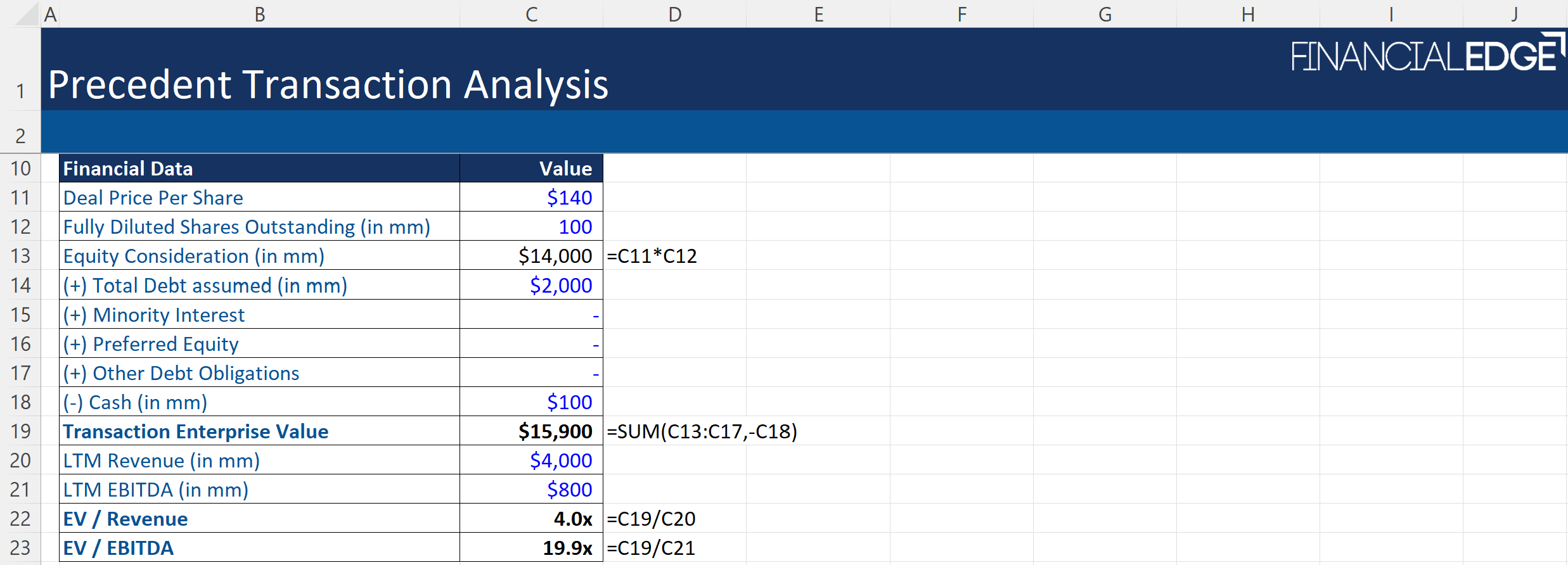
Multiples are derived by dividing Enterprise Value (numerator from Step 2) by the standardized financial metric (denominator from Step 3).
Common transaction multiples include:
- EV / LTM EBITDA – most widely referenced in M&A
- EV / NTM EBITDA – appropriate for cyclical or high-growth sectors
- EV / LTM Revenue – useful when margins vary significantly or EBITDA is negative
- Offer Price / EPS – equity-focused perspective
For example (for a single transaction):
Step 5: Add Multiple Drivers
Most slide decks show minimum / median / average / maximum multiple. That’s fine for the page, but weak for decision making. What is really important is why the distribution looks the way it does. As an analyst, here’s a better way to present results internally by building a ‘drivers column’ next to multiples. For each deal, tag:
- Buyer type – strategic vs sponsor
- Process – hostile vs friendly takeover
- Synergy intensity – high/medium/low
- Consideration – cash/stock/mix of cash & stock
This turns precedent multiples from “a set of numbers” into a defensible narrative, such as:
- “High multiples cluster where strategic buyers pursued targets using high synergies and hostile takeover environments”
- “Low multiples cluster where sponsored buyers were constrained with the use of leverage and limited synergies”
Step 6: Apply the Multiple Range to the Target
With multiples calculated for each selected transaction, apply it to the target:
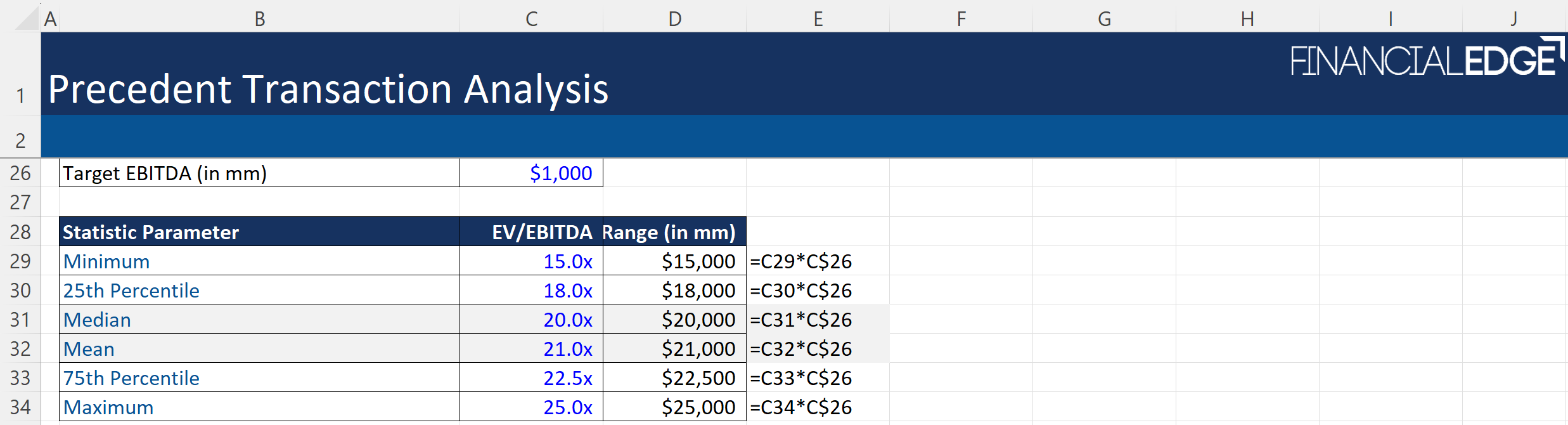
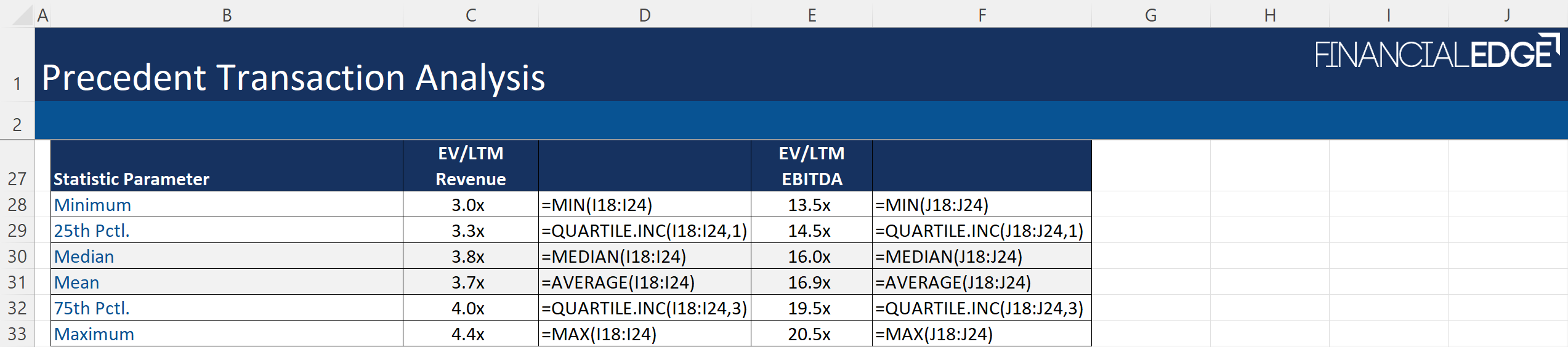
Standard Statistical Outputs:
- Mean multiple
- Median multiple
- 25th / 75th percentile multiples
- Minimum and max multiples (to establish outer bounds)
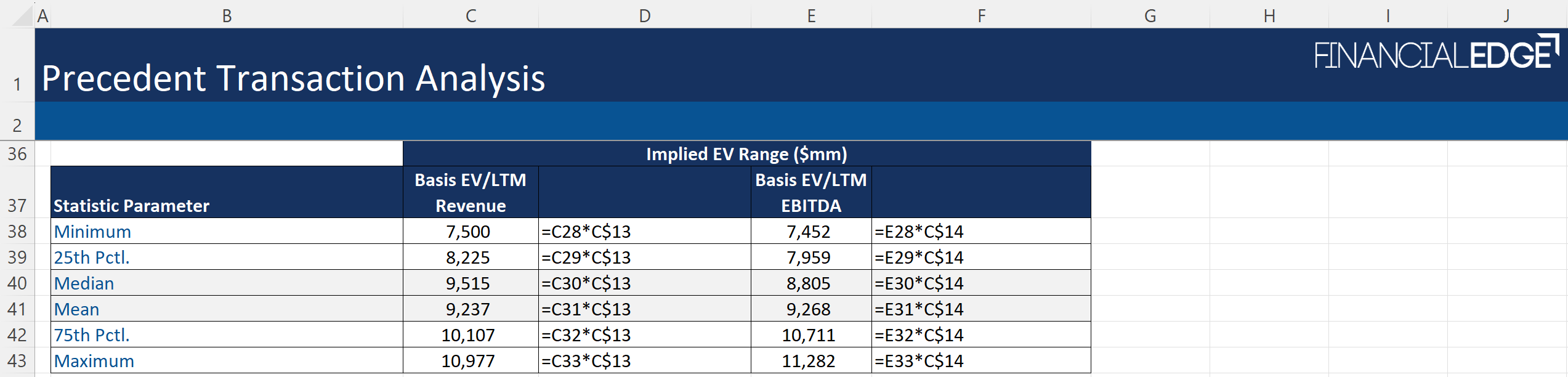
Apply multiples to derive the implied value range:
Assume the target has LTM EBITDA of $1,000mm.
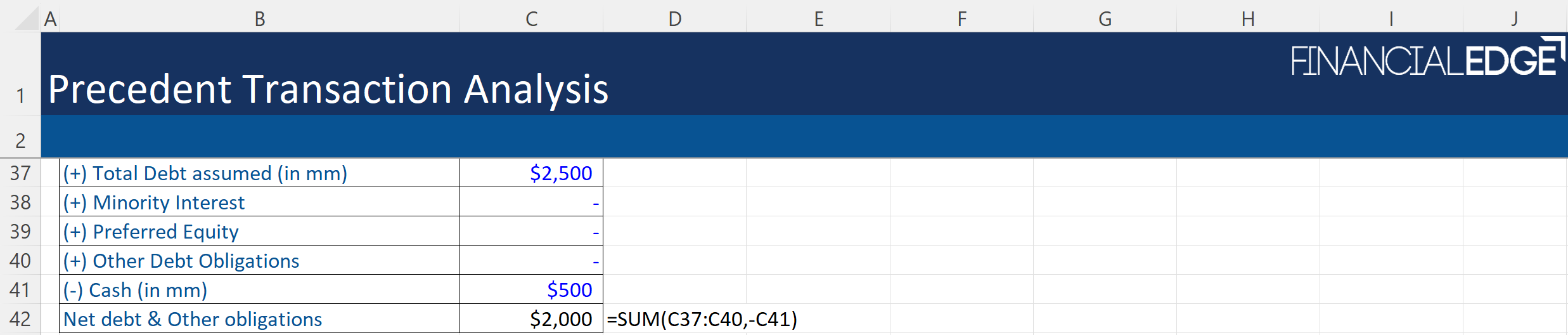
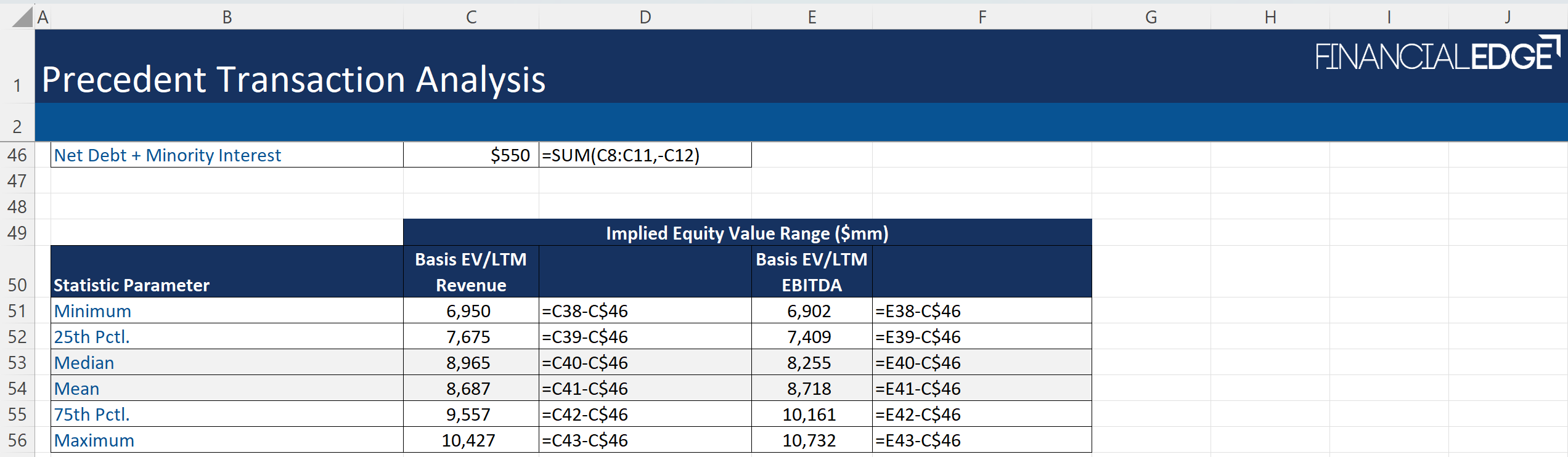
Assuming the target has total debt of $2,500mm and cash of $500mm, with no minority interest, preferred equity, or other debt-like obligations, and 100mm fully diluted shares outstanding, the implied offer price range is as follows:
Comparable Company Analysis vs. Precedent Transaction Analysis
While the mechanics are similar and both apply multiples from a reference group to a target, the methodologies answer different questions and serve different purposes.
| Factor | Comparable Company Analysis (also known as Transaction Comps) | Precedent Transaction Analysis |
| Core question | “What is this business worth as a going concern in the public market?” | “What would a buyer pay to acquire the whole business?” |
| Premium embedded | None | Control premium (typically in the range of 20–40%, subject to sector and deal dynamics) |
| Comparable universe | Publicly traded peers | Acquired companies (public or private) |
| Market sensitivity | Highly sensitive to current market conditions | Less sensitive; anchored to historical deal terms |
| Use in M&A | Sets floor / market context | Sets ceiling / deal pricing reference |
| `When to rely more heavily on each? | Use comparable company analysis when:
· The target is considering an IPO or strategic alternatives that do not involve selling a controlling stake · You need a current market anchor |
Use Precedent Transaction Analysis when:
· A full sale or change of control is under consideration · You need to support or challenge an offer price · A fairness opinion is required |
Precedent Transaction Analysis: What are the Pros and Cons?
Advantages
- Reflects real-world deal economics: Precedent Transaction Analysis is grounded in actual prices paid by informed buyers in arm’s-length negotiations. This is empirical evidence of value, not a theoretical model
- Captures the Control Premium: For M&A purposes, a valuation that omits Control Premium systematically undervalues the target
- Useful for fairness opinions: Boards of directors (and their financial advisors) lean on Precedent Transaction Analysis heavily when determining whether a proposed deal price is “fair from a financial point of view”
- Less sensitive to current market volatility: Because the data is historical, Precedent Transaction Analysis is not impacted by daily market fluctuations. This provides a more stable reference point in volatile environments
- Credible in adversarial contexts: In negotiations, a dataset of real deals is more defensible than a DCF with custom assumptions. “Buyers paid 12x EBITDA for five comparable companies” is harder to argue with than a custom discount rate
Disadvantages
- Data scarcity: The more specific and niche your industry, the fewer truly comparable deals exist. A highly specialized industrial company may have only two or three relevant transactions, making any analysis fragile.
- Structural differences between deals: Not all M&A transactions are comparable. Differences such as asset purchases versus stock acquisitions, distressed sales, sponsor-led acquisitions, or minority stake purchases introduce materially different pricing dynamics. If these variations are not carefully screened or adjusted for, they can distort the valuation benchmark.
- Synergies are priced in: Acquirers in comparable transactions often pay above the standalone value because they expect to realize synergies when the target is combined with the acquirer. When applying these old precedent multiples to a new target, one may inadvertently incorporate synergy value that has not yet been identified or quantified in the new target. If the synergy potential differs materially from that embedded in the precedent deals, the implied valuation may be wrong.
Precedent Transaction Analysis Example
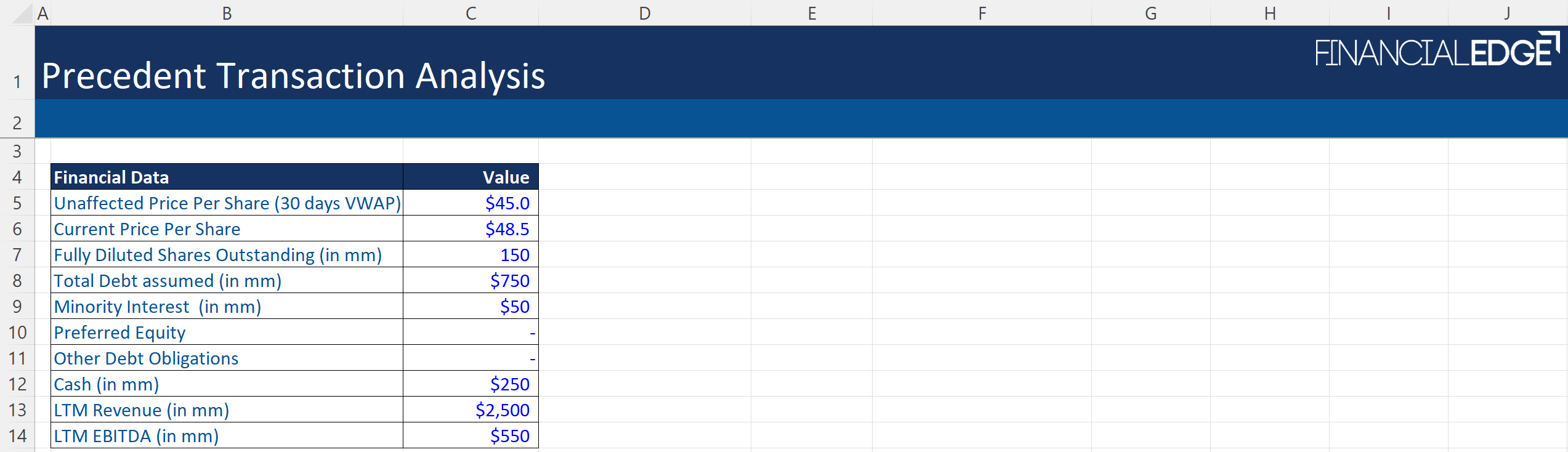
Scenario: You are advising on the potential acquisition of ABC MedTech, a medical device company with the following financials:
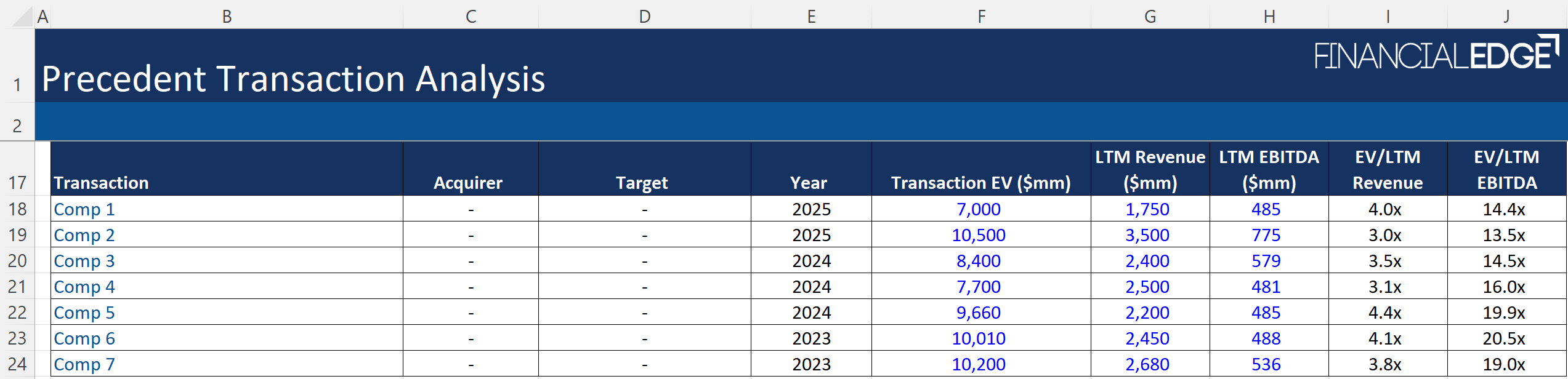
Step 1 – Precedent Transaction Universe (Selected):
Comparable transactions should focus on medical device companies with similar regulatory exposure, product mix, and margin profiles.
Step 2 – Summary Statistic:
Step 3 – Implied Enterprise Value
Step 4 – Implied Equity Value
Step 5 – Control Premium Analysis
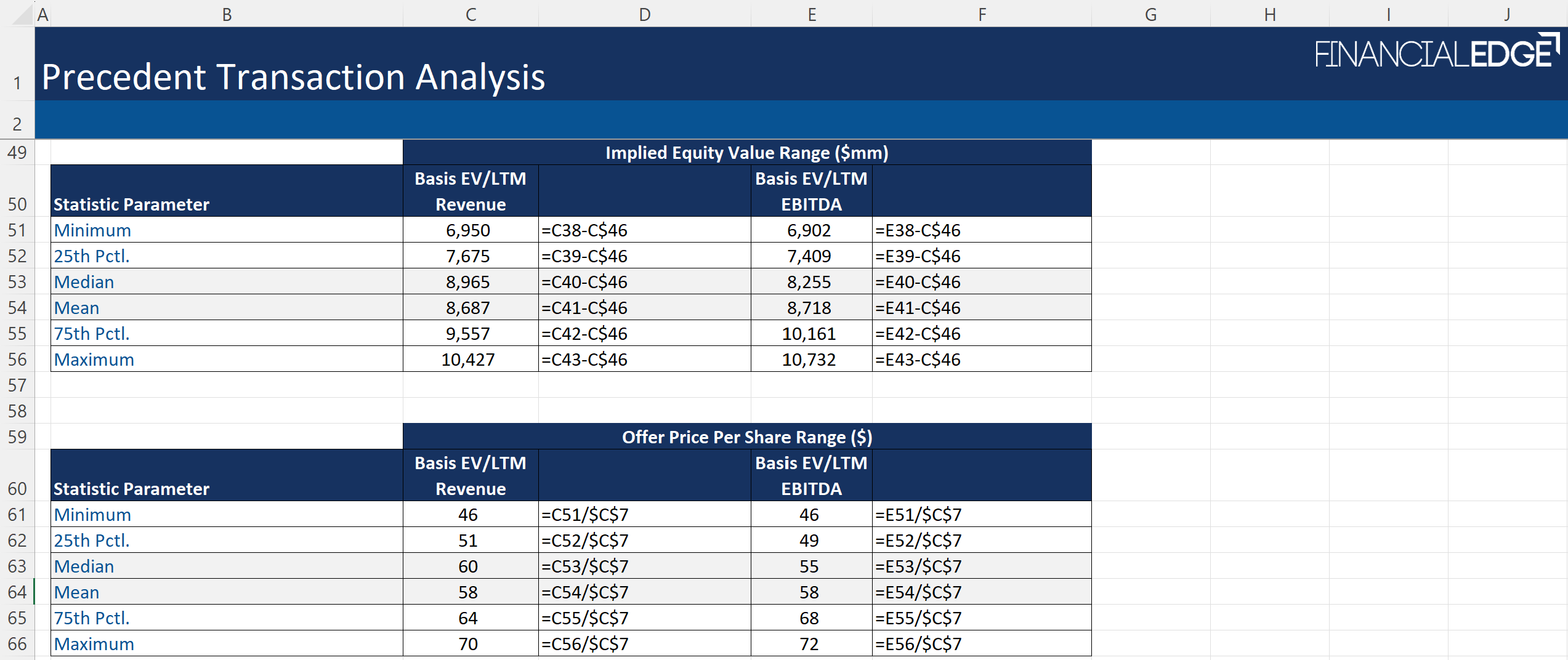
The median control premium of 33% based on LTM revenue and 22% based on LTM EBITDA, with a maximum premium reaching 59% based on LTM EBITDA, suggests that either the precedent universe reflects strong competitive pricing dynamics or that ABC MedTech’s growth profile justifies a higher premium, a qualitative judgment that requires careful assessment.
Download the Precedent Transaction Analysis calculator for free.
Conclusion
When assessing whether a proposed offer is fair, Precedent Transaction Analysis provides the most direct evidence of what buyers have paid for similar businesses under comparable conditions. Use of this methodology requires disciplined screening of transactions, precise alignment of financial timing, and interpretation of embedded control premiums and strategic drivers. Used in combination with trading comps and a DCF, Precedent Transaction Analysis gives investment bankers the most complete picture of where a business’s value truly sits, and what a buyer should reasonably be expected to pay to own it.