
Stock-Based Compensation in a DCF Model
August 20, 2026
What is Stock-Based Compensation?
Stock-Based Compensation (SBC) must be treated as an economic expense in a discounted cash flow (DCF) model, as adding this non-cash charge back to free cash flow to the firm (FCFF) artificially inflates a company’s enterprise value.
For companies where SBC makes up a material percentage of operating expenses, such as high-growth technology firms, how you treat this line item dictates the accuracy of your entire valuation. Because SBC is categorized as a non-cash accounting expense, many analysts reflexively add it back to cash flows, and more often than not, companies use it to boost non-GAAP adjusted EBITDA metrics. However, adding SBC back simply because cash does not leave the bank account ignores the very real economic cost of shareholder dilution. If you add it back to your FCFF, you are effectively pretending that employee labor is free. This blog breaks down exactly why SBC should remain fully deducted within your cash flow projections.
If you need a refresher on the SBC expense, its foundational accounting, instruments, and ASC 718 rules, read our blog on first.
Key Learning Points
- Never add back SBC to FCFF in a DCF model. Adding it back pretends employee labor is free and artificially inflates the company’s enterprise value
- The treatment of SBC is different from depreciation & amortization (D&A). D&A accounts for cash spent in the past, whereas SBC represents real company equity given away today to cover payroll
- When calculating fully diluted shares, use the treasury stock method (TSM) to find the net new shares created by vested, in-the-money options. Avoid adding unvested or future grants to the basic shares outstanding if you have already deducted their cost in your cash flows to prevent double-counting
- Companies often add SBC back to create an inflated “adjusted EBITDA,” which makes their valuation multiples look cheaper. Deduct SBC across all companies to ensure an honest, apples-to-apples comparison
Do You Add Stock-Based Compensation Back in a DCF Model?
Do you add stock-based compensation back in a DCF? No, stock-based compensation should not be added back in a DCF model. Here is why:
Let’s take a step back. A DCF is the discounted value of future free cash flow to the firm (FCFF). FCFF is calculated as below:

Where:
- EBIT = Earnings Before Interest and Taxes
- D&A = Depreciation & Amortization
- Capex = Capital Expenditures
Since SBC is a non-cash expense, standard modeling practice dictates adding it back to the FCFF layer the exact same way you add back D&A. However, that’s not right. Adding it creates a trap in valuation, which can be illustrated from the example below.
The Clearest Way to See the Problem: Two Identical Businesses
Imagine two companies that are completely identical in revenue, cost structure, margins, growth, and customer base. They even compensate their employees the exact same total amount for the exact same work. The only difference lies in their compensation structure: Business 1 pays entirely in cash, while Business 2 pays a portion in stock.
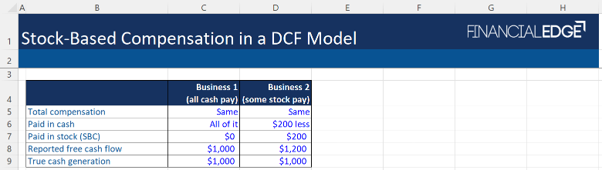
The critical flaw in the valuation runs directly through the non-cash add-back. Business 2 appears to generate more cash, but it does not; its FCFF is artificially higher only because $200 of SBC is added back to the cash flow. The cash conserved by paying in equity was not actually earned by the operations of the business. It was essentially borrowed from future shareholders who must silently absorb the cost through permanent dilution.
Now run it through a DCF and you will find that the gap is large. Take a 10% WACC, 5% growth, and no debt. Transform each company’s calculated FCFF into enterprise value (EV), using the Gordon Growth model:

Where:
- g = growth rate
- WACC = weighted average cost of capital
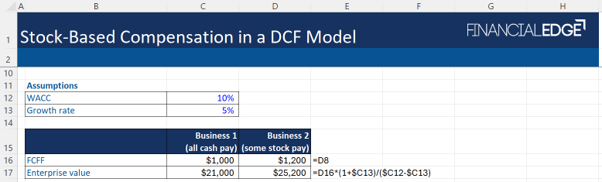
As per the above illustration, Business 2 is worth 20% more. For two economically identify companies, that cannot be right.
The clearest way to settle the question is to view the transaction through the lens of a rational acquirer. Why would a buyer pay a premium for Business 2 simply because it pays its staff in stock? When you acquire the company, you inherit the existing shareholder obligations, meaning Business 2 still owes its employees $200 a year in equity. Post-acquisition, one of two things must happen, and both cost the acquirer exactly $200:
- You honor the plan: You keep issuing $200 of stock annually, diluting your own ownership
- You stop the dilution: You freeze the equity plan and switch the employees to all-cash pay. Cash compensation immediately rises by $200, and FCFF falls back to $1,000, identical to Business 1
To avoid a massive valuation trap in a DCF model, SBC must never be added back to FCFF, but rather left fully deducted as a true cash expense. This matters because treating SBC correctly ensures that two economically identical businesses, one paying in cash and the other paying a portion of it in equity, yield the exact same enterprise value, preventing an analyst from artificially inflating a company’s worth by pretending employee labor is free where equity is paid instead of cash.
How to Calculate Total Number of Fully Diluted Shares: The Treasury Stock Method
Calculating fully diluted shares is the final mechanical step in a DCF model, bridging the gap between total equity value and the intrinsic value per share.
Before diving into the math, we must establish the best practice for handling equity in your model. The industry standard, highly recommended by valuation experts like Aswath Damodaran, is to expense the remaining cost of existing unvested grants, plus the projected cost of future grants, directly in your future cash flows. For a step-by-step tutorial on this, see our guide on How to Model Stock-Based Compensation.
As you have already penalized the company’s future cash flows for unvested and future grants, you do not add them to the share count. Adding them to the share count would double-count the penalty. You only need to adjust for vested, in-the-money options.
| Instrument | Include in the diluted count? | Why |
| Basic shares outstanding | Yes | These shares are already issued and publicly trading |
| Existing vested RSUs | No | These are already settled and included in the basic shares outstanding |
| Existing unvested RSUs | No | You already deducted their expense in your projected cash flows. Adding the shares here would double-count the penalty, artificially crushing the value per share |
| Vested, in-the-money options | Yes (net, via TSM) | Their expense is historically sunk, so it is not in your expense forecast. However, they will be exercised, generating cash for the company while issuing new shares. We use the treasury stock method to find the net impact, which is explained further in this section. |
| Out-of-the-money vested options | No | The strike price is higher than the current market price, so rational employees will not exercise them. They are anti-dilutive |
| Out-of-the-money unvested options | No | The options are anti-dilutive, and any future expense is already captured in the cash flows |
| Future grants (not yet made) | No | Their future cost is fully captured by the projected SBC expense in your cash flows |
Treasury Stock Method (TSM)
The treasury stock method (TSM) calculates the net dilution from options. It assumes that when employees exercise their in-the-money vested options, they pay cash (the strike / exercise price) to the company. The company then takes the cash proceeds and immediately buys back its own shares from the market at the current market price, meaning only the net new shares dilute the investor.
Applying the TSM Step by Step
For example, assume your DCF yields a total equity value of $20,000. The company has 1,000mm basic shares outstanding, and 100 vested in-the-money options with a weighted average strike price of $12.
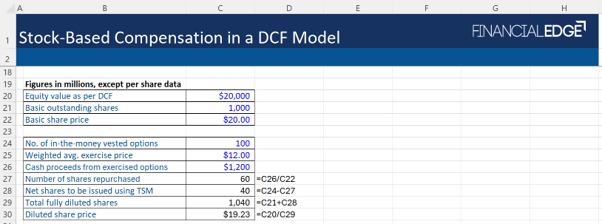
- Start with equity value per DCF: $20,000
- Basic shares outstanding: 1,000
- Assume the share price is $20, which is total equity per DCF / basic outstanding shares
- Take the vested in-the-money options: 100, weighted avg. exercise price of $12
- Assume they are exercised. The company collects 100 × $12 = $1,200 in cash proceeds
- Assume the cash is used to repurchase shares at $20: $1,200 / $20 = 60 shares bought back
- Net new shares that must be created = 100mm − 60 = 40
- Diluted shares = 1,000 + 40 = 1,040
- The diluted value per share = $20,000 / 1,040 = $19.23, versus $20.00 undiluted.
Calculating the fully diluted share count requires aligning your share additions perfectly with how you modeled your cash flows. It takes the form of using the treasury stock method to net out the impact of vested options, while explicitly excluding unvested and future grants if you already expensed them on the income statement. This matters because double-counting both the cash flow expense and the share count dilution will severely and unfairly undervalue the business.
Stock-Based Compensation (SBC) vs. Depreciation & Amortization (D&A)
While Stock-Based Compensation (SBC) and Depreciation & Amortization (D&A) are both classified as non-cash expenses on the income statement, they represent fundamentally opposite economic realities: D&A is a backward-looking allocation of a historical cash outflow, whereas SBC is a real-time transfer of wealth that actively dilutes existing shareholders.
Analysts frequently fall into the trap of treating these two line items identically and adding both back to calculate FCFF simply because they do not trigger immediate cash disbursements. This is a fundamental modeling error. D&A must be added back to free cash flow to prevent double-counting a capital expenditure (capex) where the physical cash already left the business in a prior period when that capex was made. SBC, conversely, acts as a direct substitute for cash compensation today. The company is issuing permanent claims on its future equity to fund its current payroll. If you add SBC back to your cash flows alongside D&A, you are explicitly modeling that the company acquired this employee labor at zero economic cost.
SBC and D&A are not the same because D&A accounts for physical cash spent in the past, while SBC gives away real company equity today to cover payroll. This matters because if you add SBC back into your cash flows, you are falsely treating shareholder dilution as free cash flow, which will cause you to severely overvalue the business.
How SBC Distorts EBITDA Multiples in a Comps Valuation
EBITDA multiple distortion in comparable company analysis (comps) occurs when management adds back SBC to report an inflated non-GAAP adjusted EBITDA, artificially deflating the valuation multiple to make the company appear cheaper to investors.
The Valuation Illusion
In the EV/EBITDA ratio, adding SBC back to the denominator makes the reported EBITDA artificially large. Mathematically, because the numerator (Enterprise Value) remains constant, this larger denominator forces the resulting multiple down. This allows a company that pays its workforce heavily in stock to appear as a “bargain” compared to peers who pay 100% in cash.
Normalizing the Peer Group
To run an accurate comps analysis, analysts must avoid using adjusted EBITDA as is and revert to “SBC-loaded EBITDA”. This requires deliberately deducting the SBC expense across the entire peer group, forcing cash-paying and stock-paying companies onto a level economic playing field.
Example
- Company A (the cash payer): Holds an enterprise value of $1,000 with a true EBITDA of $100 and $0 in SBC. The multiple sits cleanly at 10.0x
- Company B (the stock payer): Holds the exact same enterprise value of $1,000, and generates the same true EBITDA of only $100. Management adds back $20 of SBC to claim an “adjusted EBITDA” of $120
- The Trap: At first glance, the reported multiple of 8.3x for Company B makes it look cheaper than Company A
- The Reality: The normalized multiple ($1,000 / $100) is actually 10.0x. Once you account for the economic cost of SBC, Company B is not trading at a discount to Company A, rather both are available at the same valuation multiple
SBC severely distorts EBITDA multiples because companies add it back to artificially expand their margins and disguise the true cost of their valuation. This matters because explicitly deducting SBC guarantees an honest, apples-to-apples comparison, preventing analysts from overpaying for a business masking its true payroll costs with equity.
How PE Firms Treat SBC in an LBO Model
The treatment of SBC in a Leveraged Buyout (LBO) model dictates how private equity (PE) firms account for employee equity pools when assessing physical debt capacity versus the true economic cost of eventual exit returns.
Cash Flow vs. Economic Cost (The Dual Treatment)
LBO models require a bifurcated approach to SBC.
- When calculating Cash Flow Available for Debt Service (CFADS), PE firms often treat SBC as a non-cash add-back because their immediate priority is tracking physical liquidity to prevent a debt default.
Note: The adjusted EBITDA figure mentioned above already has the SBC expense added back.
- However, when evaluating the company’s valuation and returns, they treat it as a economic cost, recognizing they will have to replace public RSUs with cash bonuses or a new private equity pool post-close. The moment a company goes private, its public SBC program is terminated. To replace it, sponsors incorporate a ‘Management Option Pool’ (MOP) to align management’s incentives with the sponsor’s aggressive five-year exit timeline
The Dilution Impact on Sponsor Returns at Exit
This newly created management pool is not free. When the PE firm eventually sells the business in Year 5, the accrued value of the management pool is calculated and deducted directly from the sponsor’s total equity proceeds. This dilution inflicts a direct penalty on the PE firm’s final internal rate of return (IRR) and multiple on invested capital (MOIC).
PE firms treat SBC in an LBO model by dismantling the public equity plan and replacing it with a heavily structured management equity pool. It takes the form of adding the expense back to measure near-term debt capacity, while deducting the final equity payout from the sponsor’s exit proceeds. This matters because failing to physically model this post-acquisition equity payout will cause a sponsor to vastly overstate their projected IRR and miscalculate their actual cash returns at exit.
Conclusion
Stock-Based Compensation is never a free resource; it is a direct transfer of wealth from existing shareholders to employees. Whether you are projecting cash flows in a DCF, normalizing EBITDA for a peer comparison, or calculating exit returns in an LBO, SBC represents a true economic burden that must be accounted for. Treating it as a harmless non-cash add-back is the fastest way to artificially inflate a company’s valuation and miscalculate its true profitability.
Additional Resources
- Investment Banking Courses
- M&A Explained
- Free Cash Flow to Firm
- Discounted Cash Flow (DCF) Valuation
- Gordon Growth Model (GGM)
- Earnings Before Interest, Tax, Depreciation and Amortization (EBITDA)
- Stock-Based Compensation (SBC) – A complete guide
- How to Model Stock-Based Compensation