
Send download link to:Fixed Income Workout
Recommended Course

Fixed Income Careers
April 14, 2026
What Is Fixed Income in Asset Management?
Fixed income is an investment asset class that aims to provide predictable cash flows, typically in the form of interest payments and return of the principal at maturity. Such instruments include government bonds, corporate bonds, and other credit products such as high-yield bonds, leveraged loans, asset-backed securities (ABS), and collateral loan obligations (CLO).
Within asset management, fixed income teams are typically responsible for generating stable and consistent returns while also putting a strong focus on managing downside risk, and particularly credit risk (default), interest rate risk, and spread risk (i.e., the changes in credit spreads). Unlike riskier asset classes such as equities, where the upside potential is often the focus, fixed income has more bounded upside, with a stronger emphasis on capital preservation and downside risk management.
At a high level, fixed income professionals evaluate the creditworthiness of issuers, the interest rate outlook, and macro conditions, and relative value across securities and yield curves. This makes the asset class particularly relevant for institutional investors, such as pension funds and insurers, that require stable income streams and liability matching.
Key Learning Points
- Roles in fixed income span across different areas such as research, trading, portfolio management, and risk
- The skillset that these roles require combines credit analysis, understanding of macro drivers and quantitative tools
- Compensation could be very competitive, especially at senior levels
- The career path is relatively structured, but progression is competitive and heavily dependent on individual performance, as well as team dynamics, tenure, and turnover
Types of Fixed Income Roles in Asset Management
Fixed income roles can broadly be grouped into investment, trading, and support functions. While each of those has distinct responsibilities, all of them require strong knowledge of risk management, macro and interest rate dynamics, as well as analysing relative value across instruments.
Fixed Income Research Analyst (Credit Analyst)
A credit analyst is generally responsible for evaluating whether issuers are likely to meet their debt obligations and if their bonds adequately compensate for the risk. This involves:
- analysing financial statements
- capital structures
- assessing default probabilities
- potential recovery values
Analysts spend a lot of their time on identifying downside risks, such as refinancing pressure or covenant breaches, and comparing issuers within a sector to identify relative value. Their output usually takes the form of investment recommendations that feed directly into portfolio management decisions.
Portfolio Manager
The portfolio managers are responsible for allocating capital across different bonds and credit instruments to achieve specific risk and return objectives. The role involves constructing portfolios and managing risk by taking into account macroeconomic conditions, interest rate expectations, and the broader market trends. Portfolio managers often combine top-down views (for example, duration positioning) with bottom-up security selection (which is based on the recommendations of analysts). They are responsible for the ongoing portfolio and performance monitoring and adjusting exposures in response to changing market conditions.
Fixed Income Trader
Fixed income traders on the buy-side typically operate in fast-moving market environments and are responsible for executing trades on behalf of portfolio managers. Rather than making markets, their role is focused on achieving best execution, managing transaction costs, and sourcing liquidity across dealers. They work closely with portfolio managers and analysts to implement investment decisions efficiently, often navigating less liquid markets such as corporate bonds. This requires a strong understanding of pricing, bid-ask spreads, and market depth, as well as the ability to react quickly to macroeconomic developments and changing market conditions.
Quantitative & Risk Roles
Quantitative and risk professionals support the investment process by developing models and analytical methods to price securities and measure risk exposures. This includes calculating metrics such as duration, convexity, and credit sensitivity, as well as running scenario analyses and stress tests. These roles play an important part in ensuring portfolios are aligned with risk limits and regulatory requirements and typically work alongside portfolio managers.
Skills Required for Fixed Income Careers
The skills required for a career in fixed income include a blend of technical, analytical, and market-driven capabilities. In practice, professionals must be able to link different macro developments such as interest rate changes or inflation surprises to bond pricing and credit spreads, while at the same time interpreting issuer-level fundamentals. This combination allows them to identify relative value opportunities and manage risk across different market environments. Below, we look into these core skills.
- Credit Analysis & Financial Modelling
Credit analysis and financial modelling involve understanding leverage, coverage ratios, and cash flow dynamics. Analysts should be able to model downside scenarios such as restructuring or default
- Macro & Rates Knowledge
Interest rates are a primary driver of bond prices. Professionals must be familiar with:
- Central bank policy – for example anticipating a Federal Reserve rate hike and positioning for higher Treasury yields
- Inflation expectations – higher expected inflation generally leads to rising bond yields and falling prices, all else equal
- Yield curve dynamics – identifying a steepening curve and positioning in short versus long maturities
- Quantitative Skills
Quantitative skills require strong knowledge of key concepts such as:
- Duration and convexity (measuring how sensitive a bond’s price is to changes in interest rates and how that sensitivity changes as rates move)
- Spread analysis (evaluating the extra yield a bond offers over a benchmark to assess relative value and credit risk)
- Scenario analysis and stress testing (assessing how a bond or portfolio performs under different economic or market conditions, such as rate shocks or credit deterioration)
- Communication Skills
Fixed income professionals frequently communicate complex ideas to clients and internal stakeholders. Traders, in particular, must explain strategies clearly and build relationships
- Attention to Detail & Risk Awareness
Small errors in pricing or assumptions can materially impact returns. A strong risk mindset is critical, given the asymmetric payoff profile of bonds
A Typical Day of a Fixed Income Analyst
The day-to-day responsibilities of a fixed income analyst may vary, but typically follow a structured workflow such as the one below. However, workload and pace can increase significantly around key macroeconomic data releases (e.g., inflation, employment) and central bank decisions, when markets are more volatile and require closer monitoring.
Morning
The day typically begins with reviewing overnight market moves, including changes in rates, credit spreads, and key macro data releases. Analysts then read research reports and news affecting issuers or sectors under their coverage (an analyst is typically assigned a specific segment of the market to focus on) to identify any new risks or opportunities. They also update their models to reflect new information and ensure valuations and recommendations remain in-line with the existing views.
Midday
During midday, analysts attend internal meetings with portfolio managers and traders to discuss market developments and portfolio positioning. They may also participate in calls with company management or sell-side analysts to gather additional insights. A significant portion of their time is spent conducting deep-dive credit analysis, often focusing on specific issuers or sectors.
Afternoon
In the afternoon, analysts refine and update investment recommendations based on their analysis and discussions. This includes preparing reports or presentations for internal use or investment committees. They also monitor portfolio exposures and key risk metrics to ensure alignment with the predetermined investment objectives and risk limits.
Late Day / Close
Towards the end of the day, analysts assess market movements and pricing changes to understand how positions have evolved. They summarise key insights and communicate them to the broader team, helping inform positioning for the next trading day.
The day is usually more fast-paced in trading roles, with constant monitoring of markets and execution of trades. For example, rates traders deal with instruments such as government bonds and interest rate swaps, reacting in real time to market movements and macro events.
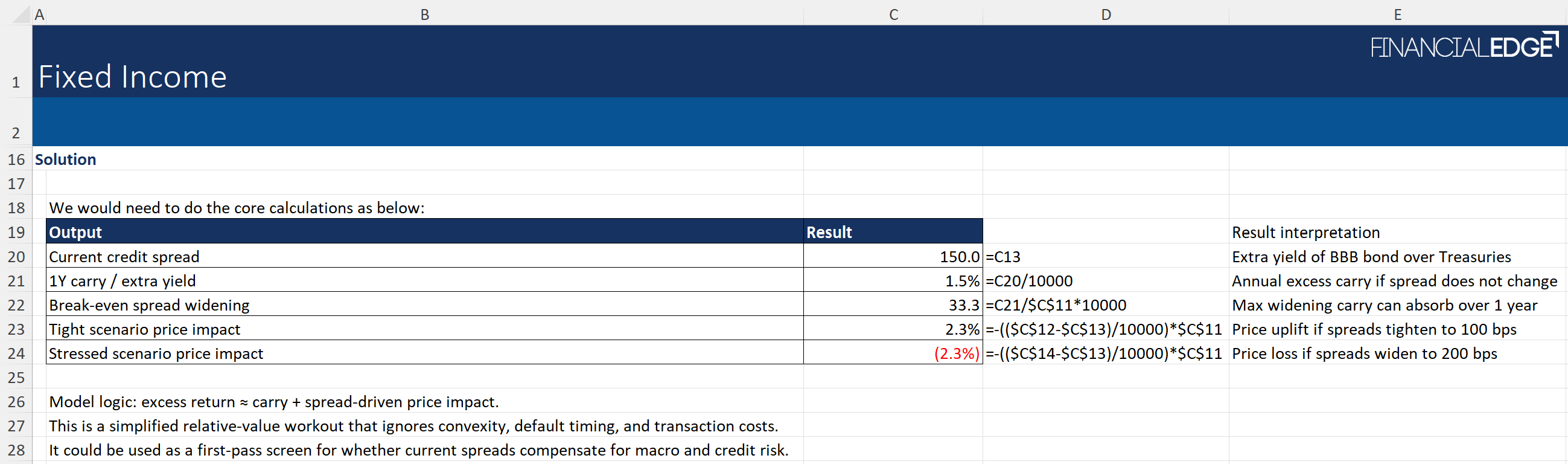
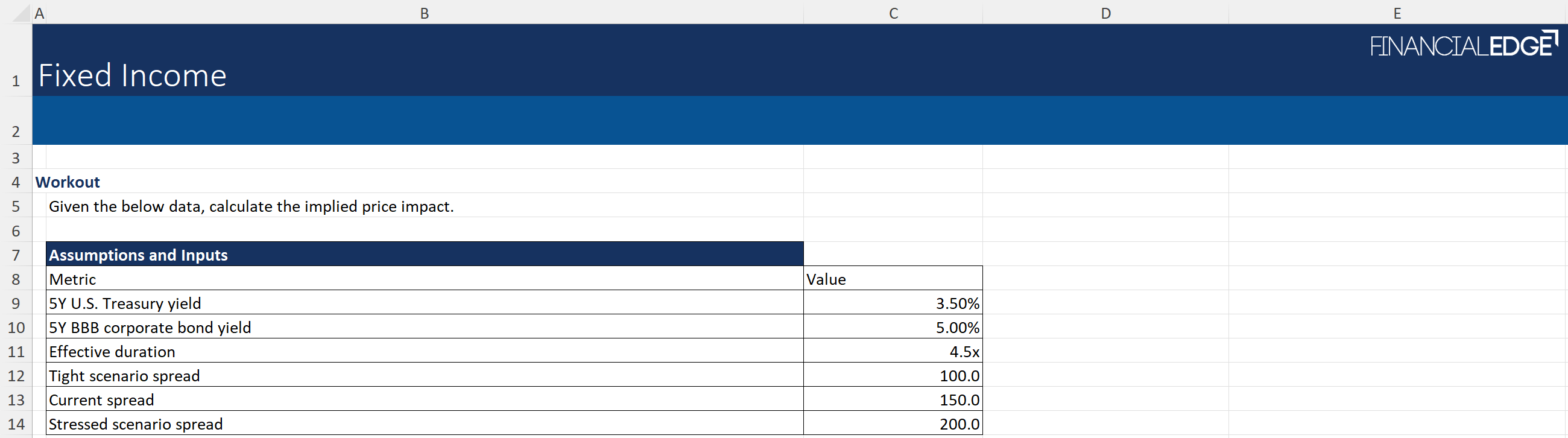
Mini Case Study: Relative Value of BBB Corporate Bond vs U.S. Treasury
Download the example workout, a mini case study of the relative value of BBB corporate bond vs U.S. Treasury.
Fixed Income Vs Equities Careers
While fixed income and equities involve financial analysis, there are some key differences. They generally derive from the underlying payoff structures and market dynamics, with fixed income roles typically paying more attention on risk and capital preservation, while equities often emphasise growth and valuation upside. This distinction shapes not only how investments are analysed, but also how portfolios are constructed and managed on a day-to-day basis. In the table below, we outline some of these differences.
Aspect |
Fixed Income |
Equities |
| Primary Focus | Downside risk, default probability | Growth and upside potential |
| Valuation | Yields, spreads, credit metrics | Earnings, multiples, growth |
| Time Horizon | Often shorter to medium-term | Medium to long-term |
| Market Drivers | Interest rates, credit conditions | Earnings, sentiment, innovation |
| Payoff Profile | Asymmetric (limited upside, with greater focus on capital preservation and downside risk) | More symmetric with potentially uncapped upside |
| Client Base | Institutional-heavy (pensions, insurers) | Broader (both retail and institutional) |
Compensation in Fixed Income Roles
Compensation in fixed income roles can vary significantly by role, experience, and firm. Below is a rough guidance of what candidates should expect.
| Level | Role Examples | London Base (£) | US Base ($) | Bonus Drivers |
| Entry-Level | Analysts | £30,000 – £50,000 + bonus | $80,000 – $120,000 + bonus | Trading performance Portfolio returns Revenue generation |
| Mid-Level | Associates & Senior Analysts | £60,000 – £120,000 + bonus | $120,000 – $200,000 + bonus | |
| Senior | Traders & Portfolio Managers | £100,000 – £250,000+ total comp | $200,000 – $500,000+ total comp |
Compared to equities, compensation in fixed income can be slightly lower at junior levels but highly competitive at senior levels, particularly in trading and portfolio management.
Career Path and Progression
A typical fixed income career progression usually follows the below path.
Analyst (0–3 years)
- Primary responsibilities include financial modelling and research
- The role is focused on supporting senior analysts or portfolio managers
Associate (3–6 years)
- They are given more ownership of coverage than analysts
- Associates often have more access to interact with portfolio managers
Senior Analyst / Vice President (6–10 years)
- Senior analysts lead coverage of sectors
- They directly influence investment decisions through expressing opinions with portfolio managers
Portfolio Manager / Director (10+ years)
- They have the ultimate responsibility for portfolio management and performance
- Responsible for strategic (and usually tactical, where applicable) asset allocation decisions
It is worth noting that progression can be slower in some institutions due to lower turnover and longer tenure of senior professionals.
How to Get a Job in Fixed Income?
Breaking into fixed income is competitive but achievable with a structured approach. The academic background for candidates typically comes from quantitative (such as mathematics or physics) or finance-related disciplines. Relevant experience is very important, with internships in asset management or investment banking (particularly in credit or DCM) roles providing exposure to fixed income markets and investment processes. These roles help candidates develop practical skills such as financial analysis, market monitoring, and communicating investment ideas.
Candidates should also have a solid understanding of core fixed income concepts such as bond pricing and yield calculations, credit ratios and capital structures, and key macroeconomic drivers. This translates into the ability to interpret how changes in interest rates, spreads, or issuer fundamentals impact valuations and investment decisions.
Pursuing professional credentials and certifications is also a differentiator include Chartered Financial Analyst (CFA), Financial Risk Manager (FRM), The Portfolio Manager Certification. Last but not least, as recruitment is often less structured than in investment banking, especially for research roles, networking and industry relationships are important.
Exit Opportunities from Fixed Income Careers
Fixed income provides a strong analytical foundation, and the skills it builds are highly transferable. In practice, the deep understanding of how capital structures, interest rates, and liquidity conditions interact, are applicable across both public and private markets. As a result, professionals are well-positioned to transition into a variety of adjacent roles within investment. Common exit opportunities include:
- Hedge funds (particularly credit or macro-focused strategies)
- Private credit or direct lending roles focused on structuring and underwriting loans
- Investment banking roles in credit or debt capital markets (DCM)
- Risk management positions at banks or asset managers
- Broader multi-asset investing roles where fixed income expertise is combined with equities and other asset classes
However, while exits exist, fixed income professionals often stay longer in their roles due to specialized expertise and stable career progression.
Conclusion
To sum up, fixed income roles offer a compelling path for those interested in macroeconomics, credit risk, and capital markets. They may often receive less attention than equities or investment banking but provide strong technical foundations and attractive long-term compensation.