Full Time Equivalent Calculator
Send download link to:
Recommended Course

Full Time Equivalent (FTE)
May 29, 2026
What is Full Time Equivalent?
Full Time Equivalent is a unit of measurement used to express employee working hours in terms of full-time employees. Rather than counting the number of individuals employed, FTE measures the amount of labor capacity represented by those employees. This distinction is important because businesses often employ a mix of full-time, part-time, temporary, and contract workers. Two companies with the same employee headcount may have very different workforce capacities depending on the hours worked by employees.
Key Learning Points
- FTE converts employee working hours into the equivalent number of full-time employees, allowing businesses to measure workforce capacity more accurately than headcount alone
- The standard FTE formula divides total employee hours worked by the number of hours considered full-time for the same period
- Companies may use different full-time hour assumptions, such as 35, 37.5, or 40 hours per week, which can materially affect FTE calculations
- Analysts frequently use FTE metrics in budgeting, financial modelling, productivity analysis, workforce planning, and labor efficiency assessments
How to Calculate Full Time Equivalent (FTE)
Full Time Equivalent is a standardized measure of employee workload. It converts the total hours worked by full-time and part-time employees into the equivalent number of full-time employees. The basic approach is straightforward – add together the total hours worked by employees over a defined period and divide that figure by the number of hours one full-time employee would work during the same period. A common full-time benchmark is 40 hours per week, or 2,080 hours per year, although companies may use different standards depending on their internal employment policy.
This general methodology is widely used by government agencies and regulatory bodies because it standardizes workforce capacity into a comparable metric. For example, the Internal Revenue Service (IRS) in the USA uses FTE calculations under the Affordable Care Act (ACA) for employer compliance purposes. Under ACA rules, a full-time employee is generally defined as an employee working on average at least 30 hours of service per week or 130 hours of service per month (Irs.gov. 2017). This means companies may use different FTE assumptions for financial analysis versus regulatory compliance, while public-sector organizations and statistical agencies also frequently use FTE metrics in labor market analysis.
As an example, if a company defines full-time employment as 40 hours per week, an employee working 40 hours per week equals 1.0 FTE, whereas an employee working 20 hours per week equals 0.5 FTE.
Full Time Equivalent Formula (FTE)
The general FTE formula is:
FTE = (Total Hours Worked)/(Full-Time Hours)

Where:
Total Hours Worked = total hours worked by all employees during the period
Full-Time Hours = number of hours one full-time employee would work during the same period
For a weekly calculation:
Weekly FTE =( Total Weekly Hours Worked)/(Standard Full-Time Weekly Hours

For an annual calculation:
Annual FTE = (Total Annual Hours Worked )/(Standard Full-Time Annual Hours)

If a company defines full-time employment as 40 hours per week, annual full-time hours are typically calculated as:
40 hours × 52 weeks = 2,080 hours
Therefore:
Annual FTE = (Total Annual Hours Worked)/2,080

The 2,080-hour benchmark is widely used in annual FTE calculations in the United States and in many financial modelling contexts.
Full Time Equivalent Calculation Step-by-Step
The FTE calculation process can be broken down into the following four steps.
1. Define the Full-Time Work Schedule
First, determine how many hours count as full-time employment. While many companies use a 40-hour workweek, some organizations define full-time work as 35, 37.5, or 38 hours per week. This assumption is important because it directly affects the FTE calculation.
Expert Instructor tip: Analysts should be careful when annualizing FTE hours because some companies exclude unpaid leave, overtime, or seasonal fluctuations from their calculations. As a result, two companies using the same employee headcount may report different FTE figures depending on how working hours are defined and adjusted throughout the year.
2. Select the Measurement Period
FTE can be calculated weekly, monthly, quarterly, or annually. The measurement period must remain consistent throughout the calculation.
For example:
- Weekly employee hours should be divided by weekly full-time hours
- Annual employee hours should be divided by annual full-time hours
Using inconsistent periods will produce incorrect results.
3. Calculate Total Employee Hours
Next, calculate the total number of hours worked by all relevant employees during the chosen period. Depending on the purpose of the analysis, this may include:
- Full-time employees
- Part-time employees
- Temporary staff
- Seasonal workers
- Contractors
For example, assume the following weekly employee hours:
| Employee | Weekly Hours |
| Employee A | 40 |
| Employee B | 40 |
| Employee C | 20 |
| Employee D | 15 |
| Total | 115 |
4. Divide by Full-Time Hours
Finally, divide total employee hours by the standard full-time hours.
If full-time employment is defined as 40 hours per week:
FTE = (115)/(40) = 2.875
The workforce therefore represents approximately 2.88 full-time equivalent employees.
FTE Calculation Example
Let’s assume a company employs the following workers:
| Employee Type | Number of Employees | Weekly Hours per Employee | Total Weekly Hours |
| Full-time employees | 6 | 40 | 240 |
| Part-time employees | 4 | 20 | 80 |
| Part-time employees | 2 | 10 | 20 |
| Total | 12 | 340 |
The company defines full-time employment as 40 hours per week.
The FTE calculation is:
FTE = (340)/(40) = 8.5
Although the business employs 12 individuals, its workforce capacity is equivalent to 8.5 full-time employees.
This distinction is important in financial analysis. Headcount measures the number of people employed, while FTE measures standardized labour capacity.
FTE vs Headcount Comparison
The below comparison illustrates why analysts often prefer FTE over headcount when evaluating labour efficiency, workforce utilization, and operating capacity.
| Workforce Structure | Headcount | FTE |
| 10 full-time employees | 10 | 10.0 |
| 20 part-time employees | 20 | 10.0 |
| 40 part-time employees | 40 | 10.0 |
Three companies may report very different employee counts while having exactly the same effective labour capacity.
In another example, a company may increase headcount while keeping FTE relatively stable if it hires additional part-time workers. Conversely, another business may maintain the same headcount but increase FTE if employees work more hours. Similarly, two firms with identical employee counts may still have materially different workforce capacities.
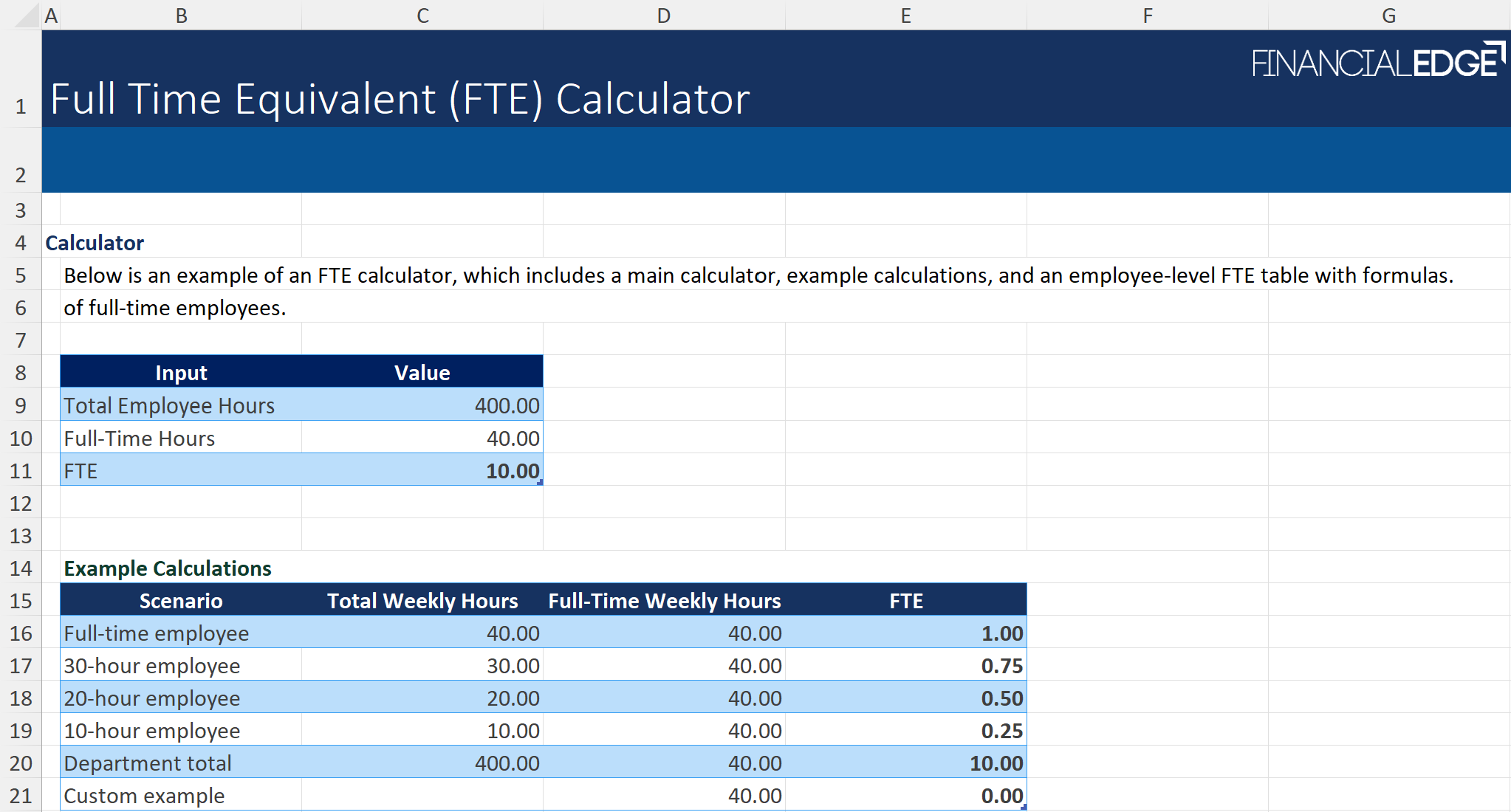
Full Time Equivalent (FTE) Employee Calculator
A simple FTE calculator requires two inputs:
- Total hours worked by employees
- Standard full-time hours for the period
Below is an example of a ready-to-use excel calculator.
Expert Instructor tip: When building workforce models in Excel, separate employee headcount assumptions from FTE assumptions. This improves transparency and allows analysts to model changes in part-time staffing ratios more effectively.
Full Time Equivalent Hours Per Week
FTE hours per week represent the number of weekly working hours associated with one full-time employee. The most common benchmark is 40 hours per week, although standards differ between industries, employers, and countries.
Using a 40-hour workweek:
| Weekly Hours Worked | FTE |
| 40 | 1.00 |
| 35 | 0.875 |
| 30 | 0.75 |
| 20 | 0.50 |
| 10 | 0.25 |
However, if the company defines full-time employment as 37.5 hours per week, the calculation changes:
| Weekly Hours Worked | FTE |
| 37.5 | 1.00 |
| 32 | 0.85 |
| 30 | 0.80 |
| 20 | 0.53 |
| 10 | 0.27 |
Expert Instructor tip: International Financial Reporting Standards (IFRS) and US Generally Accepted Accounting Principles (GAAP) do not prescribe one universal FTE calculation method, meaning companies may define FTE differently in management reporting or sustainability disclosures. Analysts should therefore review the company’s stated methodology before comparing workforce metrics across firms.
Conclusion
Overall, FTE is a valuable workforce metric because it standardizes labour hours into a comparable unit. It is widely used in budgeting, financial modelling, operational analysis, workforce planning, and productivity benchmarking where the economic capacity of labour matters more than simple employee headcount.