


Sortino Ratio Formula: How to Calculate It in Excel
March 9, 2026
What is Sortino Ratio?
The Sortino ratio is a risk-adjusted performance metric that measures an investment’s return relative to its downside risk. Unlike the Sharpe ratio, which penalizes both upside and downside volatility, the Sortino ratio considers only negative return volatility that falls below a target or minimum acceptable return. This makes it a more precise measure of risk-adjusted performance for investors concerned primarily with harmful downside fluctuations.
Under the modern portfolio theory, risk is typically determined by standard deviation, which penalizes both positive and negative deviations from the mean. In practice, investors are primarily concerned with downside outcomes, that is, returns that fall below a required or target level.
The Sortino ratio replaces total standard deviation with downside deviation and evaluates how much excess return a portfolio generates per unit of downside risk taken. Focusing exclusively on negative deviations from a specified threshold provides a more intuitive measure of risk-adjusted performance when loss aversion is fundamental to the analysis.
Sortino Ratio Formula

Variable definitions:
Rp = Return on the portfolio
Rt = Portfolio return in period t
MAR = Minimum acceptable return
od = Downside deviation
N = Total number of periods
Dt= Downside component in period t
Key Learning Points
- The Sortino ratio evaluates how much excess return a portfolio generates per unit of negative volatility
- Unlike the Sharpe ratio, the Sortino ratio penalizes only returns that fall below a chosen minimum acceptable return (MAR)
- It provides deeper insight for strategies where downside protection is important or where returns are not normally distributed
- For a comprehensive performance evaluation, the Sortino ratio should be considered alongside other metrics such as the Sharpe ratio, maximum drawdown, and other tail-risk measures
How to Calculate Sortino Ratio?
The calculation of the Sortino Ratio involves several steps:
Step 1: Obtain the Return Series
First, we need to collect the periodic returns (e.g., monthly or daily). We also need to ensure consistency in frequency when specifying the Minimum Acceptable Return (MAR).
Step 2: Defining the Minimum Acceptable Return (MAR)
This may be:
- The risk-free rate, such as the Treasury Bill Benchmark
- Zero – typical for capital preservation strategies
- A required rate of return – for example some retirement strategies may have a target annual return of 7%
- A mandate-specific hurdle rate – for example a hedge fund may have a specific hurdle rate (let’s say 6%) before performance fees apply
Step 3: Calculating the downside deviation for each period
Variable definitions are given below:
Dt={Rt−MAR,if Rt<MAR0,if Rt≥MAR}

We then need to square these negative deviations, average them across the sample, and take the square root:

Step 4: Calculating the excess return:

Step 5: Applying the sortino formula:

Consistency in the methodology (for example, whether to divide by total observations or only downside observations) should always be clearly stated, as it affects comparability.
Variable definitions:
Rp = Return on the portfolio
Rt = Portfolio return in period t
MAR = Minimum acceptable return
od = Downside deviation
N = Total number of periods
Dt= Downside component in period t
Instructor Tip: Instructor tip: Always match the time periods. If you are using monthly returns, the MAR must also be monthly. If you annualize returns, annualize downside deviation consistently (multiply return by 12 and downside deviation by √12). Mixing frequencies is a common calculation error.
What Is a Good Sortino Ratio?
A good Sortino ratio is generally considered to be above 1, indicating that an investment’s returns adequately compensate for downside risk. Ratios above 2 are typically viewed as strong, while ratios above 3 may indicate exceptional downside risk-adjusted performance.
The Sortino ratio measures how efficiently a portfolio converts downside risk into excess return. Specifically, it shows how much return above a minimum acceptable return (MAR) is earned for each unit of downside volatility.
Below are some general guidelines for interpreting the Sortino ratio:
- Sortino ratio > 1 – Returns are adequately compensating for downside risk
- Sortino ratio > 2 – Indicates strong downside risk-adjusted performance
- Sortino ratio < 1 – Excess returns may not sufficiently justify downside exposure
- Sortino ratio < 0 – The strategy is failing to meet its minimum performance objective
However, these thresholds should be viewed only as general reference points. The Sortino ratio is most meaningful when used in relative analysis, such as comparing portfolio managers within the same asset class and investment strategy or evaluating performance against an appropriate benchmark.
Importantly, the choice of MAR significantly affects interpretation. A higher MAR increases the likelihood that returns fall below the threshold, which increases downside deviation and consequently lowers the Sortino ratio. For this reason, the level and rationale for the selected MAR should always be clearly stated.
The Sortino ratio also does not capture extreme tail risk or maximum drawdowns. As a variance-based measure, it should be supplemented with other downside risk metrics, particularly for strategies with asymmetric return distributions.
Instructor Tip: Do not rely on this metric alone. Combine the Sortino ratio with other measures such as the Sharpe ratio, maximum drawdown, and tail risk metrics to build a more complete view of the strategy’s risk-adjusted performance.
Sortino Ratio Formula Excel
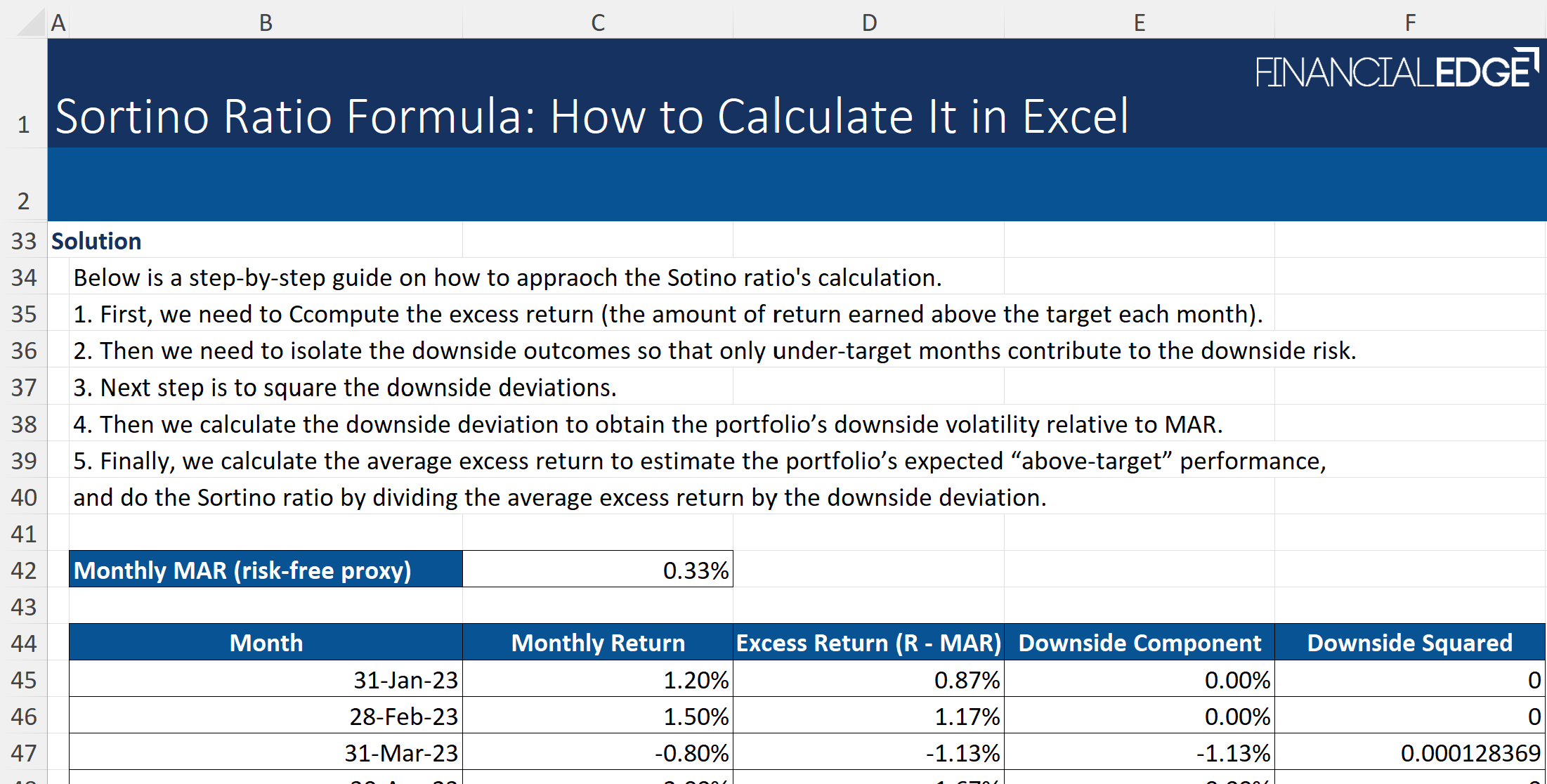
The Excel example below shows a step-by-step calculation of the Sortino ratio using monthly returns and a specific MAR.
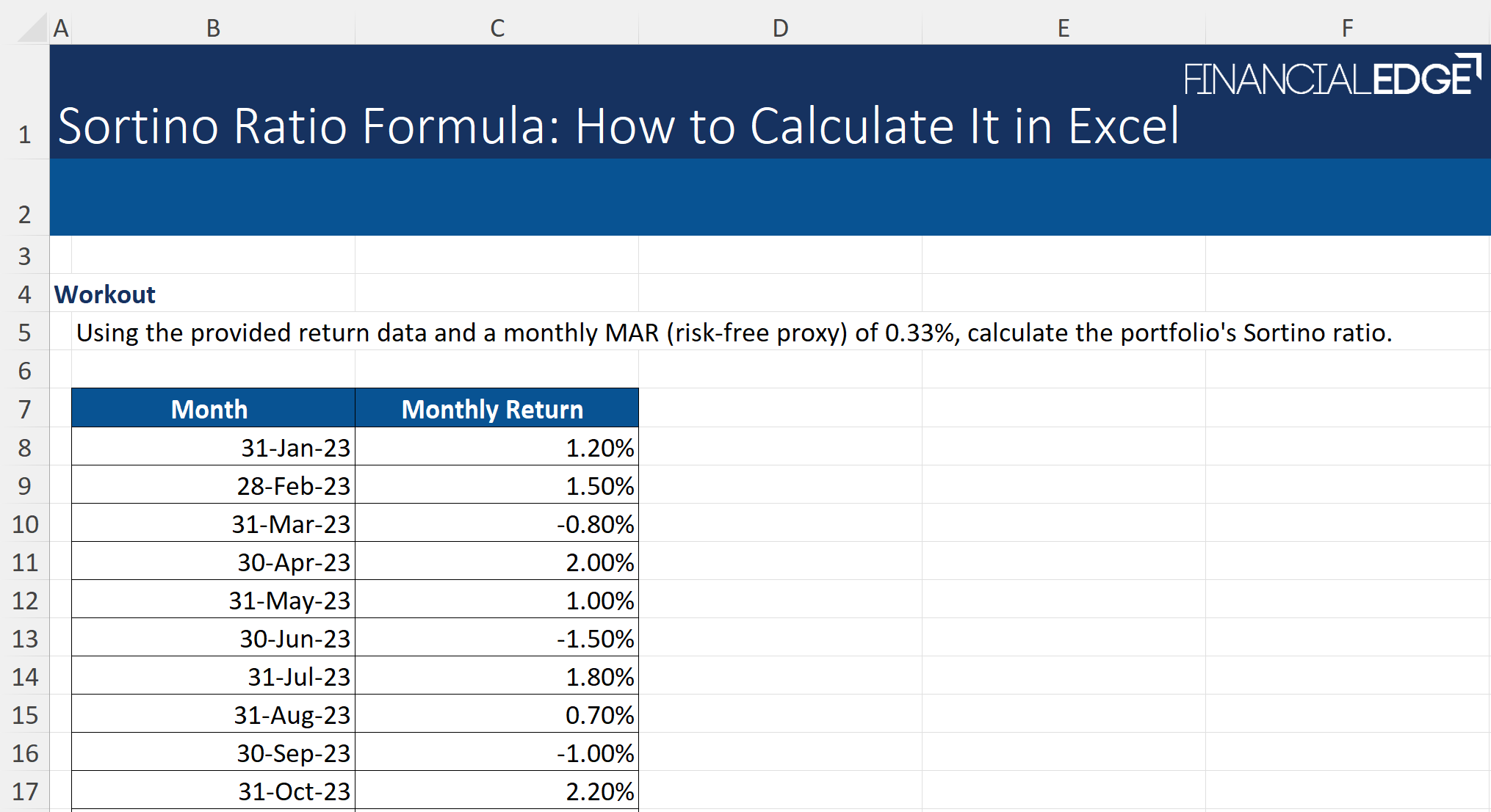
The example uses a conditional formula to isolate and square downside deviations (i.e. the downside component is only calculated when Excess Return is negative) and then computes downside deviation and divides average excess return by this value to arrive at the final Sortino ratio result.
Sortino Ratio vs Sharpe Ratio
The Sharpe ratio assumes that total variability is an appropriate measure of investment risk. This assumption is reasonable when returns are approximately normally distributed and investor preferences are symmetric with respect to volatility.
However, distributions in reality are often non-normal and exhibit skewness or fat tails (particularly in alternative investments or strategies involving options). In such cases, penalizing upside volatility may distort the real risk profile.
The Sortino ratio aims to correct this by isolating negative deviations from a specified target return. As a result, a portfolio with:
- High upside volatility but limited losses may have a modest Sharpe Ratio, but a strong Sortino ratio
- Infrequent but severe drawdowns may exhibit an acceptable Sharpe Ratio but a weak Sortino ratio
Therefore, the Sortino ratio is usually preferred when evaluating strategies where downside protection is a key objective.
Sortino Ratio vs Sharpe Ratio Formula
Both the Sharpe and the Sortino ratios measure excess return relative to risk, but the difference is in how risk is defined. The Sharpe ratio uses total volatility as the risk metric, treating upside and downside variability symmetrically.
Sharpe Ratio=Rp−Rfσp

Where:
- Rp= return on the portfolio
- Rf = risk-free rate
- op = standard deviation of portfolio returns
On the other hand, the Sortino ratio replaces standard deviation with downside deviation.

Where:
- MAR = minimum acceptable return
- od = downside deviation
The risk-free rate may also be replaced with a target or hurdle rate reflecting the investor’s objectives. The result is a measure that aligns more closely with downside risk preferences rather than overall dispersion.
Which is Better, Sharpe or Sortino?
Neither of the two metrics is universally superior and the appropriate choice depends on the context of the analysis. Generally, the Sharpe ratio is often favored when evaluating broadly diversified portfolios with rather normally distributed returns. Alternatively, if return distributions exhibit skewness and downside protection is key to the investment strategy, the Sortino ratio is normally preferred.
In practice, investors would often compute both metrics to provide a more complete view of the portfolio’s risk-adjusted returns. The Sharpe ratio is a general measure of the total risk-adjusted performance, while the Sortino ratio offers additional insight into downside exposure.
Instructor Tip: If using the metrics in isolation, watch for misleading signals. A strategy can exhibit a strong Sharpe ratio, but a weak Sortino ratio if downside losses are concentrated in fewer but larger drawdowns. Conversely, a high Sortino ratio may hide overall volatility. For robust analysis, investors would typically assess both metrics alongside others such as drawdown and tail-risk measures.
Conclusion
The Sortino ratio provides a refined view of risk-adjusted performance by isolating downside volatility rather than penalizing total variability. This makes it particularly valuable when loss aversion and capital preservation are among the objectives of an investment strategy. It provides essential insight into how efficiently a portfolio manages adverse outcomes, and when used alongside complementary risk metrics, it can offer a more robust overall assessment of the portfolio’s performance.