
Transaction Costs
Sign up to access your free download and get new article notifications, exclusive offers and more.

Transaction Costs
April 9, 2026
What are Transaction Costs?
Transaction costs are the expenses incurred when buying or selling a financial asset, such as stocks, bonds, or derivatives. These costs arise every time a trade is executed and can significantly impact overall investment returns. Transaction costs are broadly categorized into direct costs, including broker commissions, exchange fees, and taxes, and indirect costs, such as bid-ask spreads, price slippage, and market impact. While costs may seem small if looked at separately, their cumulative effect could meaningfully influence investment performance, particularly for active traders and institutional investors. Transaction costs can directly reduce net returns and alter the optimal investment strategy.
Key Learning Points
- Transaction costs are the expenses incurred when buying or selling a financial asset
- They are both explicit and implicit and combined they form the real cost of trading
- Implicit costs are often higher, particularly for large investors, as market impact and slippage can exceed visible fees when executing large or less liquid trades
- Transaction costs compound over time, meaning even small differences can lead to materially lower long-term investment returns
Transaction Costs in Investing Explained
Transaction costs are embedded in every stage of the trading process. When an investor decides to buy or sell a security, they rarely transact at a perfectly “fair” price and face several layers of costs. These include:
- The price difference between buying and selling (i.e. the bid-ask spread)
- Fees charged by intermediaries such as brokers and/or exchanges
- The impact of their own trades on market prices
For example, if a stock has a bid price of $99 and an ask price of $100, an investor buying and immediately selling would incur an implicit cost of $1 per share even before commissions. These costs are especially relevant in high-frequency trading, portfolio rebalancing, and strategies that involve high portfolio turnover.
Types of Transaction Costs
Transaction costs arise from multiple sources throughout the trade lifecycle. They can broadly be categorized based on whether they are directly observable or embedded within market pricing and execution dynamics. Each type reflects a different source of market friction, and together they form the total cost of trading.
Commissions and fees
These are the charges paid to brokers, exchanges, and clearing houses. For example, an investor trading UK equities through a retail broker may pay a flat fee of £5–£10 per trade, while institutional investors may pay a commission of c.1–5 basis points per transaction. In the US, many retail brokers now offer zero-commission equity trading, but institutional investors would still typically pay commissions. Exchange and clearing fees are typically embedded within these charges.
Taxes and duties
For example, stamp duty on equity purchases in certain jurisdictions. In the UK, investors purchasing shares listed on the London Stock Exchange are generally subject to Stamp Duty Reserve Tax (SDRT) of 0.5% of the transaction value. This represents a high explicit cost, particularly for long-term investors.
Bid-ask spread
This is the difference between buying and selling prices. For example, a highly liquid stock such as Apple (AAPL) may trade with a spread of less than 1 basis point under normal conditions, whereas a small-cap stock listed on the NASDAQ may exhibit spreads of 20–100 basis points or more due to lower liquidity.
Market impact costs
This is the price movement caused by executing large trades. For instance, a mutual fund portfolio manager attempting to buy $50 million worth of a mid-cap US equity may move the market as it consumes available liquidity, leading to a higher volume-weighted average execution price than the initial quoted price.
Slippage
This is the difference between expected and executed price. We will discuss this in more detail.
Explicit vs Implicit Transaction Costs
Transaction costs are often grouped into explicit and implicit components. Explicit costs are transparent and directly observable. Therefore, they are easy to measure and are typically disclosed upfront. Examples include brokerage commissions, exchange fees, and regulatory charges. On the other hand, implicit costs are less visible. They are more difficult to quantify but often represent the largest portion of total transaction costs, particularly for institutional investors executing large orders. Examples of implicit costs are the bid-ask spread, the market impact or slippage.
Bid-Ask Spread
The bid-ask spread is one of the most fundamental transaction costs in financial markets. The bid price is the highest price a buyer is willing to pay, whereas the ask price is the lowest price a seller is willing to accept. The spread between these two prices compensates market makers for providing liquidity and bearing risk.
For highly liquid assets such as large-cap equities or government bonds, spreads are typically narrow. In contrast, less liquid securities, such as small-cap stocks or certain fixed income instruments, can have significantly wider spreads.
The spread effectively represents an immediate loss to traders who cross it, making it a critical consideration for investors.
Market Impact Costs
Market impact refers to the effect that a trade has on the price of the asset being traded. When large orders are executed, they can move the market – buying pushes prices up and selling pushes prices down.
This is particularly relevant for institutional investors managing large portfolios. For example, attempting to buy a large block of shares may drive the price higher before the full order is completed, which would increase the average purchase price.
For example, let’s assume that a fund manager wants to buy 200,000 shares of a stock currently quoted at:
- Best ask: $50.00
- Available liquidity at $50.00: 50,000 shares
To complete the full order, the trader must buy across multiple levels of the order book (below).
| Price Level | Shares Available | Shares Bought |
| $50.00 | 50,000 | 50,000 |
| $50.05 | 70,000 | 70,000 |
| $50.10 | 80,000 | 80,000 |
In this case, the volume-weighted average price (VWAP) is:
((50,000 × 50.00) + (70,000 × 50.05) + (80,000 × 50.10)) / 200,000 = 50.06

Market Impact Cost Calculation
(Average execution price-Initial (decision) price) / (Initial (decision) price) × 10,000

or
(50.06 – 50.00) / 50,00 × 10,000 = 12bps

In this example, the investor incurs a 12-basis-point cost due to market impact, as the large order consumes liquidity and pushes the price higher during execution.
Overall, market impact could be influenced by:
- Trade size relative to market volume
- Market liquidity
- Execution speed
Managing market impact is a key objective in trade execution, particularly for institutional investors seeking to minimize implementation shortfall.
Slippage in Trading
Slippage occurs when a trade is executed at a different price than expected. This can happen due to various reasons such as elevated market volatility, delays in execution or insufficient liquidity.
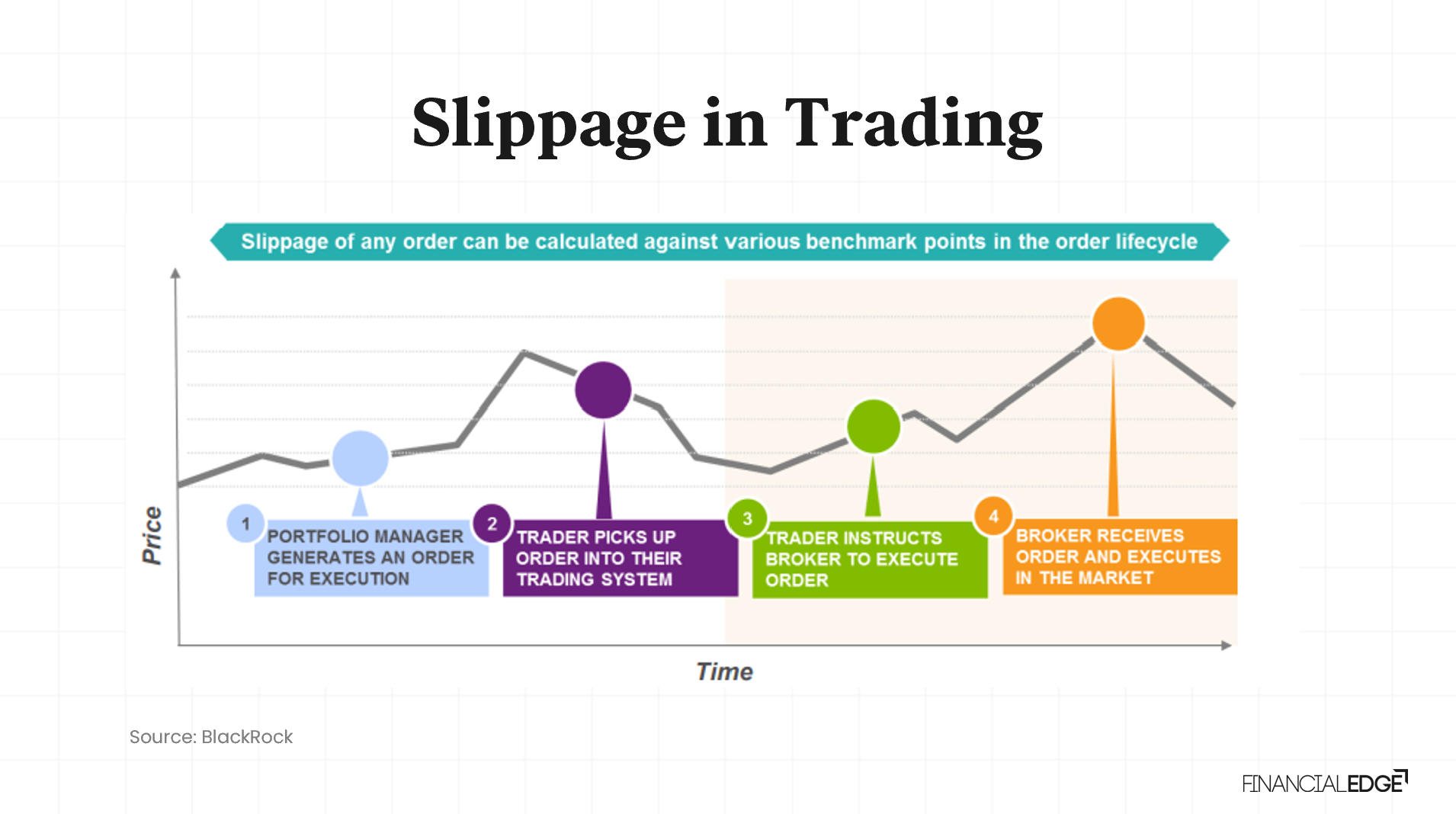
Technically, slippage can be expressed as per the formulas below:
Slippage (Buys) = ((Execution Price – Benchmark Price) / (Benchmark Price))

or:
Slippage (Sells) = ((Benchmark Price- Execution Price) / (Benchmark Price))

These two methods adjust the formula depending on trade direction to ensure that costs are always expressed as positive values. This approach is commonly used in transaction cost analysis (TCA) because it standardizes costs as positive numbers regardless of trade direction.
Below is an example of calculating slippage using the directional method.
A trader observes the following market just before submitting an order:
- Best bid: $100.00
- Best ask: $100.02
- Midpoint (benchmark price): $100.01
Buy Order Example
The trader submits a market order to buy 10,000 shares. Due to short-term volatility and limited liquidity at the top of the book, the order is executed at an average price of $100.05.
Slippage (Buy) = (100.05 – 100.01) / 100.01 = 0.0004

The trader incurs 4 basis points of slippage, as the execution price is above the benchmark.
Sell Order Example
If the trader submits a market order to sell 10,000 shares under similar conditions. The order is executed at an average price of $99.97.
Slippage (Sell) = (100.01 – 99.97) / 100.01 = 0.0004

The trader would again incur 4 basis points of slippage, as the execution price is below the benchmark.
Although the price movements are in opposite directions, both trades result in a positive slippage cost of 4 bps under the directional method. This standardization allows transaction cost analysis (TCA) frameworks to aggregate and compare execution costs consistently across buy and sell trades.
How Transaction Costs Affect Investment Returns
Transaction costs directly impact investment returns, and over longer time horizons their compounding effect can be substantial. Even small differences in costs, measured in basis points, can lead to materially different outcomes.
Impact of Transaction Costs Example
Consider an initial investment of $100,000 over 20 years, generating a 6% gross annual return.
- Without transaction costs (6% net return):
Final value = $320,714
- With transaction costs reducing returns by 1% (5% net return):
Final value = $265,330
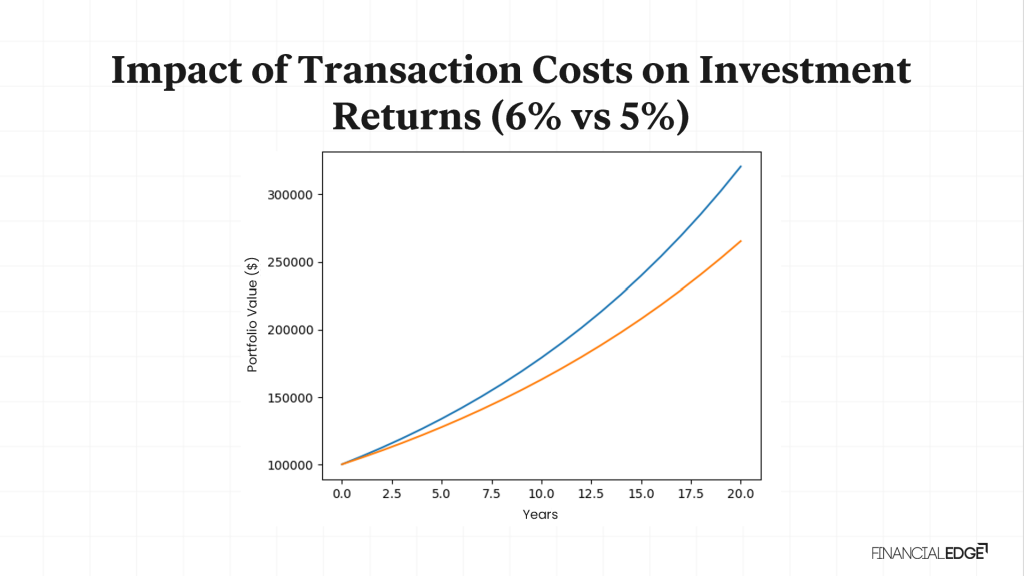
The difference is $55,384, meaning transaction costs reduce the final portfolio value by over 17%. This indicates that even a relatively small annual cost drag can lead to a substantial reduction in long-term outcomes.
Expert Instructor Tip: When evaluating performance, investors should always consider returns on a net-of-cost basis, because strategies that appear to generate alpha on a gross basis may underperform once transaction costs (particularly from high portfolio turnover) are fully incorporated. For example, a strategy generating 150 bps of gross outperformance with 200% annual turnover and 75 bps round trip trading costs would underperform on a net basis once execution costs are accounted for.
Transaction Cost Analysis (TCA)
Transaction Cost Analysis (TCA) is the process of measuring and evaluating the costs of executing trades by comparing actual execution prices to relevant benchmarks. It is used to assess execution performance, identify inefficiencies, and improve trading strategies through metrics such as implementation shortfall, effective spread, and market impact. The table below summarizes the key TCA metrics, their formulas, and how they are used to evaluate different components of execution costs. In practice, institutional investors typically rely on TCA to benchmark brokers, optimize execution, and meet best execution requirements under regulations such as the MiFID II.
| Metric | Formula | Interpretation | Practical Use |
| Implementation Shortfall | (Execution Price-Decision Price)/ Decision Price × 10,000 | Measures the total cost of execution relative to the investment decision, incorporating all explicit and implicit costs | Primary metric for assessing overall execution quality |
| Effective Spread | (Execution Price-Mid Price) / Mid Price × 2 × 10,000 | Represents the deviation of the execution price from the prevailing market mid-price at the time of execution, reflecting liquidity costs | Used to evaluate execution against prevailing market conditions |
| Realized Spread | (Execution Price – Mid Price (post trade)) / Mid Price × 2 × 10,000 | Assesses the extent to which execution prices reflect temporary versus permanent price movements following execution | Indicates adverse selection and liquidity provision quality |
| Market Impact | (Execution Price-Arrival Price) / Arrival Price × 10,000 | Captures the price movement attributable to the execution of the order itself, distinct from broader market movements | Evaluates the effect of order size and execution strategy |
| VWAP Slippage | (Execution Price-VWAP) / VWAP × 10,000 | Measures execution performance relative to a volume-weighted market benchmark over the execution horizon | Common benchmark for algorithmic execution strategies |
Transaction Costs Model Excel Example
In the Excel example below, we look into a simplified, single-sheet TCA model that combines order book inputs with key transaction cost metrics.
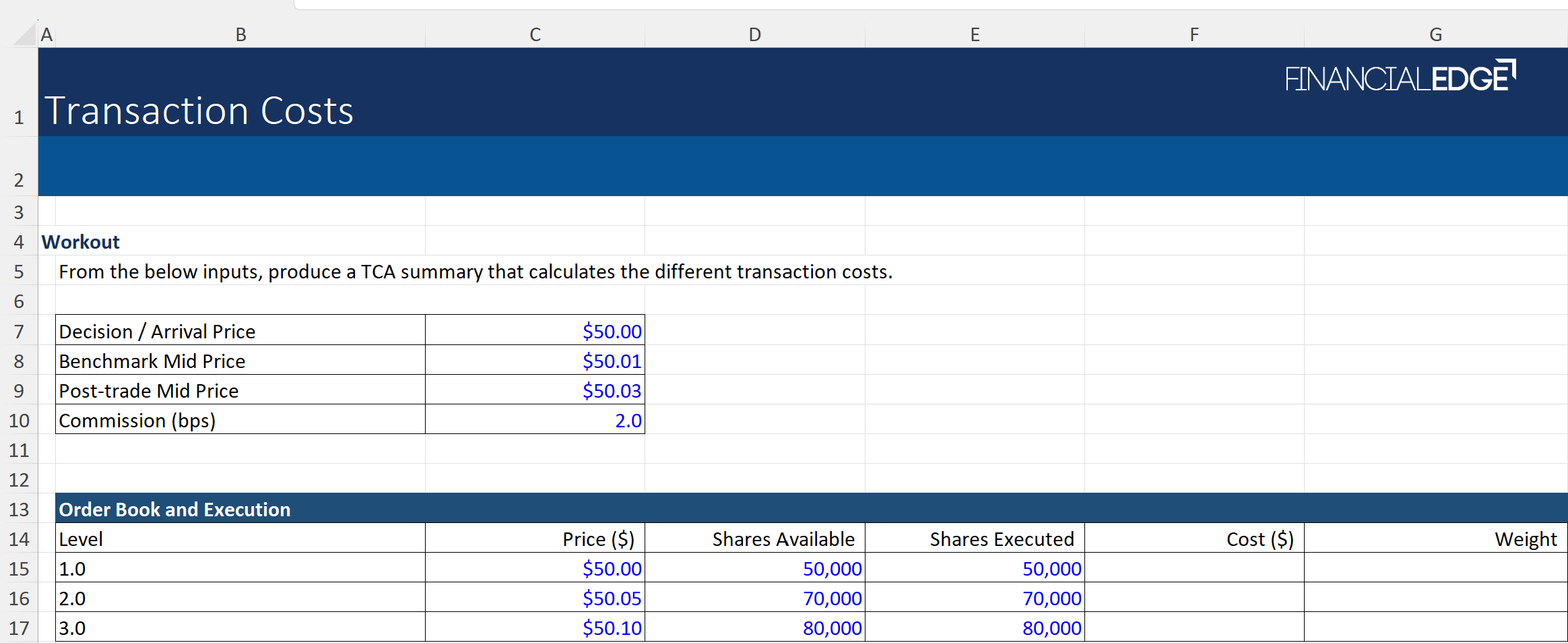
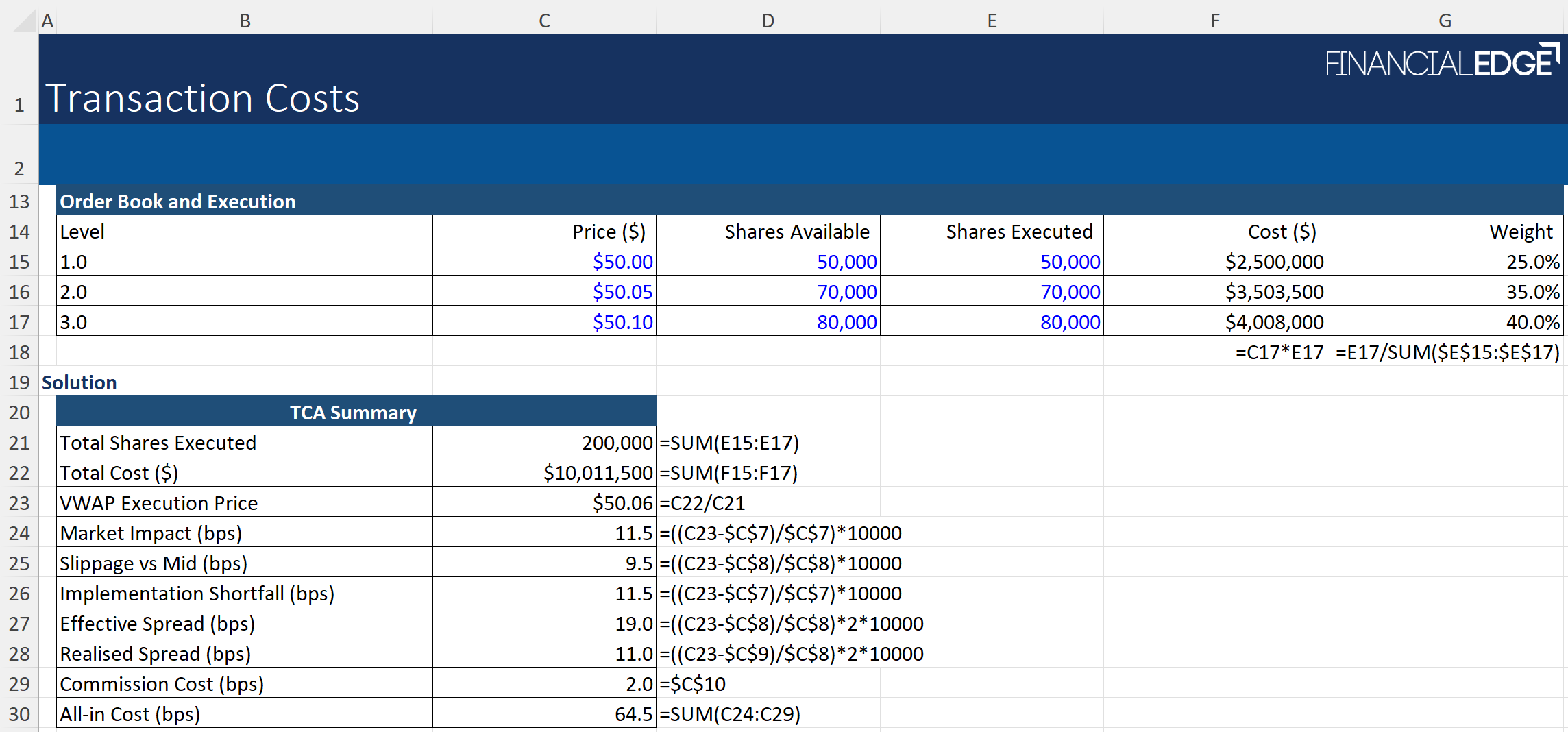
Expert Instructor Tip: When interpreting TCA results, investors should always compare metrics across similar trade conditions (e.g. trade size, liquidity, and volatility), as raw performance numbers can be misleading. For example, a 10 bps implementation shortfall on a large, illiquid small-cap trade may represent better execution quality than a 5 bps shortfall on a highly liquid large-cap stock, once differences in market conditions are taken into account.
Strategies to Reduce Transaction Costs
Investors could employ different strategies to minimize transaction costs. Examples include:
- Trade less frequently as reducing turnover lowers cumulative costs
- Use limit orders, which helps control execution prices
- Employ algorithmic execution that spreads trades over time to reduce impact
- Trade during liquid periods, which offers narrower spreads and better pricing
- Optimize trade size to avoid unnecessarily large market-moving orders
Transaction Costs Across Asset Classes
The table below provides indicative transaction cost ranges across major asset classes (expressed in basis points). It illustrates how liquidity, transparency, and market structure drive significant variation in trading costs.
| Asset Class | Illustrative Costs (basis points) | Key Drivers | Examples |
| Equities | 5–50 bps | Bid-ask spreads, commissions, market impact | Large-cap stocks at the lower end; small-cap significantly higher |
| Fixed Income | 10–100+ bps | Dealer mark-ups, low transparency, liquidity | Corporate and high-yield bonds tend to have higher costs than government bonds |
| Foreign Exchange (FX) | 0.1–10 bps | Tight spreads, deep liquidity | Major pairs such as the EUR/USD at around 0.1–1 bps; emerging markets higher |
| Derivatives | 1–20 bps | Contract liquidity, exchange and clearing fees | Futures are typically cheaper than over the counter (OTC) derivatives |
| Alternative Assets | 50–300+ bps | Illiquidity, complexity, negotiation costs | Private equity, real estate, infrastructure transactions can be highly variable |
Exchange-Traded vs. OTC Markets
In this video, we explain the difference between exchange-traded and OTC markets.
Conclusion
Overall, transaction costs are a very important part of the portfolio management process and represent a key determinant of net performance. If overlooked, they can significantly erode returns, particularly in strategies with high portfolio turnover or those investing in less liquid areas of the market.
To learn more about the whole portfolio management process, check out the Portfolio Manager Certification course.