
Send download link to:
Portfolio Diversification Workout

Portfolio Diversification
April 16, 2026
What is Portfolio Diversification?
Portfolio diversification is an investment strategy that involves spreading capital across a range of asset classes, sectors, and geographies to reduce the overall portfolio risk. The philosophy behind this is that not all assets move in the same direction at the same time. By combining assets with different return drivers and risk characteristics, investors can reduce the impact of any single asset’s poor performance on the total portfolio.
Diversification is formalized within Markowitz’s Modern Portfolio Theory (MPT), which demonstrates that portfolio risk depends not only on the risk of individual assets but also on how those assets interact with each other.
In practice, diversification is not about maximizing the number of holdings, but about combining assets with low or negative correlations, thereby improving the portfolio’s risk and return profile.
Key Learning Points
- Diversification is a concept in investing that aims to reduce portfolio risk by combining assets with low or negative correlations
- Portfolio risk depends on both volatility of individual assets and their interactions with other assets.
- Not all risks can be mitigated through diversification – idiosyncratic risks can be eliminated, but systematic risks cannot
- Metrics such as correlation, portfolio variance and risk-adjusted ratios can help assess levels of diversification
- Diversification can be implemented across asset classes, sectors, geographies, and factors
How Portfolio Diversification Works?
Portfolio diversification works through the interaction of asset return variability. When assets are not perfectly correlated, losses in one part of the portfolio may be offset by gains or stability in another. In other words, portfolio risk depends not only on how risky each asset is on its own, but also on how those assets behave relative to each other. If two assets tend to move in different directions more often, then a portfolio of these two assets would typically produce better risk adjusted returns than holding either asset in isolation.
For example, a portfolio invested entirely in equities would be fully exposed to equity risk and may experience significant losses if equity markets fell. If part of the portfolio is instead allocated to government bonds, which often perform better during periods of equity market stress, the overall portfolio decline may be reduced. The bond allocation helps offset losses from equities, resulting in smoother overall performance.
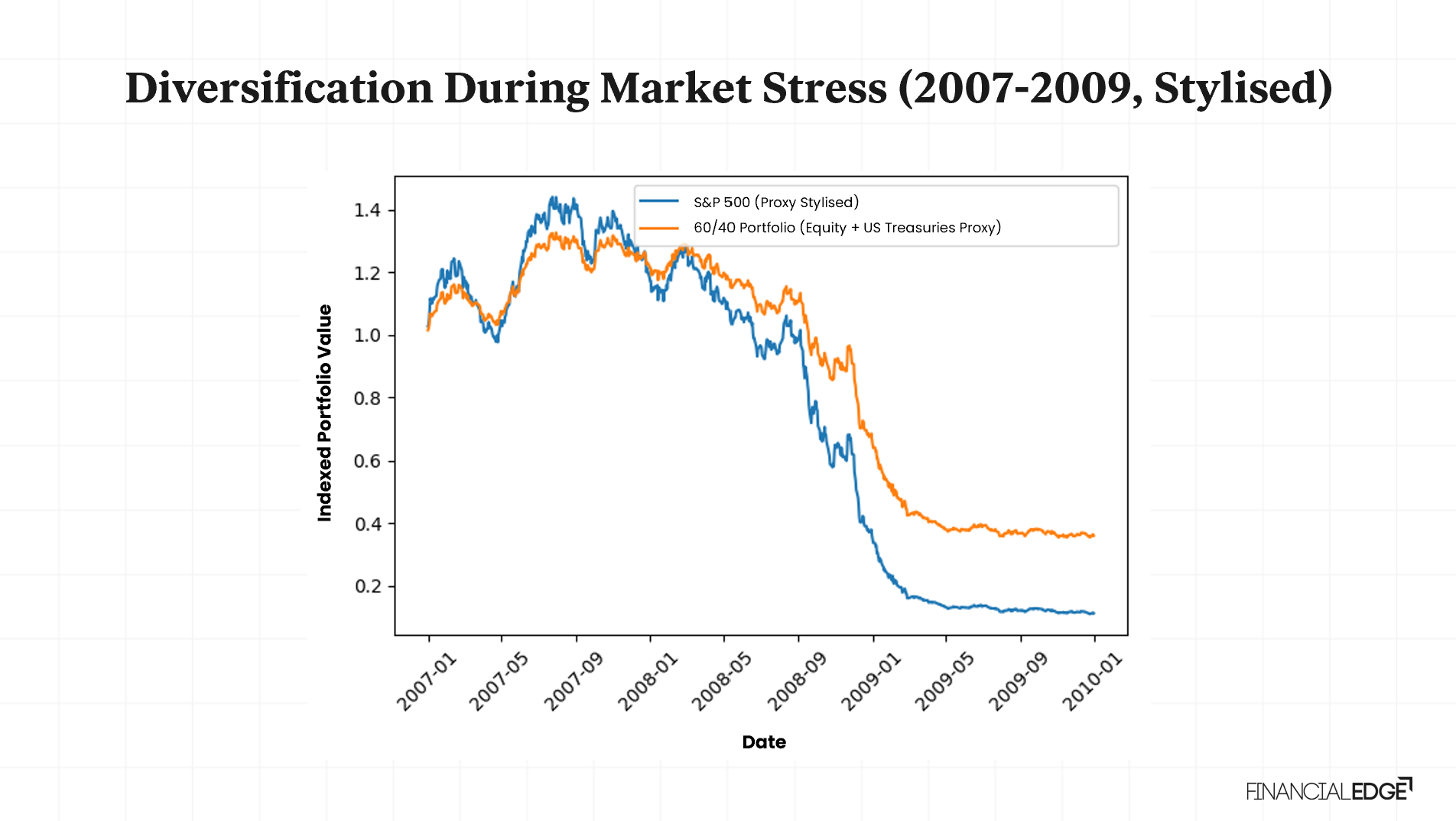
The above chart shows the effect of diversification during market stress (stylized example based on 2007–2009 dynamics). The equity proxy line reflects behavior similar to the S&P 500 Index, while bonds reflect the characteristics of US Treasuries. As seen from the chart:
- A 100% equity portfolio, showing larger fluctuations and deeper drawdowns
- A 60/40 equity–bond portfolio, showing smoother movements and smaller declines
The diversified portfolio exhibits lower volatility and less severe drawdowns, even though both portfolios are exposed to market risk.
The strength of diversification, therefore, depends on the relationship between assets. The less closely assets move together, the greater the potential diversification benefit.
It should be noted that diversification is primarily intended to reduce portfolio volatility rather than eliminate downside risk altogether, particularly during systemic market events.
Instructor Tip: “In practice, asset relationships are not stable. During periods of market stress, correlations tend to increase (“correlation breakdown”), which can reduce diversification benefits when they are most needed.”
Diversifiable vs. Non-Diversifiable Risk
Total portfolio risk can be decomposed into two components: diversifiable (idiosyncratic) risk and non-diversifiable (systematic) risk.
Diversifiable risk refers to risks specific to individual securities, such as company earnings surprises, management decisions, or sector-specific shocks. This type of risk can be reduced—or even largely eliminated—through diversification.
Non-diversifiable risk, on the other hand, arises from broader macroeconomic factors such as interest rates, inflation, or geopolitical events. This risk affects the entire market and cannot be eliminated through diversification.
This distinction is formalized in the Capital Asset Pricing Model (CAPM), in which:
Expected Return of Asset Formula
Expected return of asset = Risk-free rate + Beta of asset × (Expected market return – Risk-free rate)

The beta of the asset measures exposure to systematic risk. Investors are only compensated for bearing this non-diversifiable risk, as diversifiable risk can theoretically be eliminated at no cost, through holding a well diversified portfolio.
In reality, should a portfolio hold sufficiently large number of securities (often taken to be 30 stocks across sectors), most idiosyncratic risk would be diversified away, leaving systematic exposure primarily.
Measuring Diversification
There is no single universal measure for diversification and it can be assessed using several quantitative metrics. One of the most important is correlation, which measures the degree to which asset returns move together.
Correlation Formula
Correlation = (Cov(X,Y)) / (St. Dev(X) x St.Dev(Y))

Cov(X,Y) = Covariance between X and Y
St. Dev(X) = Standard deviation of X
St. Dev(Y) = Standard deviation of Y
A lower correlation between assets implies greater diversification benefits.
- A correlation of +1 indicates perfect positive co-movement, meaning assets move together and offer no diversification benefit
- A correlation of 0 implies no linear relationship, so asset returns are independent, providing good diversification
- A correlation of −1 indicates perfect negative correlation, where assets move in opposite directions, theoretically allowing for maximum risk reduction through diversification
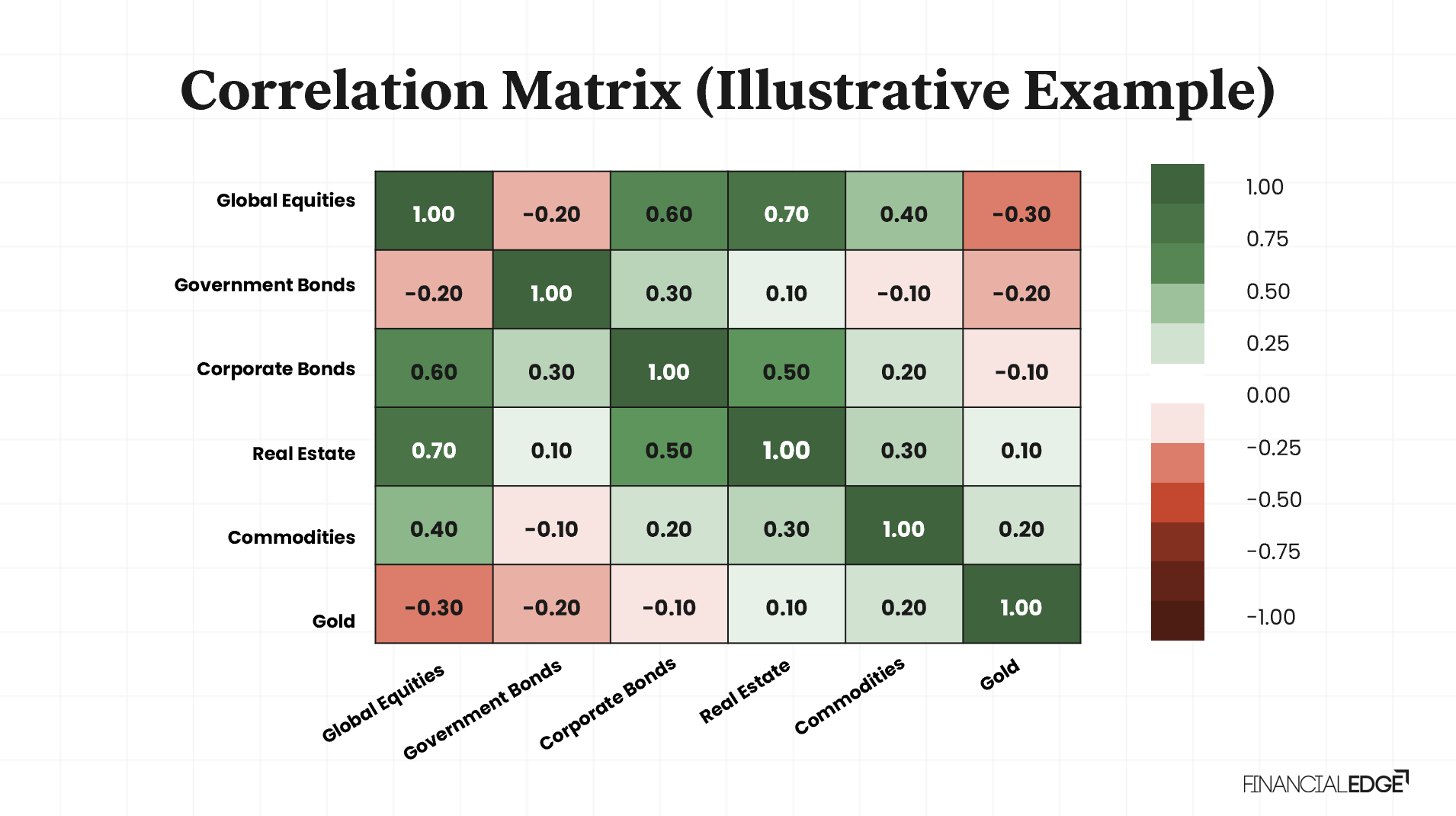
The above matrix illustrates that assets such as gold and government bonds tend to have low or negative correlation with equities, providing strong diversification benefits. For example, adding gold (−0.30 correlation with equities) can help offset equity drawdowns and improve the portfolio’s resilience, particularly during periods of market stress.
Another popular measure is the portfolio variance (or standard deviation), which captures the total portfolio risk. It formally depends on individual asset variances and the covariances between them, so diversification reduces risk when correlations are below 1.
Let’s consider a 50/50 portfolio of two assets, each with 10% volatility:
- If correlation is 1, the overall portfolio volatility remains 10%
- If correlation is 0, volatility falls to about 7.1% (calculation below)
σp = √[(0.5²×0.10²) + (0.5²×0.10²) + (2×0.5×0.5×0.10×0.10×0)] = √[0.0025 + 0.0025 + 0] = √0.005 ≈ 7.1%
- If correlation is −0.5, it drops further to around 5%
As a result, a well-diversified portfolio will typically exhibit lower volatility than the weighted average of its individual assets, with the magnitude of the reduction driven by the correlation structure.
Instructor Tip: When assessing diversification, focus on how much each asset impacts total portfolio risk rather than looking at its risk in isolation. Even a volatile asset can improve diversification if it behaves differently from the rest of the portfolio.
An alternative approach to assessing diversification indirectly is through risk-adjusted measures such as the Sharpe ratio. Although it is not a direct measure of diversification, improvements in the diversification of a portfolio would typically reduce its volatility without proportionally reducing returns. As a result, an improvement in risk-adjusted performance after adding new assets can indicate that diversification has been beneficial.
Types of Diversification/Diversification Strategies
Diversification can be approached from different angles, each targeting different sources of risk. Below we address some of the key strategies:
From an asset class perspective, diversification involves allocating across different assets such as equities, fixed income, property or alternatives. The philosophy is that each asset class responds differently to economic conditions
We explore the benefits of diversification in multiple asset classes.
Sector diversification, on the other hand, would reduce exposure to industry-specific risks. For example, combining technology, healthcare, and energy stocks reduces vulnerability to sector-specific downturns
- In terms of geography, regional diversification spreads investments across various locations such as the US, Europe, and emerging markets. This reduces risk from a single region’s economy performance
- Style diversification involves combining investment styles such as growth and value. These styles tend to outperform in different market environments
Institutional investors are increasingly approaching diversification through a factor-based lens, where exposure is diversified across risk premia such as equity beta, duration, credit and inflation sensitivity.
How to Assess the Diversification of Two-Asset Portfolios
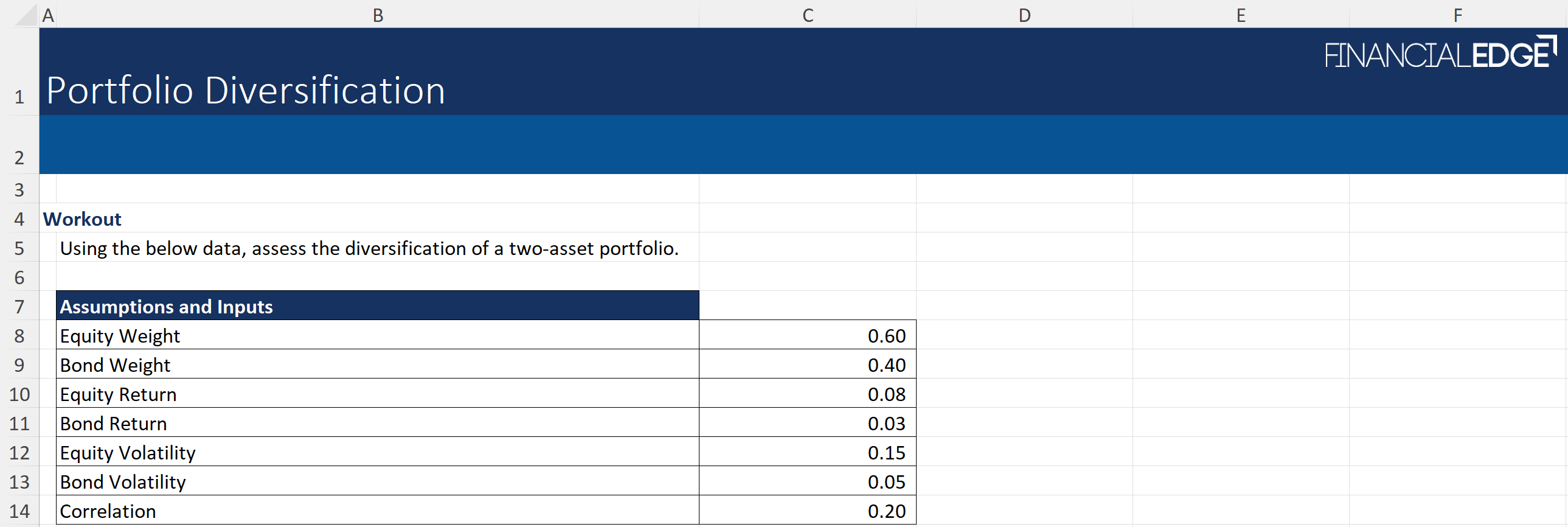
Below, we provide an example of how combining assets with imperfect correlation can improve the portfolio’s risk-adjusted performance.
It starts with the inputs, asset weights, expected returns, risk levels, and their correlation. These define both the individual characteristics of each asset and how they interact.
Click to Zoom
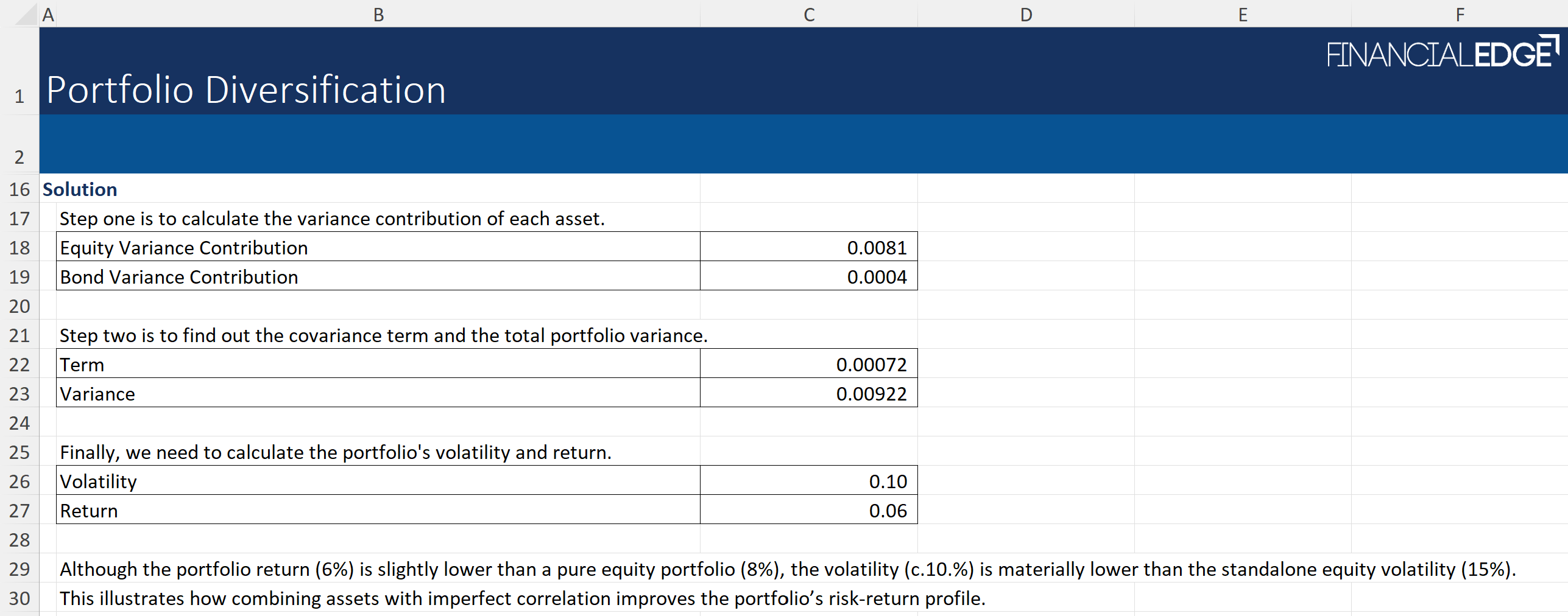
The calculation combines these inputs to come up with the portfolio return (as a weighted average) and the portfolio’s risk, which incorporates both individual risks and their interaction. If the assets do not move together, then the overall risk is reduced.
Click to Zoom
The result is a portfolio with lower volatility and smoother return characteristics, showing how diversification improves the risk–return trade-off.
Advantages of Diversification
The primary benefit of diversification is risk reduction without proportionate sacrifice in returns. By combining assets with low correlations, investors can achieve a more efficient portfolio.
Diversification is also expected to lead to more stable performance over time, reducing volatility and drawdowns. This is particularly important for long-term investors, as lower volatility improves compounding outcomes.
Another key advantage is the mitigation of idiosyncratic risk. This ensures that poor performance of a single asset (or sector) does not significantly impact the overall portfolio.
From a behavioral perspective, diversification helps investors remain disciplined by reducing the emotional impact of large losses in individual positions.
Limitations of Diversification
Diversification also comes with some limitations. It cannot eliminate systematic risk and during periods of market stress, asset correlations often increase, which reduces the effectiveness of diversification. This phenomenon was notably evident during the Global Financial Crisis, when many asset classes declined simultaneously.
In addition, over-diversification can dilute returns and make the portfolio resemble the performance of the broader market. Hidden risks, such as liquidity risk or exposure to complex instruments (particularly in alternatives), may also be viewed as disadvantages.
Diversification vs. Asset Allocation
Diversification and asset allocation are related but distinct concepts.
Asset allocation refers to the strategic distribution of capital across major asset classes (for example, equities, bonds, and alternatives) based on the investor’s objectives, risk profile and investment horizon.
Diversification, on the other hand, refers to the spread of investments within and across various asset classes to reduce risk. In practice, asset allocation determines the broad structure of the portfolio, while diversification refines the risk profile within that structure.
For example, a portfolio may allocate 60% to equities and 40% to bonds, but within equities, diversification may involve exposure to multiple sectors, regions, and factors.
FAQs / Related Questions
How Can Diversification Help Reduce the Impact of Market Volatility?
By combining assets that do not move together, losses in one asset can be offset by stability or gains in another, reducing overall portfolio fluctuations.
What Is a Diversified Portfolio?
A portfolio that spreads investments across different assets, sectors, and regions to reduce exposure to any single source of risk.
How Many Investments Are Enough?
Empirical evidence suggests that holding around 30 securities across sectors can eliminate most idiosyncratic risk.
Does Diversification Guarantee Profit?
No, diversification reduces risk but does not eliminate losses or guarantee positive returns.
Conclusion
Overall, portfolio diversification is a key concept in portfolio management that enables investors to optimize the trade-off between risk and return. By focusing on correlations rather than individual asset characteristics, diversification provides a structured approach to reducing volatility and improving risk-adjusted performance.